Question 1


▶️ Answer/Explanation
A periodic function repeats its values at regular intervals called the period, $P$.
For a graph to have a period of $3$, the pattern must repeat every $3$ units along the $x$-axis.
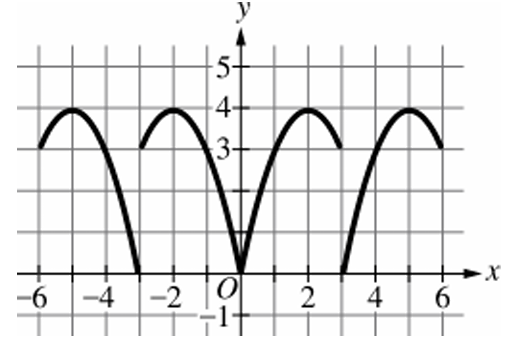
In option (A), the peaks occur at $x = -4$, $x = 0$, and $x = 4$, indicating a period of $4$.
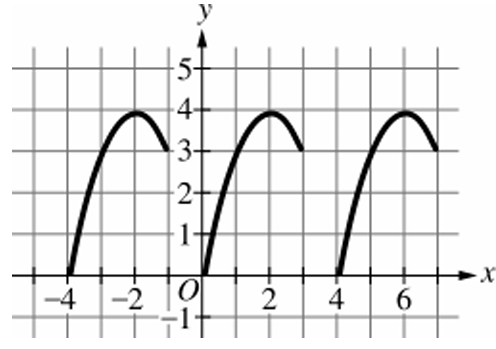
In option (B), the function repeats from $x = 0.5$ to $x = 4$, indicating a period of $3.5$.
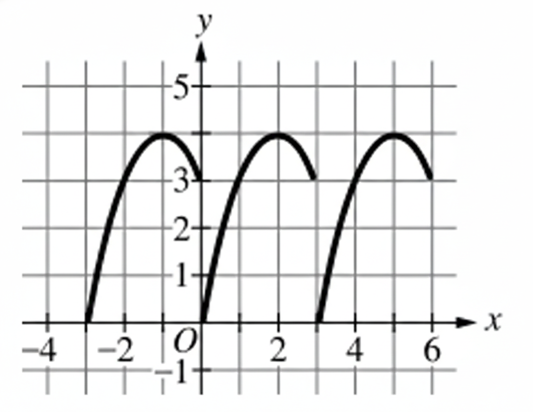
In option (C), the function starts a cycle at $x = 0$ and begins the next identical cycle at $x = 3$.
This confirms the distance between corresponding points is exactly $3$ units.
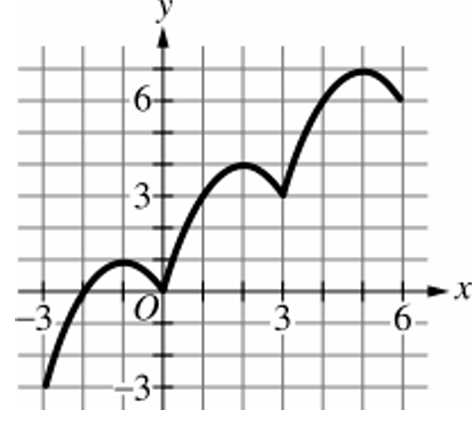
Option (D) is not periodic as the $y$-values increase as $x$ increases.
Therefore, (C) is the correct representation of a function with a period of $3$.
Question 2

(B) $\sin \theta$ only
(C) $\cos \theta$ or $\sin \theta$
(D) Neither $\cos \theta$ nor $\sin \theta$
▶️ Answer/Explanation
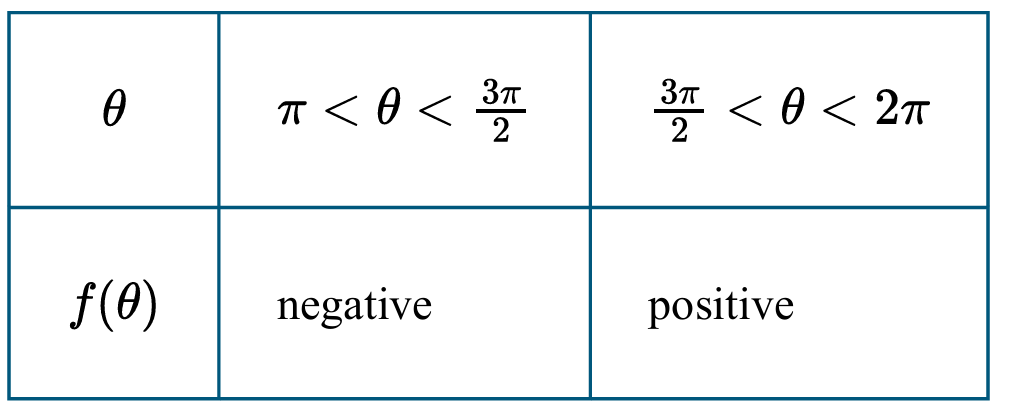
The interval $\pi < \theta < \frac{3\pi}{2}$ represents the Third Quadrant.
In the third quadrant, both $\cos \theta$ and $\sin \theta$ are negative.
The interval $\frac{3\pi}{2} < \theta < 2\pi$ represents the Fourth Quadrant.
In the fourth quadrant, $\cos \theta$ is positive while $\sin \theta$ remains negative.
The table shows $f(\theta)$ changing from negative to positive across these intervals.
Since $\cos \theta$ is negative then positive, it matches the table perfectly.
Since $\sin \theta$ is negative in both intervals, it does not match the table.
Therefore, the correct choice is (A) $\cos \theta$ only.
Question 3


▶️ Answer/Explanation
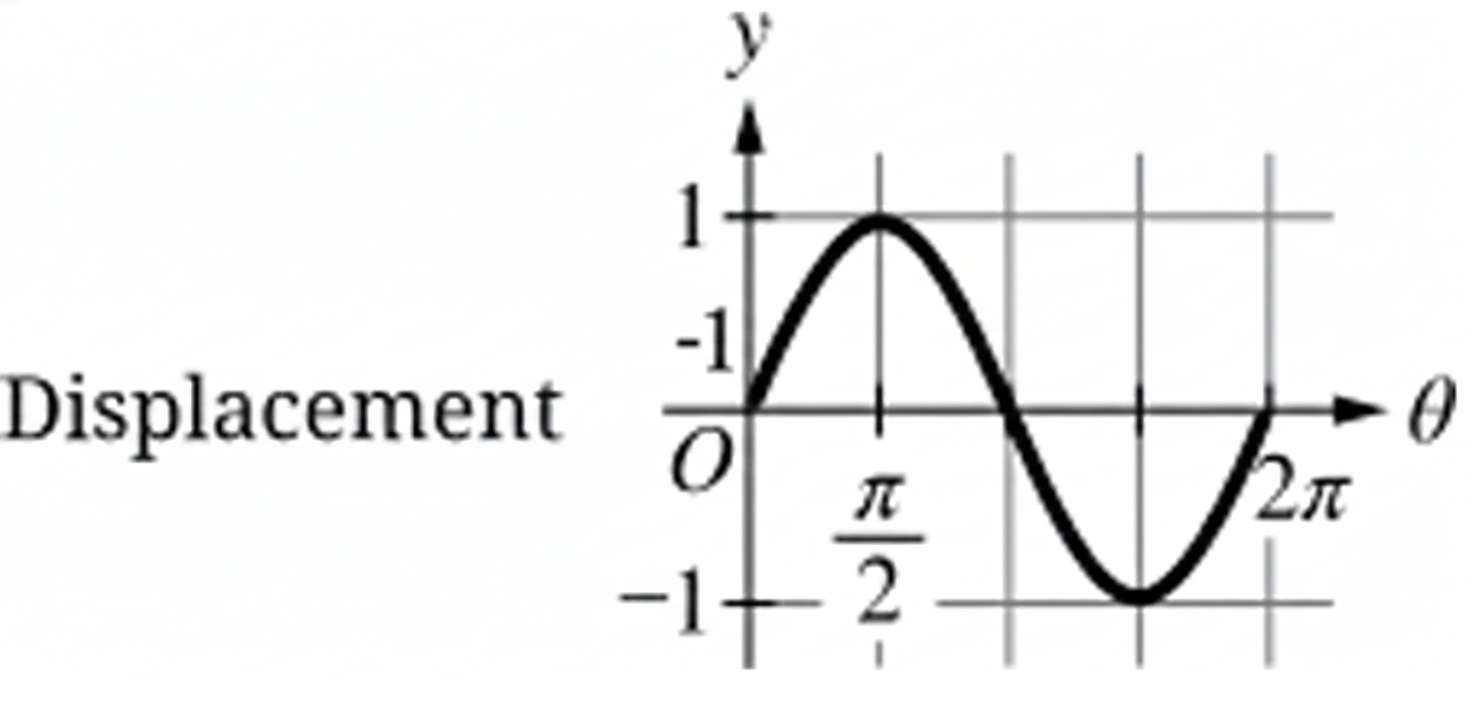
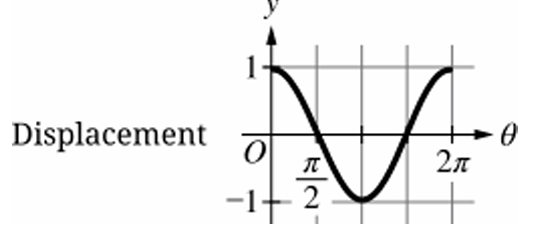
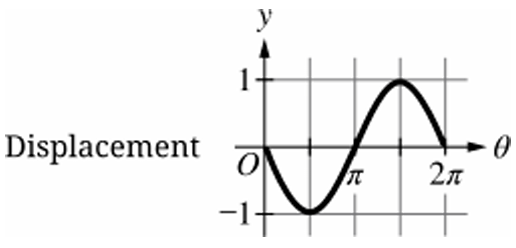
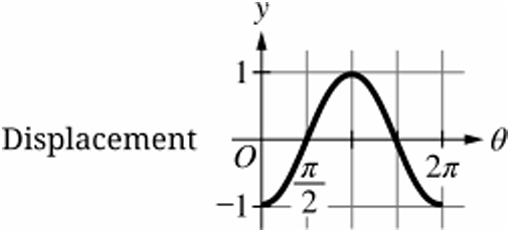
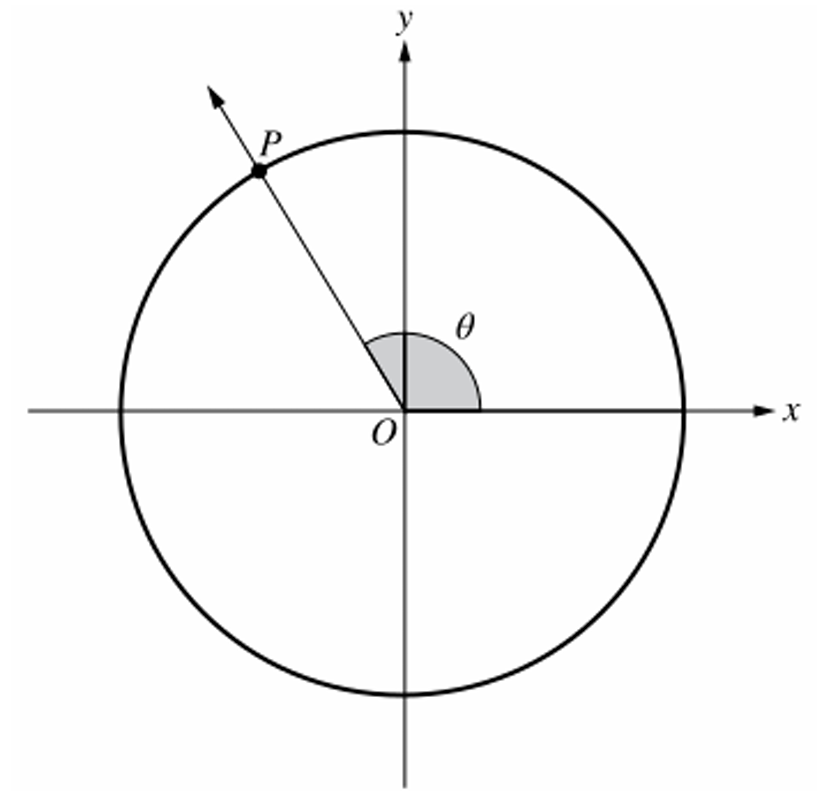
The displacement of point $P$ from the $x$-axis corresponds to its $y$-coordinate.
On a unit circle, the $y$-coordinate of point $P$ is defined by the function $y = \sin(\theta)$.
At $\theta = 0$, the $y$-coordinate is $\sin(0) = 0$, so the graph must start at the origin $(0,0)$.
As $\theta$ increases to $\frac{\pi}{2}$, the $y$-coordinate increases to its maximum value of $1$.
At $\theta = \pi$, the $y$-coordinate returns to $0$, and at $\theta = \frac{3\pi}{2}$, it reaches its minimum of $-1$.
The curve that correctly represents $y = \sin(\theta)$ starting at $0$ and moving upward is graph (A).
Question 4
▶️ Answer/Explanation
To evaluate $g(27)$, we can subtract multiples of the period: $27 – (4 \times 6) = 27 – 24 = 3$.
This confirms that $g(27) = g(3)$, making option (D) mathematically certain.
Option (A) is not necessarily true as there could be other local extrema between $0$ and $5$.
Option (B) is not guaranteed because the function could dip below zero outside the given points.
Option (C) is false because $g(18) = g(18 – 12) = g(6)$, which does not inherently differ from $g(4)$ based on given info.
Thus, $g(3) = g(27)$ is the only statement that must be true due to periodicity.
Question 5

(B) $-\frac{4}{5}$
(C) $-3$
(D) $-4$
▶️ Answer/Explanation
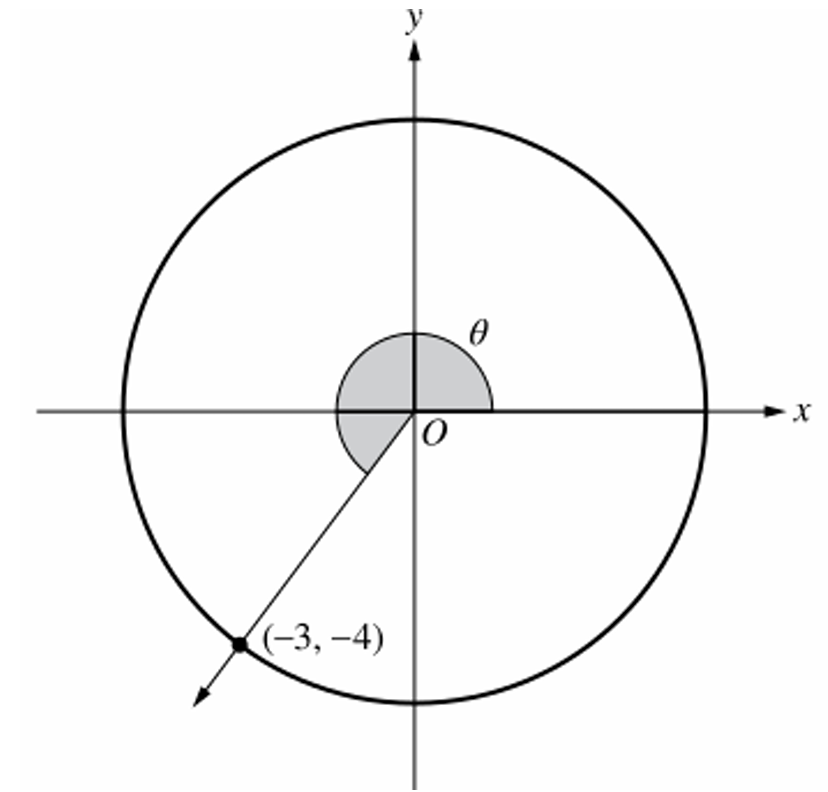
The terminal ray intersects the circle at the point $(x, y) = (-3, -4)$.
The radius $r$ of the circle is calculated using $r = \sqrt{x^2 + y^2}$.
Substituting the coordinates: $r = \sqrt{(-3)^2 + (-4)^2} = \sqrt{9 + 16} = \sqrt{25} = 5$.
By definition, for an angle $\theta$ in standard position, $\sin \theta = \frac{y}{r}$.
Substituting the values: $\sin \theta = \frac{-4}{5}$.
Therefore, the correct option is (B).
Question 6
▶️ Answer/Explanation
On a unit circle, the cosine of an angle corresponds to the $x$-coordinate of point $P$.
The $x$-coordinate represents the horizontal displacement of point $P$ from the $y$-axis.
As the angle increases from $0$ to $\pi$, the point $P$ moves from $(1, 0)$ to $(-1, 0)$.
The value of $\cos(\theta)$ starts at $\cos(0) = 1$ and ends at $\cos(\pi) = -1$.
Since $1$ is greater than $-1$, the value decreases continuously across this interval.
The horizontal displacement from the $y$-axis shifts from positive to negative, effectively decreasing.
Therefore, Option (B) is the correct choice.
Question 7
(B) $0.524$
(C) $1.047$
(D) $1.107$
▶️ Answer/Explanation
On the unit circle, the coordinates of point $P$ are defined as $(\cos \theta, \sin \theta)$.
The problem states the $x$-coordinate is $2$ times the $y$-coordinate, so $\cos \theta = 2 \sin \theta$.
Dividing both sides by $\cos \theta$ gives $1 = 2 \tan \theta$, which simplifies to $\tan \theta = \frac{1}{2}$.
To find $\theta$, we take the inverse tangent: $\theta = \arctan(0.5)$.
Using a calculator in radian mode, $\arctan(0.5) \approx 0.463647$.
Rounding to three decimal places, we get $\theta \approx 0.464$.
Since $0 \leq 0.464 \leq \frac{\pi}{2}$ (approx $1.57$), this value is in the correct quadrant.
Therefore, the correct choice is (A).
Question 8

(B) $-\frac{\sqrt{3}}{2}$
(C) $-\frac{3}{2}$
(D) $-\frac{1}{2}$
▶️ Answer/Explanation
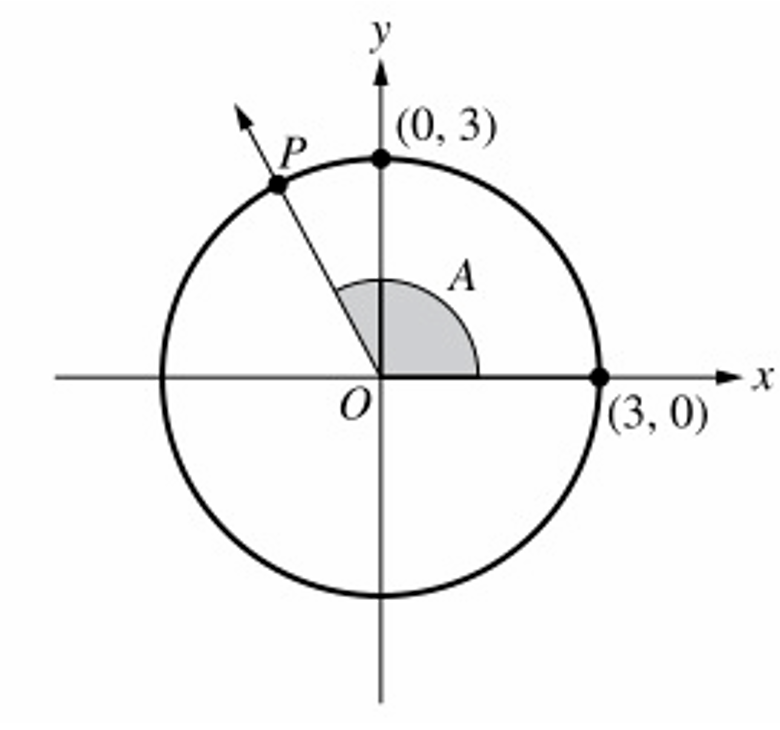
The circle passes through $(3, 0)$ and $(0, 3)$, so its radius $r$ is $3$.
The $x$-coordinate of a point on a circle is given by $x = r \cos(A)$.
The given angle is $A = \frac{2\pi}{3}$ radians.
The cosine of $\frac{2\pi}{3}$ is $\cos\left(\frac{2\pi}{3}\right) = -\frac{1}{2}$.
Substitute the values: $x = 3 \cdot \left(-\frac{1}{2}\right)$.
The $x$-coordinate of $P$ is $-\frac{3}{2}$.
Therefore, the correct option is (C).
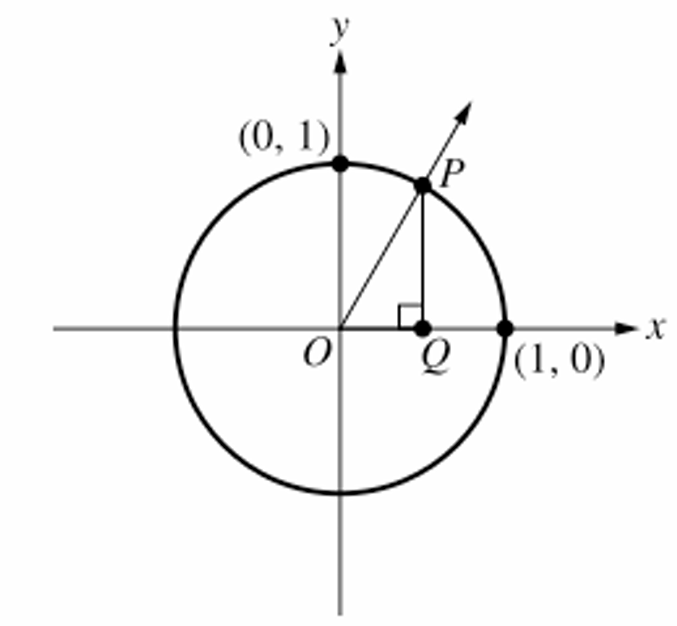
Question 9

(B) $\frac{\sqrt{3}}{4}$
(C) $\frac{1}{2}$
(D) $\frac{\sqrt{3}}{2}$
▶️ Answer/Explanation
For a unit circle, the coordinates of point $P$ are $(\cos \theta, \sin \theta)$.
The base of the triangle $OQ$ is the $x$-coordinate, so $b = \cos \theta$.
The height of the triangle $PQ$ is the $y$-coordinate, so $h = \sin \theta$.
The area function is $A(\theta) = \frac{1}{2} \cdot \cos \theta \cdot \sin \theta$.
Substitute $\theta = \frac{\pi}{3}$: $A\left(\frac{\pi}{3}\right) = \frac{1}{2} \cdot \cos\left(\frac{\pi}{3}\right) \cdot \sin\left(\frac{\pi}{3}\right)$.
Using exact values: $A\left(\frac{\pi}{3}\right) = \frac{1}{2} \cdot \left(\frac{1}{2}\right) \cdot \left(\frac{\sqrt{3}}{2}\right)$.
Calculate the final result: $A\left(\frac{\pi}{3}\right) = \frac{\sqrt{3}}{8}$.
The correct option is (A).
Question 10
▶️ Answer/Explanation
The given equation is $\sin \theta = \sin(\theta + \frac{\pi}{2})$.
Using the trigonometric identity, $\sin(\theta + \frac{\pi}{2}) = \cos \theta$.
The equation becomes $\sin \theta = \cos \theta$, which implies $\tan \theta = 1$.
In the interval $[0, 2\pi]$, $\tan \theta = 1$ occurs at $\theta = \frac{\pi}{4}$ and $\theta = \frac{5\pi}{4}$.
Graphically, the sine and cosine curves intersect exactly twice in one full period.
Therefore, there are two solutions.
The correct option is (C).
Question 11
▶️ Answer/Explanation
Evaluate the initial value: $f(0) = \cos(0) = 1$.
This eliminates options (A) and (B) where the initial value is $0$.
Determine the period: The standard period of $f(\theta) = \cos \theta$ is $2\pi$.
Calculate the frequency: $\text{frequency} = \frac{1}{\text{period}}$.
Substitute the period: $\text{frequency} = \frac{1}{2\pi}$.
Comparing results: Option (D) correctly identifies both the frequency and initial value.
Question 12
▶️ Answer/Explanation
The period of the parent function $f(\theta) = 2 \cos \theta$ is $2\pi$.
The period of the function $g(\theta) = 2 \cos(b\theta)$ is given by the formula $\frac{2\pi}{b}$.
The problem states that the period of $g$ is half the period of $f$.
This relationship can be written as: $\text{Period of } g = \frac{1}{2} \times (\text{Period of } f)$.
Substituting the known values, we get the equation $\frac{2\pi}{b} = \frac{1}{2}(2\pi)$.
Therefore, solving this equation will yield the correct value for the constant $b$.
This matches choice (B).
Question 13
▶️ Answer/Explanation
The amplitude of a cosine function $h(\theta) = a \cos(b\theta)$ is given by $|a|$.
Given amplitude is $4$, so $|a| = 4$, which implies $a = 4$.
The period of the function is calculated using the formula $\text{Period} = \frac{2\pi}{|b|}$.
Given the period is $\pi$, we set up the equation $\pi = \frac{2\pi}{b}$.
Solving for $b$, we get $b \cdot \pi = 2\pi$, which simplifies to $b = 2$.
Therefore, the constants are $a = 4$ and $b = 2$.
The correct option is (D).
Question 14
▶️ Answer/Explanation
The midline is $y = \frac{10 + 2}{2} = 6$ and the amplitude is $a = \frac{10 – 2}{2} = 4$.
The period is $12$, so the frequency coefficient is $b = \frac{2\pi}{12} = \frac{\pi}{6}$.
Since a maximum occurs at $t = 3$, a cosine function is most easily shifted to this point.
A standard cosine graph starts at its maximum at $t = 0$.
To move the maximum to $t = 3$, we apply a horizontal shift of $3$ units to the right.
This resulting phase shift is represented by the term $(t – 3)$ inside the function.
Combining these gives $f(t) = 4 \cos\left(\frac{\pi}{6}(t – 3)\right) + 6$, which matches option (A).
Question 15

(B) $-4.0$
(C) $-4.1$
(D) $-5.2$
▶️ Answer/Explanation
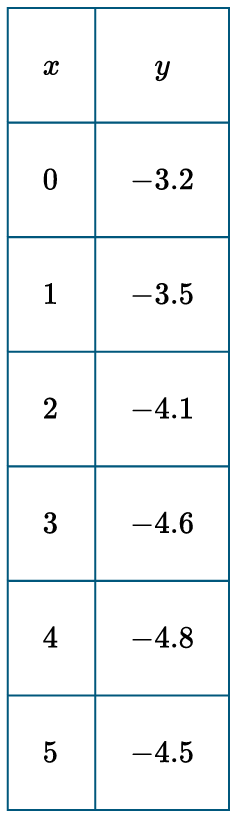
Input the given $(x, y)$ coordinates into a graphing calculator’s sinusoidal regression tool.
The regression calculates the parameters for the model $y = a \sin(bx + c) + d$.
Based on the data, the resulting function is approximately $f(x) \approx 0.811 \sin(0.793x + 1.258) – 4.024$.
Substitute $x = 6$ into the regression equation: $f(6) = 0.811 \sin(0.793(6) + 1.258) – 4.024$.
Calculate the value: $f(6) \approx 0.811 \sin(6.016) – 4.024 \approx -3.879$.
Rounding $-3.879$ to the nearest tenth gives $-3.9$.
The correct option is (A).
Question 16
▶️ Answer/Explanation
Since the period is \(4\), we use \(f(x) = f(x – 4k)\) to find values in the interval \([0, 4]\).
For \(f(9)\), we calculate \(9 – 2(4) = 1\), so \(f(9) = f(1)\).
For \(f(15)\), we calculate \(15 – 3(4) = 3\), so \(f(15) = f(3)\).
The function is given as increasing on the interval \([0, 4]\).
Because \(1 < 3\) within this interval, it follows that \(f(1) < f(3)\).
Substituting the original values, we conclude \(f(9) < f(15)\).
Therefore, option (A) is the correct statement.
Question 17
▶️ Answer/Explanation
The angles $\alpha$ and $\beta$ are located in the second quadrant ($QII$) because $\frac{\pi}{2} < \theta < \pi$.
In the second quadrant, the tangent function $f(x) = \tan x$ is always negative.
The function $f(x) = \tan x$ is strictly increasing on the open interval $(\frac{\pi}{2}, \pi)$.
Since the function is increasing and $\alpha < \beta$, it follows that $f(\alpha) < f(\beta)$.
Therefore, $\tan \alpha < \tan \beta$.
This confirms that (B) is the correct choice.
Question 18
▶️ Answer/Explanation
For $g(\theta) = \sin \theta$ to be increasing, its derivative $g'(\theta) = \cos \theta$ must be positive, which occurs in Quadrants I and IV.
For $f(\theta) = \cos \theta$ to be increasing, its derivative $f'(\theta) = -\sin \theta$ must be positive, meaning $\sin \theta$ must be negative.
$\sin \theta$ is negative in Quadrants III and IV.
The interval where both conditions are met is Quadrant IV.
In Quadrant IV, the values of $\theta$ range from $\frac{3\pi}{2}$ to $2\pi$.
Therefore, both functions are increasing on the interval $\frac{3\pi}{2} < \theta < 2\pi$.
The correct option is (D).
Question 19
▶️ Answer/Explanation
The function is $f(\theta) = \sin \theta$ on the interval $(\pi, \frac{3\pi}{2})$.
The first derivative is $f'(\theta) = \cos \theta$, which is negative in the third quadrant.
Since $f'(\theta) < 0$, the function values are decreasing.
The second derivative is $f”(\theta) = -\sin \theta$.
On $(\pi, \frac{3\pi}{2})$, $\sin \theta$ is negative, so $f”(\theta) = -(\text{negative}) > 0$.
A positive second derivative means the rate of change is increasing.
Thus, the values are decreasing at an increasing rate.
Correct Option: (B)
Question 20

▶️ Answer/Explanation
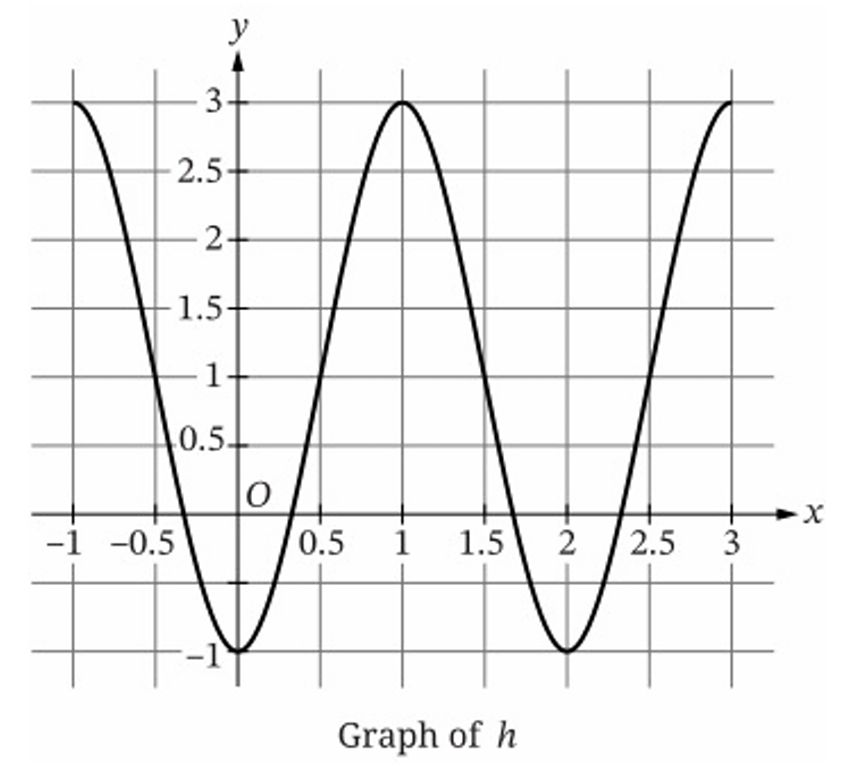
The midline is at $y = 1$ and the amplitude is $2$, giving the form $2 \sin(B(x – C)) + 1$.
The period $P$ is the distance between peaks at $x = 1$ and $x = 3$, so $P = 2$.
Calculate $B$ using the formula $B = \frac{2\pi}{P} = \frac{2\pi}{2} = \pi$.
A standard sine graph starts at the midline; here, the midline crossing $(0.5, 1)$ shows a right shift.
The horizontal phase shift is $C = 0.5$ units to the right.
Substituting these values, we get the function $h(x) = 2 \sin(\pi(x – 0.5)) + 1$.
Therefore, the correct choice is (C).
Question 21
▶️ Answer/Explanation
The distance is modeled by the periodic function $f(t) = 15 \sin(\pi t) + 18$.
The pendulum is farthest from the wall when the sine function reaches its maximum value.
The interval between consecutive maximum values is defined as the period ($P$) of the function.
For a function $f(t) = A \sin(Bt) + C$, the period is calculated using the formula $P = \frac{2\pi}{|B|}$.
In this equation, the coefficient of $t$ is $B = \pi$.
Substituting the value, the period is $P = \frac{2\pi}{\pi} = 2$ seconds.
Therefore, the least interval of time between being “farthest” is $2$ seconds, matching option (B).