
1.11.A.1 Sampling Without Replacement
Sampling without replacement is a sampling method in which an individual or observational unit can be selected only once.
- After an individual is selected, it is not returned to the population before the next selection is made.
- Therefore, the same individual cannot be selected again.
- As more observations are selected, the population becomes smaller because previously selected individuals are removed.
This causes the probability of selecting the remaining individuals to change slightly after each selection.
Key Characteristics
- Each individual can be selected only once.
- Selected individuals are removed from the population.
- The population size decreases after each selection.
- The probability of selection changes after every draw.
| Feature | Sampling Without Replacement |
|---|---|
| Can an individual be selected twice? | No |
| Returned to population? | No |
| Population size changes? | Yes |
Example
A teacher writes the names of all 30 students on slips of paper and places them in a box.
The teacher randomly selects 5 students for a science competition and does not return any selected names to the box.
Identify the sampling method used.
▶️ Answer / Explanation
This is sampling without replacement.
Each selected student is removed from the box before the next selection.
Therefore, no student can be selected more than once.
1.11.A.2 Sampling With Replacement
Sampling with replacement is a sampling method in which an individual or observational unit may be selected more than once.
- After each selection, the individual is returned to the population before the next selection is made.

- Because the population remains unchanged, every selection has the same probability.
It is possible for the same individual to be selected multiple times.
Key Characteristics
- Individuals are returned after every selection.
- The same individual may be selected multiple times.
- The population size remains constant.
- The probability of selection stays the same for every draw.
| Feature | Sampling With Replacement |
|---|---|
| Can an individual be selected twice? | Yes |
| Returned to population? | Yes |
| Population size changes? | No |
Example
A raffle ticket is drawn from a box, recorded, and then returned before another ticket is selected.
This process continues until 10 tickets have been selected.
Identify the sampling method used.
▶️ Answer / Explanation
This is sampling with replacement.
Since each ticket is returned after being selected, the same ticket could be selected again.
The probability of selection remains the same for every draw.
1.11.A.3 Simple Random Sample (SRS)
A Simple Random Sample (SRS) is one of the most important sampling methods in statistics.
In a simple random sample of size \( n \), every possible sample of size \( n \) has an equal chance of being selected.
This ensures fairness because every individual and every possible group of the required size has the same probability of being chosen.
Simple random sampling forms the basis for many other sampling methods.
Researchers commonly obtain an SRS by using:
- A random number generator.
- A random digit table.
- Numbered slips of paper drawn randomly.
Key Characteristics
- Every possible sample has an equal chance of selection.
- Selection is completely random.
- No preference is given to any individual.
- Helps reduce selection bias.
| Method | How It Works |
|---|---|
| Random Number Generator | Computer randomly selects individuals. |
| Random Digit Table | Random digits identify selected individuals. |
| Numbered Slips | Names or numbers are drawn randomly. |
Important AP Statistics Idea
- An SRS does not simply mean “chosen randomly.”
- The defining feature is that every possible sample of size \( n \) has an equal chance of being selected.
Example
A university has 8,000 students.
Each student is assigned a unique identification number.
A computer randomly selects 250 identification numbers to participate in a health survey.
Identify the sampling method used.
▶️ Answer / Explanation
This is a Simple Random Sample (SRS).
Each student was identified by a number, and a random number generator selected the sample.
Every possible group of 250 students had an equal chance of being selected.
1.11.A.4 Stratified Random Sample
A stratified random sample is a sampling method in which the population is first divided into smaller groups called strata.
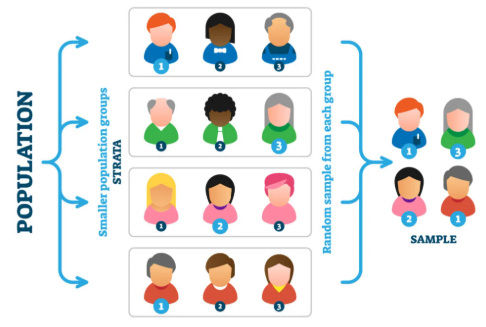
- Each stratum consists of individuals who share a common characteristic, making the members within each stratum relatively similar (homogeneous).
- After the population is divided, a simple random sample (SRS) is selected from every stratum.
- The selected individuals from all strata are then combined to form one overall sample.
This method helps ensure that every important subgroup of the population is represented in the sample.
Key Characteristics
- The population is divided into strata.
- Individuals within each stratum are similar.
- A simple random sample is taken from every stratum.
- The selected individuals are combined into one sample.
| Step | What Happens? |
|---|---|
| 1 | Divide the population into homogeneous strata. |
| 2 | Randomly sample individuals from every stratum. |
| 3 | Combine all selected individuals into one sample. |
Important AP Statistics Idea
- In a stratified random sample, some individuals are selected from every stratum.
- The researcher samples individuals, not entire groups.
Example
A high school wants to survey students about school lunches.
Students are first divided into four grade levels:
- 9th Grade
- 10th Grade
- 11th Grade
- 12th Grade
A random sample of students is selected from each grade level.
Identify the sampling method used.
▶️ Answer / Explanation
This is a stratified random sample.
The population was divided into strata (grade levels).
A simple random sample was selected from every stratum, and the selected students were combined into one sample.
1.11.A.5 Cluster Random Sample
A cluster random sample is a sampling method in which the population is divided into smaller groups called clusters.

- Unlike strata, each cluster should be a small representation of the entire population.
- In other words, each cluster should contain a mixture of different types of individuals (heterogeneous).
- A simple random sample of entire clusters is then selected.
Data are collected from every individual within each selected cluster.
Key Characteristics
- The population is divided into clusters.
- Each cluster resembles the overall population.
- Entire clusters are selected randomly.
- Every individual in the selected clusters is surveyed.
| Stratified Sampling | Cluster Sampling |
|---|---|
| Randomly sample individuals from every group. | Randomly select entire groups. |
| Groups are homogeneous. | Groups are heterogeneous. |
| Every group contributes individuals. | Only selected clusters are surveyed. |
Important AP Statistics Idea
A common AP exam mistake is confusing stratified and cluster sampling.
- Stratified: Sample from every group.
- Cluster: Sample entire groups.
Example
A school district randomly selects 6 classrooms from all classrooms in the district.
Every student in the selected classrooms is surveyed.
Identify the sampling method used.
▶️ Answer / Explanation
This is a cluster random sample.
Entire classrooms (clusters) were selected randomly.
Every student in the selected classrooms was included in the sample.
1.11.A.6 Systematic Random Sample
A systematic random sample is a sampling method in which sample members are selected using a random starting point followed by a fixed interval.

After randomly choosing the first individual, every \(k\)th individual is selected until the desired sample size is reached.
For example, a researcher may randomly choose the 7th person on a list and then select every 20th person after that.
Key Characteristics
- A random starting point is chosen.
- A fixed interval (\(k\)) is used.
- Every \(k\)th individual is selected.
- The interval remains constant throughout the sampling process.
| Step | Description |
|---|---|
| 1 | Choose a random starting point. |
| 2 | Select every \(k\)th individual. |
| 3 | Continue until the desired sample size is reached. |
Important AP Statistics Idea
- Systematic sampling is not simply selecting every \(k\)th person.
- A random starting point must be chosen first.
Example
A supermarket manager wants to survey customers.
The manager randomly selects the 8th customer entering the store and then surveys every 15th customer after that.
Identify the sampling method used.
▶️ Answer / Explanation
This is a systematic random sample.
The first customer was chosen randomly, and then every 15th customer was selected using a fixed interval.
Therefore, the study uses systematic random sampling.
1.11.B Justify the Appropriateness of a Sampling Method
There is no single sampling method that is best for every statistical study.
The most appropriate sampling method depends on:
- The research question.
- The characteristics of the population.
- The time and cost involved.
- How representative the sample needs to be.
Each random sampling method has unique strengths that make it more suitable for certain situations.
Choosing the appropriate sampling method helps reduce bias and improves the accuracy of statistical conclusions.
1.11.B.1 Choosing an Appropriate Sampling Method
- Each random sampling method has characteristics that make it more appropriate for particular types of studies.
- Researchers should select the method that best matches the population and the purpose of the investigation.
| Sampling Method | Most Appropriate When… |
|---|---|
| Simple Random Sample (SRS) | Every individual should have an equal chance of being selected and no important subgroups require special attention. |
| Stratified Random Sample | The population contains important subgroups that should all be represented in the sample. |
| Cluster Random Sample | The population is naturally divided into groups, making it easier or less expensive to sample entire groups. |
| Systematic Random Sample | The population is organized in a list or sequence and selecting every \(k\)th individual is practical. |
Advantages of Each Sampling Method
| Method | Main Advantage |
|---|---|
| Simple Random Sample | Easy to understand and gives every possible sample an equal chance of selection. |
| Stratified Random Sample | Ensures every important subgroup is represented, often increasing precision. |
| Cluster Random Sample | Reduces travel, time, and cost by sampling entire groups. |
| Systematic Random Sample | Simple and efficient for large ordered populations. |
AP Statistics Decision Guide
- If every individual should have an equal chance → Simple Random Sample (SRS)
- If every subgroup must be represented → Stratified Random Sample
- If entire naturally occurring groups are sampled → Cluster Random Sample
- If every \(k\)th individual is selected after a random start → Systematic Random Sample
Important AP Statistics Idea
When asked to justify a sampling method, explain why that method is appropriate for the specific study.
Do not simply identify the sampling method.
A complete justification should:
- Identify the sampling method.
- Explain how it selects the sample.
- State why it is appropriate for the research question or population.
AP Exam Tip
- Many AP Statistics multiple-choice and free-response questions ask you to justify why one sampling method is better than another.
- Always connect your explanation to the characteristics of the population and the purpose of the study, not just the definition of the sampling method.
Example
A school wants to survey students about cafeteria food.
The students are first divided by grade level.
A random sample of students is selected from each grade.
Explain why this sampling method is appropriate.
▶️ Answer / Explanation
The sampling method is a stratified random sample.
It is appropriate because students are divided into strata based on grade level, and a random sample is selected from each grade.
This ensures that every grade level is represented in the sample, making the results more representative of the entire school population.
Example
A city is divided into 50 neighborhoods.
Researchers randomly select 8 neighborhoods and survey every household within the selected neighborhoods.
Explain why this sampling method is appropriate.
▶️ Answer / Explanation
The sampling method is a cluster random sample.
It is appropriate because surveying every household in a few randomly selected neighborhoods is much more efficient and less expensive than surveying households scattered throughout the entire city.
Using naturally occurring groups (neighborhoods) reduces time and travel while still providing a random sample.