
2.5.A.1 Joint Probability
Joint probability is the probability that two events occur together.
It represents the probability of the intersection of two events, meaning both events happen at the same time.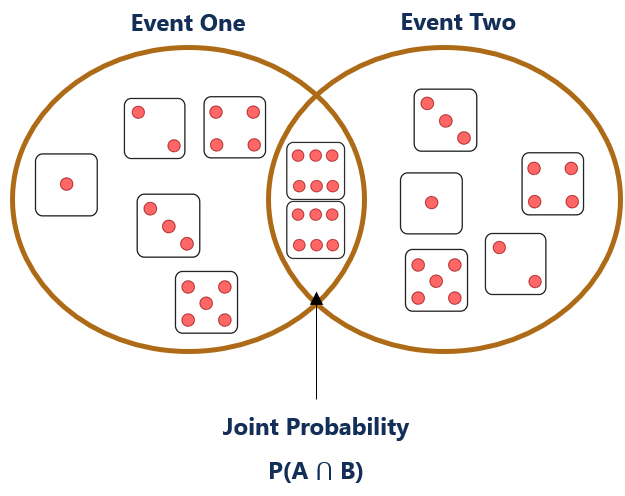
If the two events are labeled \(A\) and \(B\), the joint probability is written as
\( P(A \cap B) \)
where \(A \cap B\) is read as “A intersection B” or “A and B.”
Definition
The joint probability of two events is
\( P(A \cap B)=\text{Probability that both }A\text{ and }B\text{ occur} \)
Understanding Joint Probability
- \(A\) occurs.
- \(B\) occurs.
- Both \(A\) and \(B\) occur simultaneously.
Joint probability always refers to the third situation.
Example 1: Drawing One Card
A card is selected at random from a standard deck of 52 cards.
Find the probability that the card is a King and a Heart.
Step 1: Define the events.
- \(A\): Drawing a King
- \(B\): Drawing a Heart
Step 2: Identify the overlap.
Only the King of Hearts satisfies both events.
Step 3: Calculate the joint probability.
\( P(A\cap B)=\dfrac{1}{52} \)
Example 2: Rolling a Die
A fair six-sided die is rolled once.
Let
- \(A\): Rolling an even number
- \(B\): Rolling a number greater than 3
Find \(P(A\cap B)\).
Step 1: List each event.
\(A=\{2,4,6\}\)
\(B=\{4,5,6\}\)
Step 2: Find the intersection.
\(A\cap B=\{4,6\}\)
Step 3: Compute the probability.
\(P(A\cap B)=\dfrac{2}{6}=\dfrac13\)
Finding the Intersection
| Event \(A\) | Event \(B\) | \(A\cap B\) |
|---|---|---|
| Even numbers | Numbers greater than 3 | {4, 6} |
| Kings | Hearts | King of Hearts |
Important AP Exam Notes
- Joint probability means the probability that both events occur.
- The word “and” indicates an intersection.
- Joint probability is written as \(P(A\cap B)\).
- Always identify the outcomes that belong to both events before calculating the probability.
- The intersection contains only the outcomes common to both events.
Common AP Exam Mistakes
| Incorrect | Correct |
|---|---|
| Treating “and” as “or”. | “And” means intersection. |
| Using all outcomes from both events. | Use only the outcomes common to both events. |
| Confusing \(P(A\cap B)\) with \(P(A\cup B)\). | \(A\cap B\) means both events occur; \(A\cup B\) means at least one event occurs. |
Example
A fair six-sided die is rolled once.
Let
- \(A\): The outcome is an even number.
- \(B\): The outcome is greater than 4.
Calculate the joint probability \(P(A\cap B)\).
▶️ Answer / Explanation
Step 1: Write each event.
\(A=\{2,4,6\}\)
\(B=\{5,6\}\)
Step 2: Find the intersection.
\(A\cap B=\{6\}\)
Step 3: Calculate the probability.
\(P(A\cap B)=\dfrac16\)
Answer
The probability that the outcome is both even and greater than 4 is
\(\dfrac16\)
2.5.A.2 Mutually Exclusive (Disjoint) Events
Two events are mutually exclusive, also called disjoint, if they cannot occur at the same time.
This means the two events have no outcomes in common, so their intersection is an empty set.
Therefore, the joint probability of two mutually exclusive events is always
\( P(A\cap B)=0 \)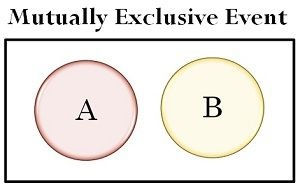
Definition
Events \(A\) and \(B\) are mutually exclusive (disjoint) if
\( A\cap B=\varnothing \)
where \(\varnothing\) represents the empty set (no common outcomes).
As a result,
\( P(A\cap B)=0 \)
Examples of Mutually Exclusive Events
| Random Process | Event A | Event B | Mutually Exclusive? |
|---|---|---|---|
| Roll one die | Roll a 2 | Roll a 5 | Yes |
| Flip one coin | Heads | Tails | Yes |
| Draw one card | Heart | Spade | Yes |
Example 1: Rolling a Die
A fair six-sided die is rolled once.
Let
- \(A\): Rolling a 1
- \(B\): Rolling a 6
These events cannot occur on the same roll.
Therefore,
\( A\cap B=\varnothing \)
and
\( P(A\cap B)=0 \)
Example 2: Drawing a Card
One card is drawn from a standard deck.
Let
- \(A\): Drawing a King
- \(B\): Drawing a Queen
A single card cannot be both a King and a Queen.
Therefore, the events are mutually exclusive.
\( P(A\cap B)=0 \)
Mutually Exclusive vs. Not Mutually Exclusive
| Events | Common Outcomes? | \(P(A\cap B)\) |
|---|---|---|
| Rolling a 2 and rolling a 5 | No | 0 |
| Rolling an even number and rolling a number greater than 3 | Yes (4, 6) | Not 0 |
Important AP Exam Notes
- Mutually exclusive and disjoint mean the same thing.
- Mutually exclusive events cannot occur simultaneously.
- They have no outcomes in common.
- For mutually exclusive events, the joint probability is always
\( P(A\cap B)=0 \)
- Always check whether the events can happen during the same trial.
Common AP Exam Mistakes
| Incorrect | Correct |
|---|---|
| Assuming all independent events are mutually exclusive. | Independent events can occur together; mutually exclusive events cannot. |
| Thinking two events with different names are automatically disjoint. | Check whether they share any common outcomes. |
| Writing \(P(A\cap B)\neq0\) for mutually exclusive events. | Always remember \(P(A\cap B)=0\). |
Example
A fair six-sided die is rolled once.
Let
- \(A\): Rolling an odd number.
- \(B\): Rolling a 2.
Determine whether the events are mutually exclusive. Justify your answer.
▶️ Answer / Explanation
Step 1: Write the outcomes for each event.
\(A=\{1,3,5\}\)
\(B=\{2\}\)
Step 2: Find the intersection.
\(A\cap B=\varnothing\)
Step 3: State the conclusion.
Since the events have no outcomes in common, they are mutually exclusive (disjoint).
Therefore,
\(P(A\cap B)=0\)