
2.7.A.1 Independent Events
Two events are independent if the occurrence (or nonoccurrence) of one event does not change the probability of the other event occurring.
In other words, knowing that one event has occurred provides no additional information about whether the other event will occur.
For independent events, the conditional probability is the same as the original probability.
Conditions for Independence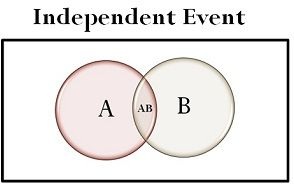
Events \(A\) and \(B\) are independent if and only if
\(\mathrm{ P(A\mid B)=P(A) }\)
or equivalently,
\(\mathrm{ P(B\mid A)=P(B)} \)
Another equivalent condition is the Multiplication Rule for Independent Events:
\( \mathrm{ P(A\cap B)=P(A)\cdot P(B) }\)
If any one of these conditions is true, the events are independent.
Key Formulas
| Formula | Meaning |
|---|---|
| \(P(A\mid B)=P(A)\) | Knowing \(B\) occurred does not change the probability of \(A\). |
| \(P(B\mid A)=P(B)\) | Knowing \(A\) occurred does not change the probability of \(B\). |
| \(P(A\cap B)=P(A)\times P(B)\) | Multiplication Rule for independent events. |
Example 1: Flipping a Coin and Rolling a Die
A fair coin is flipped and a fair six-sided die is rolled.
Let
- \(A\): The coin lands on Heads.
- \(B\): The die shows a 6.
Step 1: Find the individual probabilities.
\(P(A)=\dfrac12\)
\(P(B)=\dfrac16\)
Step 2: Apply the Multiplication Rule.
\(P(A\cap B)=\dfrac12\times\dfrac16=\dfrac1{12}\)
Since flipping the coin does not affect the die roll, the events are independent.
Example 2: Drawing Cards Without Replacement
Two cards are drawn from a standard deck without replacement.
Let
- \(A\): The first card is an Ace.
- \(B\): The second card is an Ace.
After the first Ace is removed, the probability of drawing another Ace changes.
\(P(B)=\dfrac4{52}\)
\(P(B\mid A)=\dfrac3{51}\)
Since
\(P(B\mid A)\neq P(B)\)
the events are not independent (they are dependent).
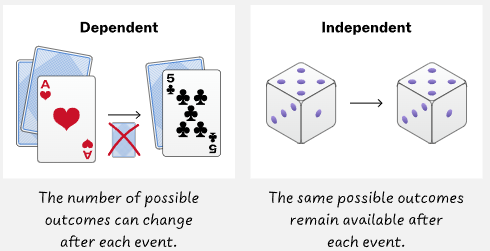
Independent vs. Dependent Events
| Independent Events | Dependent Events |
|---|---|
| One event does not affect the other. | One event changes the probability of the other. |
| \(P(A\mid B)=P(A)\) | \(P(A\mid B)\neq P(A)\) |
| \(P(A\cap B)=P(A)P(B)\) | Use \(P(A\cap B)=P(A)P(B\mid A)\) |
Important AP Exam Notes
- Independent events do not influence each other’s probabilities.
- If events are independent, then
\(P(A\mid B)=P(A)\)
\(P(B\mid A)=P(B)\)
\(P(A\cap B)=P(A)\times P(B)\)
- These three statements are mathematically equivalent.
- Drawing without replacement usually creates dependent events.
- Separate random processes (such as flipping a coin and rolling a die) are typically independent.
Common AP Exam Mistakes
| Incorrect | Correct |
|---|---|
| Using \(P(A)P(B)\) for dependent events. | Only use this rule for independent events. |
| Assuming mutually exclusive events are independent. | Mutually exclusive events (with positive probability) are not independent. |
| Ignoring changes in the sample space. | Check whether the first event changes the probability of the second. |
Example
A fair coin is flipped, and a fair six-sided die is rolled.
Let
- \(A\): The coin lands on Heads.
- \(B\): The die shows an even number.
Determine whether the events are independent, and calculate \(P(A\cap B)\).
▶️ Answer / Explanation
Step 1: Determine whether the events affect each other.
The result of the coin flip does not affect the die roll.
Therefore, the events are independent.
Step 2: Find the probabilities.
\(P(A)=\dfrac12\)
\(P(B)=\dfrac36=\dfrac12\)
Step 3: Apply the Multiplication Rule.
\(P(A\cap B)=\dfrac12\times\dfrac12=\dfrac14\)
Answer
The events are independent, and the probability that both occur is
\(\dfrac14\).
2.7.A.2 Union of Two Events
The union of two events includes all outcomes that are in event \(A\), event \(B\), or both events.
In probability, the word “or” means that at least one of the events occurs.
The probability of the union of two events is written as
\( P(A\cup B) \)
where \(A\cup B\) is read as
“A union B” or “A or B.”
Definition
The union of two events consists of:
- All outcomes in event \(A\).
- All outcomes in event \(B\).
- Any outcomes that belong to both events.
Therefore,
\( P(A\cup B)=\text{Probability that }A\text{ occurs, }B\text{ occurs, or both occur.} \)
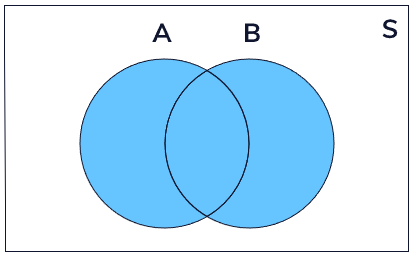
Imagine a Venn diagram:
- The left circle represents event \(A\).
- The right circle represents event \(B\).
- The union includes every part of both circles, including the overlap.
Therefore, the union represents all outcomes that belong to either event or to both events.
Example 1: Rolling a Die
A fair six-sided die is rolled once.
Let
- \(A\): Rolling an even number
- \(B\): Rolling a number greater than 4
Step 1: Write each event.
\(A=\{2,4,6\}\)
\(B=\{5,6\}\)
Step 2: Find the union.
\(A\cup B=\{2,4,5,6\}\)
The union contains every outcome that is in either event.
Example 2: Drawing a Card
A card is selected from a standard deck.
Let
- \(A\): Drawing a Heart.
- \(B\): Drawing a King.
The union consists of
- All 13 Hearts.
- All 4 Kings.
- The King of Hearts belongs to both events but is still included only once in the union.
Examples of Unions
| Event A | Event B | \(A\cup B\) |
|---|---|---|
| Even numbers | Numbers greater than 4 | {2, 4, 5, 6} |
| Hearts | Kings | All Hearts and all Kings |
| Heads | Tails | {Heads, Tails} |
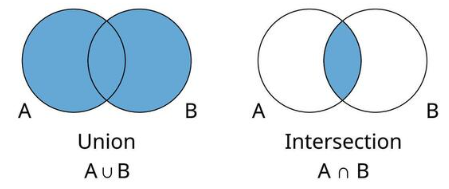
Union vs. Intersection
| Union | Intersection |
|---|---|
| Symbol: \(A\cup B\) | Symbol: \(A\cap B\) |
| Means A or B (or both). | Means A and B. |
| Includes every outcome in either event. | Includes only outcomes common to both events. |
Important AP Exam Notes
- The word “or” means the union of two events.
- The union includes outcomes in either event or both events.
- The symbol for union is \(\cup\).
- Outcomes that belong to both events are counted only once in the union.
- The actual probability formula for calculating \(P(A\cup B)\) is introduced in the next learning objective (2.7.A.3).
Common AP Exam Mistakes
| Incorrect | Correct |
|---|---|
| Thinking “or” means only one event occurs. | “Or” includes one event, the other event, or both. |
| Confusing union with intersection. | Union means “or”; intersection means “and”. |
| Listing only the overlapping outcomes. | Include every outcome that belongs to either event. |
Example
A fair six-sided die is rolled once.
Let
- \(A\): Rolling an odd number.
- \(B\): Rolling a number greater than 4.
List the outcomes in the union \(A\cup B\).
▶️ Answer / Explanation
Step 1: Write each event.
\(A=\{1,3,5\}\)
\(B=\{5,6\}\)
Step 2: Combine all unique outcomes.
\(A\cup B=\{1,3,5,6\}\)
Answer
The union contains every outcome that is in event \(A\), event \(B\), or both.
2.7.A.3 Addition Rule for the Union of Two Events
To calculate the probability that event \(A\) or event \(B\) (or both) occurs, use the Addition Rule.
When adding the probabilities of two events, any outcomes that belong to both events are counted twice. Therefore, the probability of the intersection must be subtracted once to avoid double counting.
Addition Rule Formula
\(\mathrm{ P(A\cup B)=P(A)+P(B)-P(A\cap B)} \)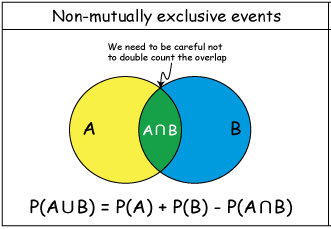
Where:
- \(P(A)\) = Probability of event \(A\).
- \(P(B)\) = Probability of event \(B\).
- \(P(A\cap B)\) = Probability that both events occur.
- \(P(A\cup B)\) = Probability that \(A\), \(B\), or both occur.
Why Do We Subtract the Intersection?
When we calculate
\(P(A)+P(B)\)
the outcomes that belong to both events are counted twice.
Subtracting
\(P(A\cap B)\)
removes the duplicate count so that each outcome is counted only once.
Example 1: Rolling a Die
A fair six-sided die is rolled once.
Let
- \(A\): Rolling an even number.
- \(B\): Rolling a number greater than 3.
Step 1: Find each probability.
\(P(A)=\dfrac36=\dfrac12\)
\(P(B)=\dfrac36=\dfrac12\)
The intersection is
\(A\cap B=\{4,6\}\)
\(P(A\cap B)=\dfrac26=\dfrac13\)
Step 2: Apply the Addition Rule.
\(P(A\cup B)=\dfrac12+\dfrac12-\dfrac13=\dfrac23\)
The probability of rolling an even number or a number greater than 3 is
\(\dfrac23\)
Example 2: Drawing a Card
A card is selected at random from a standard deck of 52 cards.
Find the probability that the card is a Heart or a King.
Step 1: Find each probability.
\(P(\text{Heart})=\dfrac{13}{52}\)
\(P(\text{King})=\dfrac4{52}\)
The only card that is both a Heart and a King is the King of Hearts.
\(P(\text{Heart}\cap\text{King})=\dfrac1{52}\)
Step 2: Apply the Addition Rule.
\(P(\text{Heart}\cup\text{King})=\dfrac{13}{52}+\dfrac4{52}-\dfrac1{52}=\dfrac{16}{52}=\dfrac4{13}\)
Special Case: Mutually Exclusive Events
If two events are mutually exclusive (disjoint), then
\(P(A\cap B)=0\)
Therefore, the Addition Rule simplifies to
\(P(A\cup B)=P(A)+P(B)\)
This simplification should only be used when the events cannot occur together.
Summary of the Addition Rule
| Situation | Formula |
|---|---|
| General Case | \(P(A\cup B)=P(A)+P(B)-P(A\cap B)\) |
| Mutually Exclusive Events | \(P(A\cup B)=P(A)+P(B)\) |
Important AP Exam Notes
- The word “or” indicates that the Addition Rule should be considered.
- Always subtract the intersection because it is counted twice when adding \(P(A)\) and \(P(B)\).
- Use the simplified rule \(P(A)+P(B)\) only if the events are mutually exclusive.
- The Addition Rule works for both independent and dependent events.
- Always determine whether the events overlap before choosing the formula.
Common AP Exam Mistakes
| Incorrect | Correct |
|---|---|
| Adding probabilities without subtracting the overlap. | Subtract \(P(A\cap B)\). |
| Using \(P(A)+P(B)\) for overlapping events. | Only use this when the events are mutually exclusive. |
| Confusing “or” with “and”. | “Or” uses the Addition Rule; “and” uses the Multiplication Rule. |
Example
A standard deck of 52 cards is shuffled thoroughly. One card is selected at random.
Calculate the probability that the selected card is either a Queen or a Diamond.
▶️ Answer / Explanation
Step 1: Find each probability.
\(P(\text{Queen})=\dfrac4{52}\)
\(P(\text{Diamond})=\dfrac{13}{52}\)
The Queen of Diamonds belongs to both events.
\(P(\text{Queen}\cap\text{Diamond})=\dfrac1{52}\)
Step 2: Apply the Addition Rule.
\(P(\text{Queen}\cup\text{Diamond})=\dfrac4{52}+\dfrac{13}{52}-\dfrac1{52}=\dfrac{16}{52}=\dfrac4{13}\)
Answer
The probability of drawing a Queen or a Diamond is
\(\dfrac4{13}\)