Question 1
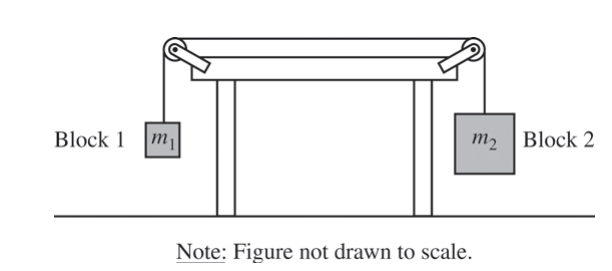
Two blocks are connected by a string of negligible mass that passes over massless pulleys that turn with negligible friction, as shown in the figure above. The mass \(m_2\) of block 2 is greater than the mass \(m_1\) of block 1. The blocks are released from rest.
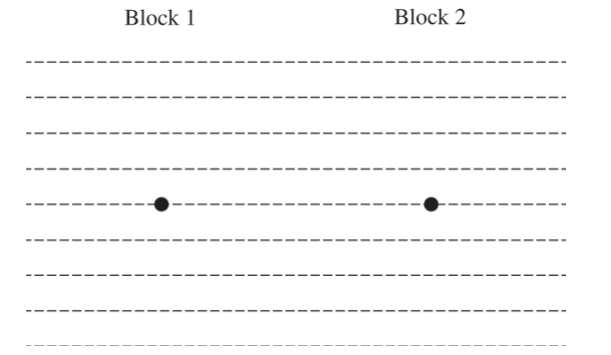
(a) The dots below represent the two blocks. Draw free-body diagrams showing and labeling the forces (not components) exerted on each block. Draw the relative lengths of all vectors to reflect the relative magnitudes of all the forces.
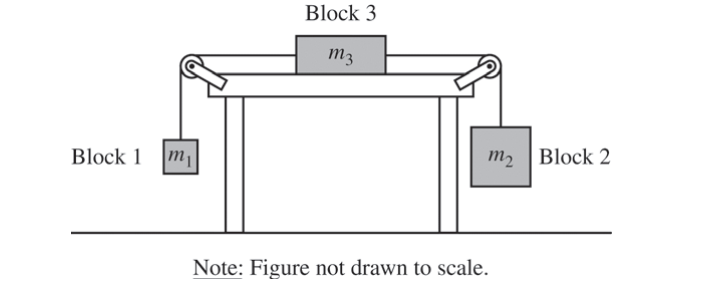
(c) A third block of mass \(m_3\) is placed on top of block 1. Predict whether the new acceleration of block 2 is greater than, less than, or the same as the acceleration found in part (b). Briefly justify your answer.
Most-appropriate topic codes (AP Physics 1):
• Topic 2.5 — Newton’s Second Law (Parts (b), (c))
• Topic 2.6 — Gravitational Force (Parts (a), (b), (c))
▶️ Answer/Explanation
(a)
Each block has exactly two forces acting on it: the gravitational force downward and the string tension upward. Since \(m_2 > m_1\), block 2 accelerates downward and block 1 accelerates upward. The tension \(T\) is the same in both blocks (massless string, massless pulleys). The gravitational force on block 2 (\(m_2 g\)) is larger than on block 1 (\(m_1 g\)), so the downward arrow on block 2 must be drawn longer than the downward arrow on block 1. Both tension arrows are equal in length.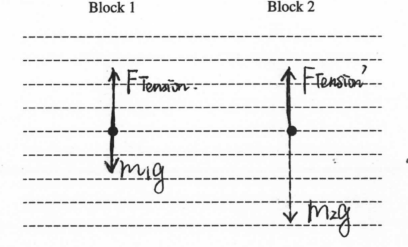
Key features of the correct diagram: both tension arrows are the same length (same tension throughout the string); the \(m_2 g\) arrow is longer than the \(m_1 g\) arrow (since \(m_2 > m_1\)); for block 1 the tension arrow is longer than \(m_1 g\) (net force upward); for block 2 the \(m_2 g\) arrow is longer than the tension arrow (net force downward).
(b)
Let \(T\) be the tension in the string and \(a\) be the magnitude of the acceleration of the system. Take the positive direction for each block to be its direction of motion: upward for block 1 and downward for block 2.
Applying Newton’s Second Law to block 1 (net force upward): \( T – m_1 g = m_1 a \quad \cdots (1) \)
Applying Newton’s Second Law to block 2 (net force downward): \( m_2 g – T = m_2 a \quad \cdots (2) \)
Adding equations (1) and (2) to eliminate \(T\): \( m_2 g – m_1 g = m_1 a + m_2 a \) \( (m_2 – m_1)g = (m_1 + m_2)a \)
Solving for \(a\): \( \boxed{a = \frac{(m_2 – m_1)\,g}{m_1 + m_2}} \)
This result makes physical sense: if \(m_2 = m_1\), then \(a = 0\) (balanced Atwood machine); if \(m_2 \gg m_1\), then \(a \approx g\) (free fall of block 2).
(c) \(\boxed{\textbf{Less than}}\)
When block 3 of mass \(m_3\) is placed on top of block 1, two things change simultaneously:
1. The total mass of the system increases from \((m_1 + m_2)\) to \((m_1 + m_2 + m_3)\). A larger total mass means more inertia to accelerate.
2. The net driving force decreases from \((m_2 – m_1)g\) to \((m_2 – m_1 – m_3)g\), because block 3’s weight now acts on the same side as block 1 (opposing block 2’s downward pull).
Both effects act together to reduce the acceleration. Applying the same derivation as part (b) with \(m_1\) replaced by \((m_1 + m_3)\): \( a’ = \frac{(m_2 – m_1 – m_3)\,g}{m_1 + m_2 + m_3} \)
Comparing with the original: \( a = \dfrac{(m_2 – m_1)\,g}{m_1 + m_2} \), one can verify that \(a’ < a\) since the numerator decreased and the denominator increased. Therefore the acceleration of block 2 is less than before.
Additionally, the tension on block 2 increases. From block 2’s equation: \(T’ = m_2(g – a’)\). Since \(a’ < a\), we have \(T’ > T\) — consistent with the string now having to support a heavier load on block 1’s side.
Question 2
Most-appropriate topic codes (AP Physics \(2\)):
• Topic \(11.2\) — Simple Circuits (Part \( \mathrm{(a)} \), Part \( \mathrm{(c)} \))
• Topic \(11.3\) — Resistance, Resistivity, and Ohm’s Law (Part \( \mathrm{(c)} \), Part \( \mathrm{(d)} \))
• Topic \(11.6\) — Kirchhoff’s Loop Rule (Part \( \mathrm{(b)(ii)} \))
• Topic \(11.7\) — Kirchhoff’s Junction Rule (Part \( \mathrm{(b)(i)} \))
▶️ Answer/Explanation
(a)
Connect the power source, resistor, and bulb in series. Place one ammeter in series before the bulb and a second ammeter in series after the bulb. Connect the voltmeter in parallel across the bulb.
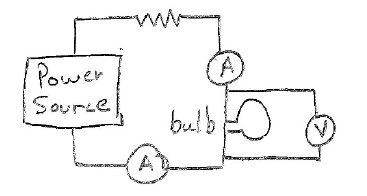
Measure the current entering the bulb, \(I_{\text{in}}\), with one ammeter. Measure the current leaving the bulb, \(I_{\text{out}}\), with the other ammeter. Measure the potential difference across the bulb, \(\Delta V_{\text{bulb}}\), with the voltmeter.
The two ammeters allow the students to test whether current is used up in the bulb. The voltmeter allows the students to test whether charges lose electric potential energy while passing through the bulb.
(b)(i)
Compare \(I_{\text{in}}\) and \(I_{\text{out}}\).
If \(I_{\text{in}}=I_{\text{out}}\), then the number of electrons per second entering the bulb is equal to the number of electrons per second leaving the bulb. Therefore, current is not used up in the bulb.
This agrees with conservation of charge. Charge flows through the bulb, but the bulb does not consume charge.
(b)(ii)
Use the voltmeter reading across the bulb.
If \(\Delta V_{\text{bulb}}\neq 0\), then electrons change electric potential while moving through the bulb. The change in electric potential energy is related to potential difference by
\(\Delta U_E=q\Delta V_{\text{bulb}}\)
Thus, a nonzero \(\Delta V_{\text{bulb}}\) means the electrons transfer energy to the bulb, where the energy is transformed mostly into thermal energy and light.
(c)(i)
No major change is required. The same setup can be used to test whether the bulb is nonohmic.
One ammeter could be removed because the current entering and leaving the bulb should be the same, but keeping both ammeters does not prevent the experiment from working.
(c)(ii)
Collect additional data by changing the setting of the adjustable power supply. For each setting, measure the current through the bulb \(I\) and the potential difference across the bulb \(\Delta V_{\text{bulb}}\).
Multiple pairs of \(I\) and \(\Delta V_{\text{bulb}}\) are needed to determine whether the resistance stays constant as current changes.
(d)
Make a graph of \(I\) as a function of \(\Delta V_{\text{bulb}}\), or make a graph of \(\Delta V_{\text{bulb}}\) as a function of \(I\).
If the bulb is ohmic, then the data should be linear because
\(\Delta V_{\text{bulb}}=IR\)
For an ohmic bulb, \(R\) is constant, so the ratio
\(R=\dfrac{\Delta V_{\text{bulb}}}{I}\)
should remain constant for different currents.
If the graph is clearly curved, or if the ratio \(\dfrac{\Delta V_{\text{bulb}}}{I}\) changes more than can be explained by measurement uncertainty, then the bulb is nonohmic.
The voltmeter uncertainty is about \(\pm 0.05\text{ V}\), and the ammeter uncertainty is about \(\pm 0.005\text{ A}\), based on the smallest markings. The students should include uncertainty bars on the graph. If a straight best-fit line cannot reasonably pass through the uncertainty ranges of the data points, then the data support the conclusion that the bulb is nonohmic.
Question 3


Most-appropriate topic codes (AP Physics \(1\)):
• Topic \(2.8\) — Spring Forces (Part \( \mathrm{(a)} \), Part \( \mathrm{(b)} \), Part \( \mathrm{(c)} \))
• Topic \(3.1\) — Translational Kinetic Energy (Part \( \mathrm{(a)} \))
• Topic \(3.2\) — Work (Part \( \mathrm{(c)} \), Part \( \mathrm{(d)} \))
• Topic \(3.3\) — Potential Energy (Part \( \mathrm{(a)} \), Part \( \mathrm{(b)} \), Part \( \mathrm{(c)} \))
• Topic \(3.4\) — Conservation of Energy (Part \( \mathrm{(a)} \), Part \( \mathrm{(b)} \), Part \( \mathrm{(c)} \), Part \( \mathrm{(d)} \))
▶️ Answer/Explanation
(a)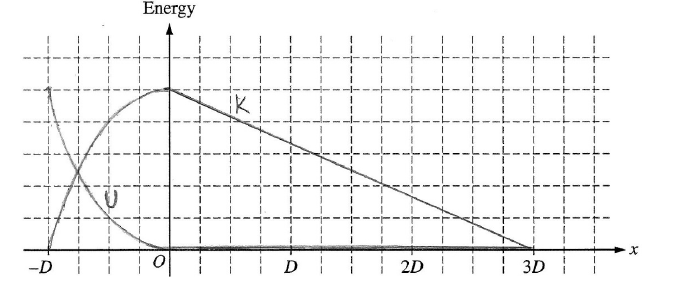
From \(x=-D\) to \(x=0\), the surface is frictionless, so the mechanical energy of the block-spring system is constant.
At \(x=-D\), the spring is compressed and the block is released from rest, so the energy is all spring potential energy:
\(U=\dfrac{1}{2}kD^2\), and \(K=0\)
As the block moves from \(x=-D\) to \(x=0\), the spring potential energy decreases like a curved, parabolic graph:
\(U=\dfrac{1}{2}kx^2\)
The kinetic energy increases by the same amount that \(U\) decreases, so
\(K=\dfrac{1}{2}kD^2-\dfrac{1}{2}kx^2\)
Thus, from \(x=-D\) to \(x=0\), \(U\) decreases to \(0\), while \(K\) increases to its maximum value.
From \(x=0\) to \(x=3D\), the spring is no longer compressed, so
\(U=0\)
On the rough track, kinetic friction removes mechanical energy at a constant rate because the friction force has constant magnitude:
\(f_k=\mu mg\)
Therefore, \(K\) decreases linearly from its maximum value at \(x=0\) to \(0\) at \(x=3D\).
The graph should show \(U\) as a decreasing parabola from \(x=-D\) to \(x=0\), then zero from \(x=0\) to \(x=3D\). The graph should show \(K\) increasing from \(0\) to a maximum from \(x=-D\) to \(x=0\), then decreasing linearly to \(0\) at \(x=3D\).
(b)(i)
The student is correct that the block has more energy when it leaves the spring if the spring is compressed more.
A larger compression stores more spring potential energy, and that energy becomes kinetic energy as the block leaves the spring.
(b)(ii)
The student is incorrect that doubling the compression gives only twice as much energy.
Spring potential energy depends on the square of the compression:
\(U_s=\dfrac{1}{2}k(\Delta x)^2\)
So if the compression changes from \(D\) to \(2D\), the spring energy becomes
\(U_2=\dfrac{1}{2}k(2D)^2=4\left(\dfrac{1}{2}kD^2\right)\)
The energy is \(4\) times as large, not \(2\) times as large.
(c)
In the original situation, the block stops at \(x=3D\). The spring energy is fully dissipated by friction:
\(\dfrac{1}{2}kD^2=\mu mg(3D)\)
For the new situation, the compression is \(2D\), so the initial spring energy is
\(U_2=\dfrac{1}{2}k(2D)^2\)
\(U_2=4\left(\dfrac{1}{2}kD^2\right)\)
Since the friction force is the same, the work done by friction is proportional to stopping distance:
\(W_f=f_k x=\mu mgx\)
If \(4\) times as much energy must be dissipated by the same friction force, the stopping distance is \(4\) times as large.
Original stopping distance:
\(x_1=3D\)
New stopping distance:
\(x_2=4x_1=4(3D)\)
\(\boxed{x_2=12D}\)
(d)
The correct part of the student’s reasoning is that a greater spring compression gives the block more energy when it leaves the spring. This appears in the relationship
\(U_s=\dfrac{1}{2}k(\Delta x)^2\)
The incorrect part is the claim that the energy doubles when the compression doubles. The equation shows that energy depends on \((\Delta x)^2\), so doubling \(\Delta x\) makes the energy \(4\) times as large.
The student’s idea that more energy makes the block slide farther is correct, and this is expressed by
\(W_f=\mu mgx\)
Since friction has the same magnitude in both trials, the distance traveled on the rough track is proportional to the energy that must be dissipated. Therefore, \(4\) times as much energy leads to \(4\) times the stopping distance, so the final position is \(12D\), not \(6D\).
Question 4
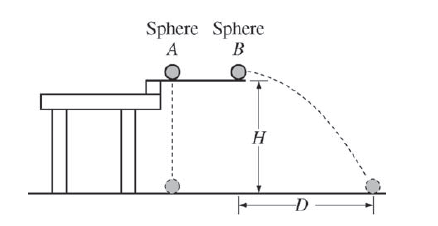
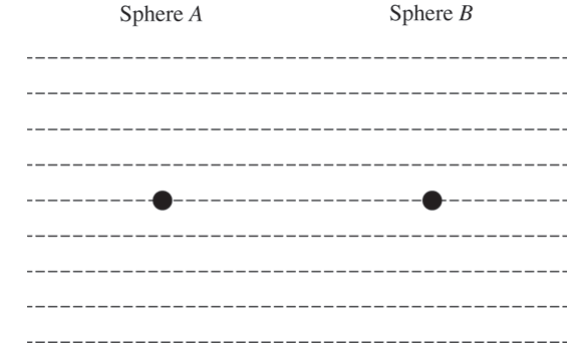
Two identical spheres are released from a device at time \(t=0\) from the same height \(H\), as shown above. Sphere \(A\) has no initial velocity and falls straight down. Sphere \(B\) is given an initial horizontal velocity of magnitude \(v_0\) and travels a horizontal distance \(D\) before it reaches the ground. The spheres reach the ground at the same time \(t_f\), even though sphere \(B\) has more distance to cover before landing. Air resistance is negligible.
Most-appropriate topic codes (AP Physics \(1\)):
• Topic \(1.3\) — Representing Motion (Part \( \mathrm{(b)} \))
• Topic \(1.5\) — Vectors and Motion in Two Dimensions (Part \( \mathrm{(b)} \), Part \( \mathrm{(c)} \))
• Topic \(2.2\) — Forces and Free-Body Diagrams (Part \( \mathrm{(a)} \))
• Topic \(2.6\) — Gravitational Force (Part \( \mathrm{(a)} \), Part \( \mathrm{(c)} \))
▶️ Answer/Explanation
(a)
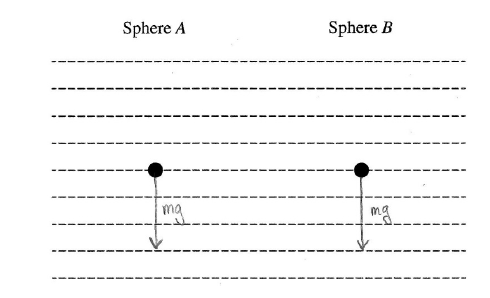
At time \(\dfrac{t_f}{2}\), each sphere is in the air. Since air resistance is negligible, the only force exerted on each sphere is the gravitational force.
Therefore, each free-body diagram should show one arrow straight downward, labeled \(mg\) or \(F_g\).
(b)
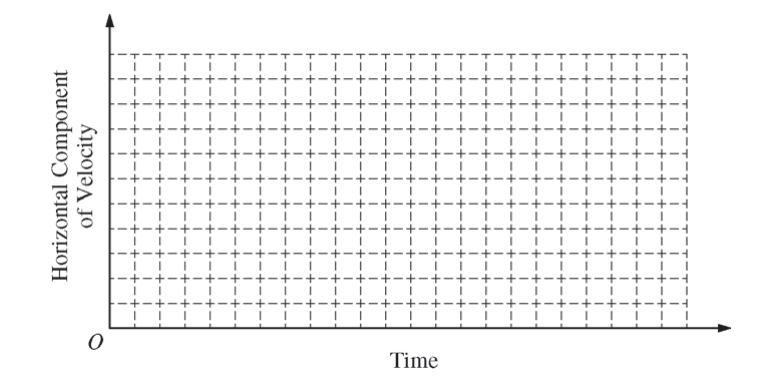
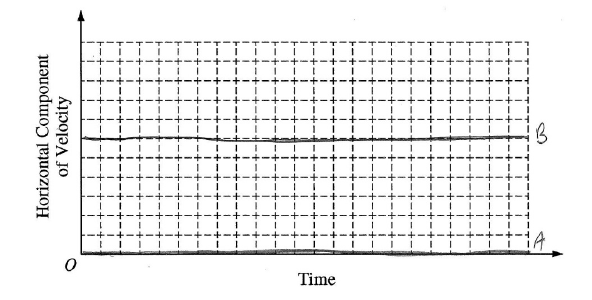
Sphere \(A\) has no horizontal velocity, so its horizontal velocity is
\(v_{x,A}=0\)
Sphere \(B\) has an initial horizontal velocity \(v_0\). Since there is no horizontal force on sphere \(B\), its horizontal velocity stays constant:
\(v_{x,B}=v_0\)
The graph should show a horizontal line at \(0\) for sphere \(A\), and a horizontal line above \(0\) at \(v_0\) for sphere \(B\).
(c)
The spheres reach the ground at the same time because their vertical motions are the same. As shown in part (a), the only force on each sphere is gravity, so both spheres have the same downward acceleration \(g\). Both spheres also start from the same height \(H\) and have the same initial vertical velocity, \(v_{y,0}=0\). Therefore, their vertical motion is identical, so the time to fall is the same for both spheres.
The horizontal motion does not affect the vertical motion. In part (b), sphere \(A\) has \(v_{x,A}=0\), while sphere \(B\) has \(v_{x,B}=v_0\), so sphere \(B\) travels horizontally while it falls. However, this extra horizontal motion does not change the vertical acceleration or the vertical distance \(H\).
The fall time can be described by
\(H=\dfrac{1}{2}gt_f^2\)
so
\(t_f=\sqrt{\dfrac{2H}{g}}\)
This expression does not depend on horizontal velocity. Thus, sphere \(B\) covers a greater total distance because it has horizontal motion, but both spheres land at the same time because they have the same vertical motion.
Question 5
Most-appropriate topic codes (AP Physics \(2\)):
• Topic \(14.6\) — Wave Interference and Standing Waves (Part \( \mathrm{(a)} \), Part \( \mathrm{(c)} \))
▶️ Answer/Explanation
(a)
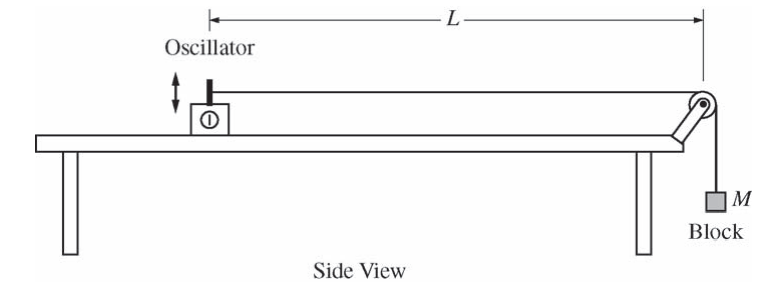
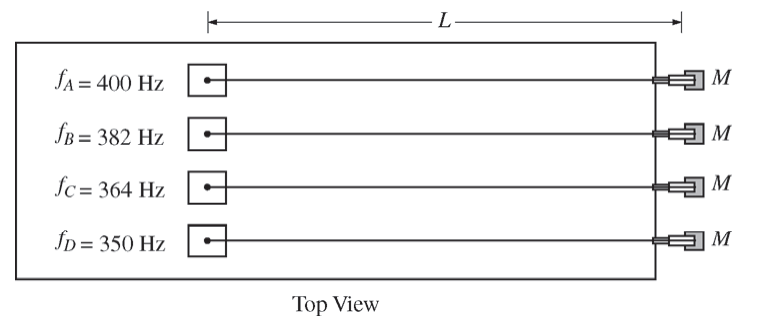
The strings must have different linear mass densities \(m/L\).
All four strings have the same length \(L\), so for the fundamental frequency the wavelength is the same for each string:
\(\lambda_1=2L\)
Since \(v=f\lambda\), different fundamental frequencies require different wave speeds.
The hanging blocks all have the same mass \(M\), so the string tensions are the same:
\(F_T=Mg\)
Using \(v=\sqrt{\dfrac{F_T}{m/L}}\), if \(F_T\) is the same but \(v\) is different, then \(m/L\) must be different. Therefore, the strings differ in their linear mass density.
(b)
No, the graph will not be linear.
For the fundamental frequency,
\(f=\dfrac{v}{2L}\)
and
\(v=\sqrt{\dfrac{F_T}{m/L}}\)
Therefore,
\(f=\dfrac{1}{2L}\sqrt{\dfrac{F_T}{m/L}}\)
Let the linear mass density be \(\mu=\dfrac{m}{L}\). Then
\(f=\dfrac{1}{2L}\sqrt{\dfrac{F_T}{\mu}}\)
Since \(L\) and \(F_T\) are constant,
\(f\propto \sqrt{\dfrac{1}{\mu}}\)
So a graph of \(f\) as a function of \(\dfrac{1}{\mu}\) is a square-root graph, not a straight line.
(c)
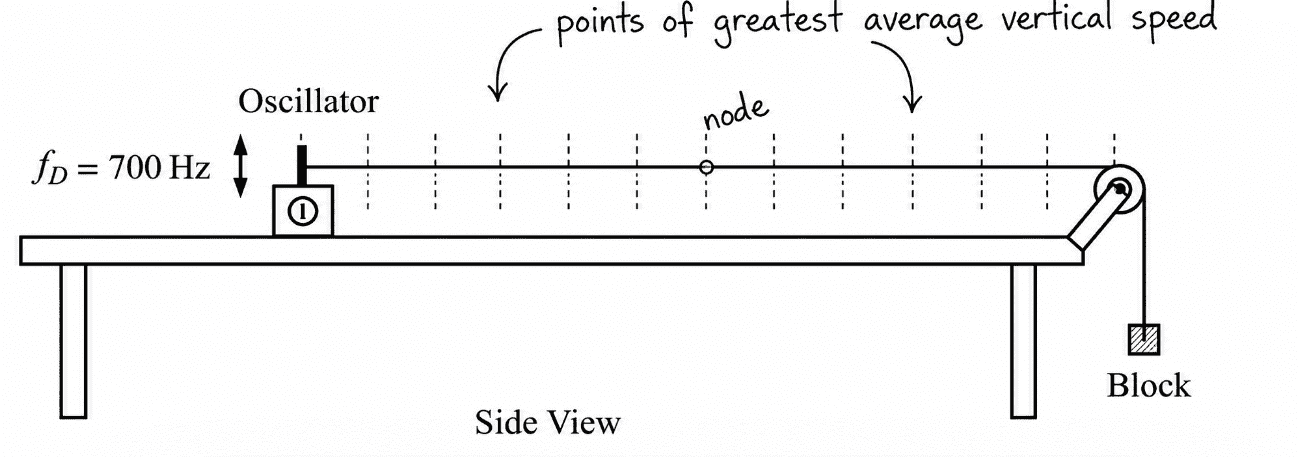
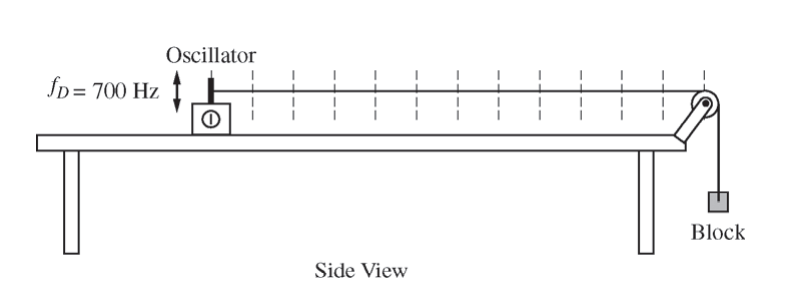
String \(D\) originally has fundamental frequency \(f_D=350\text{ Hz}\). When the oscillator frequency is changed to \(700\text{ Hz}\), the frequency is doubled, so the string is in the second harmonic.
In the second harmonic on a string fixed at both ends,
\(\lambda_2=L\)
The points with the greatest average vertical speed are the antinodes. For the second harmonic, the antinodes are located at
\(x=\dfrac{L}{4}\) and \(x=\dfrac{3L}{4}\)
Therefore, two points should be marked and labeled on the string: one at one-fourth of the length from the oscillator and one at three-fourths of the length from the oscillator.