
Question 1
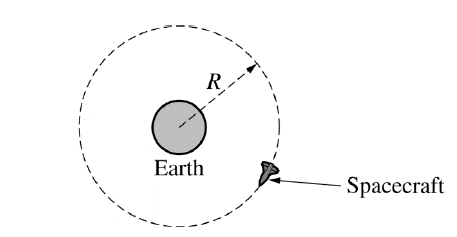
A spacecraft of mass \(m\) is in a clockwise circular orbit of radius \(R\) around Earth, as shown in the figure above. The mass of Earth is \(M_E\).
Most-appropriate topic codes (AP Physics \(1\)):
• Topic \(2.6\) — Gravitational Force (Part \( \mathrm{(a)} \), Part \( \mathrm{(b)} \), Part \( \mathrm{(c)} \))
• Topic \(2.9\) — Circular Motion (Part \( \mathrm{(b)} \), Part \( \mathrm{(c)} \))
• Topic \(6.6\) — Motion of Orbiting Satellites (Part \( \mathrm{(b)} \), Part \( \mathrm{(c)} \))
▶️ Answer/Explanation
(a)
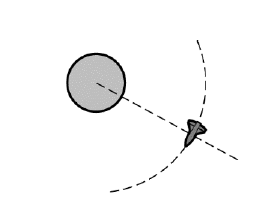
The only force acting on the spacecraft is the gravitational force exerted by Earth. The arrow should start on the spacecraft and point toward the center of Earth.
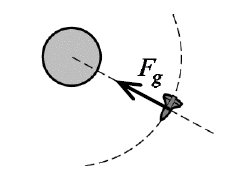
\(\boxed{\text{Draw one force arrow toward Earth’s center, labeled }F_g\text{ or }F_{\text{Earth on spacecraft}}.}\)
(b)(i)
The gravitational force provides the centripetal force needed for circular motion.
\(F_g=F_c\)
\(\dfrac{GM_Em}{R^2}=\dfrac{mv^2}{R}\)
The spacecraft mass \(m\) cancels:
\(\dfrac{GM_E}{R^2}=\dfrac{v^2}{R}\)
\(v^2=\dfrac{GM_E}{R}\)
For circular motion, the orbital speed is
\(v=\dfrac{2\pi R}{T}\)
Substitute this into \(v^2=\dfrac{GM_E}{R}\):
\(\left(\dfrac{2\pi R}{T}\right)^2=\dfrac{GM_E}{R}\)
\(\dfrac{4\pi^2R^2}{T^2}=\dfrac{GM_E}{R}\)
\(T^2=\dfrac{4\pi^2R^3}{GM_E}\)
\(\boxed{T=\sqrt{\dfrac{4\pi^2R^3}{GM_E}}}\)
(b)(ii)
\(\boxed{\text{Equal to}}\)
The expression for orbital period is \(T=\sqrt{\dfrac{4\pi^2R^3}{GM_E}}\). It depends on the orbital radius \(R\), the mass of Earth \(M_E\), and the gravitational constant \(G\), but it does not depend on the spacecraft’s mass.
Therefore, a spacecraft of mass \(2m\) at the same orbital radius \(R\) has the same orbital period as the spacecraft of mass \(m\).
(c)
\(\boxed{\text{Less than}}\)
From the derivation in part (b)(i),
\(v^2=\dfrac{GM_E}{R}\)
so
\(v=\sqrt{\dfrac{GM_E}{R}}\)
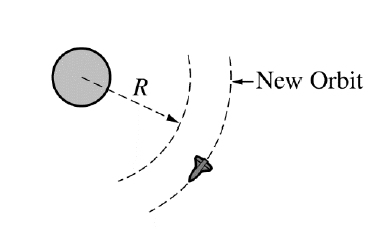
This shows that orbital speed decreases as orbital radius increases. In the new orbit, the radius is greater than \(R\), so the spacecraft’s speed is less than its original speed.
\(\boxed{R\text{ increases } \Rightarrow v\text{ decreases}}\)
Question 2
| Dough Cylinder | \(A\left(\text{m}^2\right)\) | \(\ell\left(\text{m}\right)\) | \(\Delta V\left(\text{V}\right)\) | \(R\left(\Omega\right)\) | Example: \(\dfrac{\ell}{A}\left(\text{m}^{-1}\right)\) |
|---|---|---|---|---|---|
| \(1\) | \(0.00049\) | \(0.030\) | \(1.02\) | \(23.6\) | \(61\) |
| \(2\) | \(0.00049\) | \(0.050\) | \(2.34\) | \(31.5\) | \(102\) |
| \(3\) | \(0.00053\) | \(0.080\) | \(3.58\) | \(61.2\) | \(151\) |
| \(4\) | \(0.00057\) | \(0.150\) | \(6.21\) | \(105\) | \(263\) |

Most-appropriate topic codes (AP Physics C: Electricity and Magnetism):
• Topic \(11.2\) — Simple Circuits (Part \( \mathrm{(a)} \), Part \( \mathrm{(c)} \))
• Topic \(11.3\) — Resistance, Resistivity, and Ohm’s Law (Part \( \mathrm{(a)} \), Part \( \mathrm{(b)} \), Part \( \mathrm{(c)} \))
▶️ Answer/Explanation
(a)(i)
For a uniform conductor, \(R=\rho\dfrac{\ell}{A}\).
Therefore, a useful linear graph is:
\(\boxed{\text{Vertical axis: }R\left(\Omega\right)}\)
\(\boxed{\text{Horizontal axis: }\dfrac{\ell}{A}\left(\text{m}^{-1}\right)}\)
The slope of the graph is the resistivity \(\rho\), because \(R=\rho\left(\dfrac{\ell}{A}\right)\).
(a)(ii)
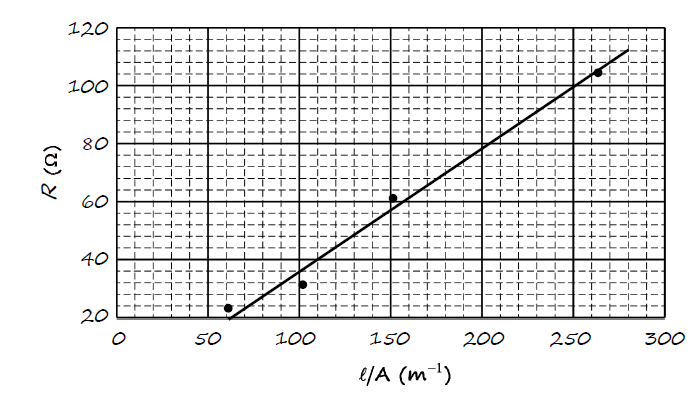
Plot the points \(\left(61,23.6\right)\), \(\left(102,31.5\right)\), \(\left(151,61.2\right)\), and \(\left(263,105\right)\), where the horizontal quantity is \(\dfrac{\ell}{A}\left(\text{m}^{-1}\right)\) and the vertical quantity is \(R\left(\Omega\right)\). Draw a reasonable best-fit line through the data.
(a)(iii)
Use the slope of the best-fit line:
\(\rho=\text{slope}=\dfrac{\Delta R}{\Delta\left(\ell/A\right)}\)
Using two points from a reasonable best-fit line, for example approximately \(\left(60\,\text{m}^{-1},20\,\Omega\right)\) and \(\left(260\,\text{m}^{-1},105\,\Omega\right)\):
\(\rho=\dfrac{105\,\Omega-20\,\Omega}{260\,\text{m}^{-1}-60\,\text{m}^{-1}}\)
\(\rho=\dfrac{85\,\Omega}{200\,\text{m}^{-1}}\)
\(\rho\approx0.43\,\Omega\cdot\text{m}\)
\(\boxed{\rho\approx0.42\,\Omega\cdot\text{m}}\)
(b)
\(\boxed{\text{No}}\)
Resistivity is a property of the material, not the shape of the object. Changing the dough from cylinders to rectangular shapes changes the resistance because \(R=\rho\dfrac{\ell}{A}\), but it does not change \(\rho\) if the material and temperature remain the same.
(c)
Make several dough cylinders with the same length \(\ell\) and the same cross-sectional area \(A\). Keep the geometry of the samples fixed so that the only intended independent variable is temperature.
Place one dough cylinder in a temperature-controlled environment, such as a warm water bath or an ice-water bath inside a sealed bag so the dough does not get wet. Use a thermometer to measure the dough temperature \(T\). For each temperature, connect the dough cylinder to a DC power supply, ammeter, and voltmeter.
Apply the same potential difference \(\Delta V\) across the dough each time and measure the current \(I\). Then calculate the resistance using Ohm’s law:
\(R=\dfrac{\Delta V}{I}\)
Then calculate the resistivity:
\(\rho=R\dfrac{A}{\ell}\)
Repeat the measurement for several different temperatures while keeping \(A\), \(\ell\), and the dough material constant. A graph of \(\rho\) versus \(T\) can then be used to determine whether the resistivity depends on temperature.
\(\boxed{\text{If }\rho\text{ changes systematically as }T\text{ changes, then resistivity depends on temperature.}}\)
Question 3
Most-appropriate topic codes (AP Physics \(1\)):
• Topic \(5.3\) — Torque (Part \( \mathrm{(b)} \), Part \( \mathrm{(d)} \))
• Topic \(5.4\) — Rotational Inertia (Part \( \mathrm{(b)} \))
• Topic \(5.6\) — Newton’s Second Law in Rotational Form (Part \( \mathrm{(a)} \), Part \( \mathrm{(b)} \), Part \( \mathrm{(c)} \))
• Topic \(6.3\) — Angular Momentum and Angular Impulse (Part \( \mathrm{(b)} \))
▶️ Answer/Explanation
(a)(i)
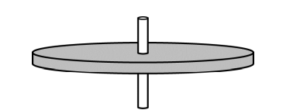
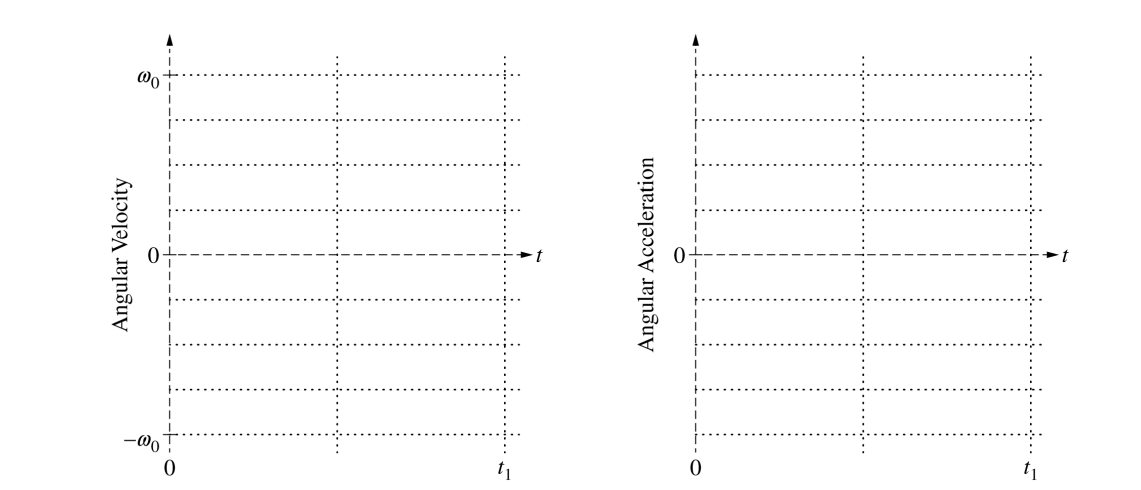
Since the frictional torque is constant, the angular acceleration is constant. Therefore, the angular velocity decreases linearly from \(+\omega_0\) at \(t=0\) to \(0\) at \(t=t_1\).
\(\boxed{\text{Draw a straight line from }(0,\omega_0)\text{ to }(t_1,0).}\)
(a)(ii)
The disk slows down at a constant rate, so the angular acceleration is constant and negative.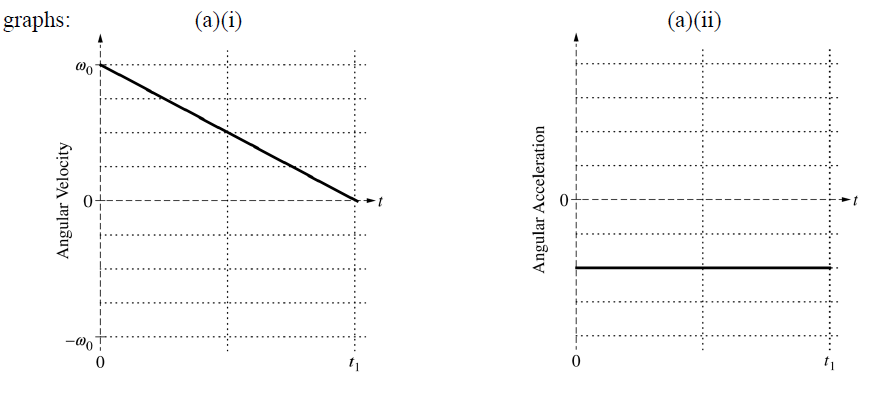
\(\alpha=\dfrac{\Delta\omega}{\Delta t}=\dfrac{0-\omega_0}{t_1}=-\dfrac{\omega_0}{t_1}\)
\(\boxed{\text{Draw a horizontal line below }0\text{ at }\alpha=-\dfrac{\omega_0}{t_1}.}\)
(b)
Use Newton’s second law for rotation:
\(\tau_{\text{net}}=I\alpha\)
The magnitude of the angular acceleration is
\(|\alpha|=\dfrac{\omega_0}{t_1}\)
Since the magnitude of the frictional torque is \(\tau_0\),
\(\tau_0=I\left(\dfrac{\omega_0}{t_1}\right)\)
Solve for \(I\):
\(\boxed{I=\dfrac{\tau_0t_1}{\omega_0}}\)
Another way to see this is with angular impulse. The angular impulse is \(\tau_0t_1\), and the change in angular momentum magnitude is \(I\omega_0\). Therefore, \(\tau_0t_1=I\omega_0\), giving the same result.
(c)(i)
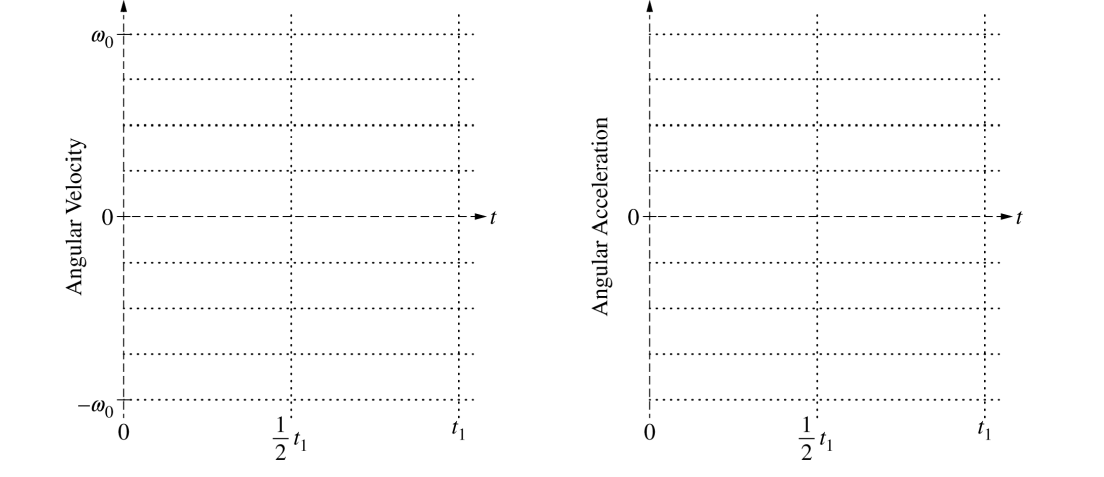
From \(t=0\) to \(t=\dfrac{1}{2}t_1\), the graph should match the original straight-line decrease because the frictional torque is unchanged.
After \(t=\dfrac{1}{2}t_1\), oil reduces the frictional torque, so the magnitude of the angular acceleration decreases. The angular velocity still decreases, but at a slower and slower rate. Therefore, the curve becomes less steep after \(t=\dfrac{1}{2}t_1\) and does not reach zero by \(t=t_1\).
\(\boxed{\text{Draw a decreasing curve that flattens after }t=\dfrac{1}{2}t_1\text{ and remains above }0\text{ at }t=t_1.}\)
(c)(ii)
From \(t=0\) to \(t=\dfrac{1}{2}t_1\), angular acceleration is constant and negative, just as in part (a).
After oil is added, friction decreases, so the magnitude of the negative angular acceleration decreases. Thus \(\alpha\) becomes less negative and moves upward toward \(0\).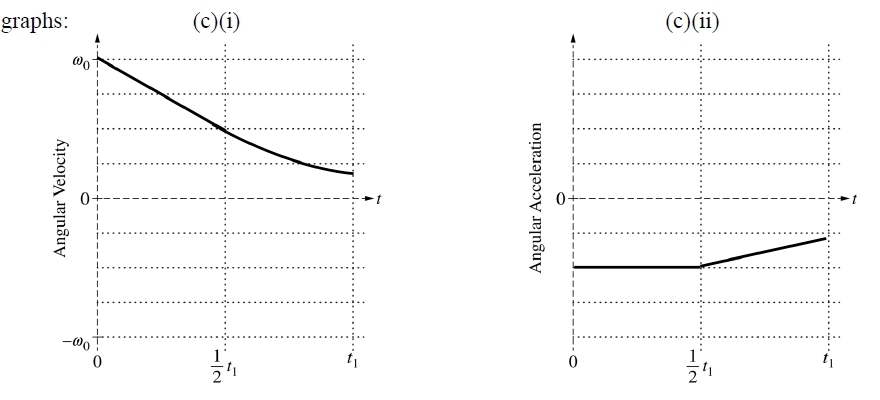
\(\boxed{\text{Draw a horizontal negative line until }t=\dfrac{1}{2}t_1\text{, then a curve increasing toward }0.}\)
(d)
\(\boxed{\text{Equation }\left(2\right)}\)
Equation \(\left(2\right)\), \(\tau=\dfrac{C_2}{\left(t+\dfrac{1}{2}t_1\right)}\), is plausible because the torque magnitude decreases as time increases. This matches the physical situation because more oil reaches the contact surface over time, reducing friction.
Equation \(\left(1\right)\), \(\tau=C_1\left(t-\dfrac{1}{2}t_1\right)\), is not plausible because it increases as time increases. That would mean the frictional torque gets larger as more oil is added, which contradicts the description of the experiment.
Question 4
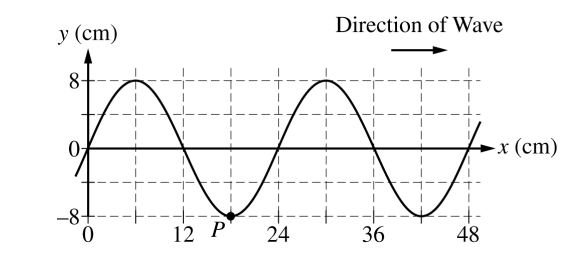
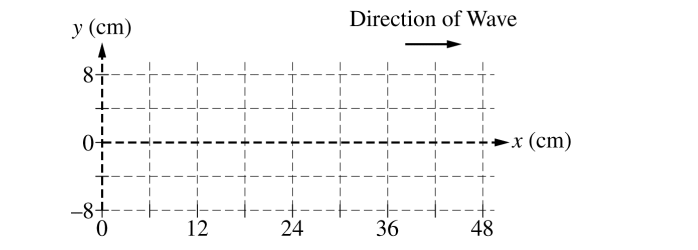
Most-appropriate topic codes (AP Physics \(2\)):
• Topic \(14.2\) — Wave Properties (Part \( \mathrm{(a)} \), Part \( \mathrm{(b)} \), Part \( \mathrm{(c)} \))
▶️ Answer/Explanation
(a)(i)
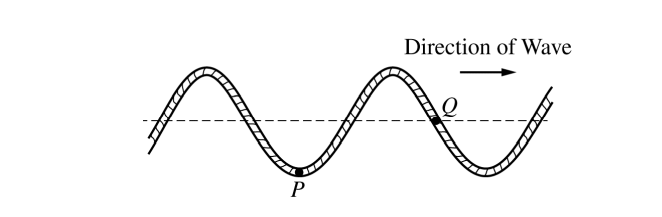
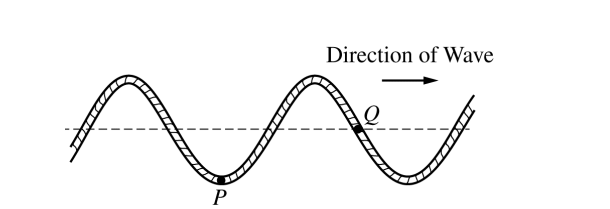
Dot \(P\) is at maximum displacement, so its instantaneous vertical velocity is zero.
\(\boxed{v_P=0}\)
For a wave traveling to the right, the string’s vertical velocity is opposite in sign to the local slope of the wave. At \(Q\), the wave is sloping downward as \(x\) increases, so dot \(Q\) is moving upward.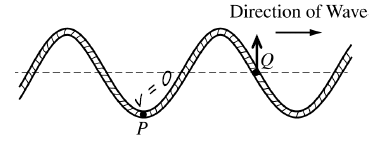
\(\boxed{\text{At }Q\text{, draw an upward velocity arrow.}}\)
(a)(ii)
For transverse wave motion, each point on the string accelerates toward the equilibrium position. Dot \(P\) is below equilibrium at maximum displacement, so its acceleration is upward.
\(\boxed{\text{At }P\text{, draw an upward acceleration arrow.}}\)
Dot \(Q\) is at the equilibrium position, so its instantaneous acceleration is zero.
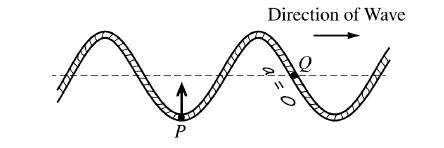
\(\boxed{a_Q=0}\)
(b)(i)
In a time \(T/4\), a wave traveling to the right moves horizontally by one-fourth of a wavelength.
From the graph, one wavelength is approximately \(24\,\text{cm}\). Therefore, the wave shifts to the right by
\(\dfrac{\lambda}{4}=\dfrac{24\,\text{cm}}{4}=6\,\text{cm}\)
So the sketch at \(t=T/4\) should have the same shape and amplitude as the original wave, but shifted \(6\,\text{cm}\) to the right.
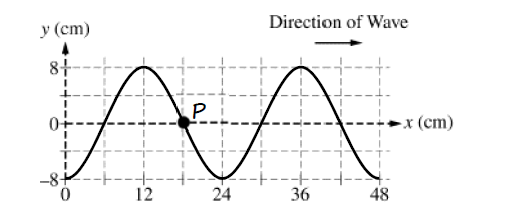
\(\boxed{\text{Draw the original wave shifted right by }\lambda/4.}\)
(b)(ii)
Dot \(P\) is a point on the string, not a point that travels horizontally with the wave shape. At \(t=0\), dot \(P\) is at a maximum downward displacement. After one-fourth period, that dot reaches equilibrium.
Therefore, dot \(P\) should be placed at the same horizontal location as before, but on the equilibrium line. From the graph, this is at about \(x=18\,\text{cm}\).
\(\boxed{\text{Place }P\text{ at }x\approx18\,\text{cm}\text{ on }y=0.}\)
(c)
The amplitude of the wave is \(8\,\text{cm}\). Dot \(P\) starts at maximum downward displacement, moves to equilibrium, then maximum upward displacement, then back to equilibrium, and finally returns to maximum downward displacement after one full period.
The total distance traveled by dot \(P\) in one full cycle is four amplitudes:
\(d=4A\)
\(d=4\left(8\,\text{cm}\right)\)
\(\boxed{d=32\,\text{cm}}\)
Question

Block \(P\) of mass \(m\) is on a horizontal, frictionless surface and is attached to a spring with spring constant \(k\). The block is oscillating with period \(T_P\) and amplitude \(A_P\) about the spring’s equilibrium position \(x_0\). A second block \(Q\) of mass \(2m\) is then dropped from rest and lands on block \(P\) at the instant it passes through the equilibrium position, as shown above. Block \(Q\) immediately sticks to the top of block \(P\), and the two-block system oscillates with period \(T_{PQ}\) and amplitude \(A_{PQ}\).

Most-appropriate topic codes (AP Physics \(1\)):
• Topic \(4.3\) — Conservation of Linear Momentum (Part \( \mathrm{(b)} \))
• Topic \(4.4\) — Elastic and Inelastic Collisions (Part \( \mathrm{(b)} \))
• Topic \(7.2\) — Frequency and Period of SHM (Part \( \mathrm{(a)} \))
• Topic \(7.3\) — Representing and Analyzing SHM (Part \( \mathrm{(a)} \), Part \( \mathrm{(b)} \))
• Topic \(7.4\) — Energy of Simple Harmonic Oscillators (Part \( \mathrm{(b)} \))
▶️ Answer/Explanation
(a)
For a mass-spring oscillator, the period is
\(T=2\pi\sqrt{\dfrac{M}{k}}\)
For block \(P\) alone, the oscillating mass is \(m\), so
\(T_P=2\pi\sqrt{\dfrac{m}{k}}\)
After block \(Q\) sticks to block \(P\), the total oscillating mass is
\(m+2m=3m\)
Therefore,
\(T_{PQ}=2\pi\sqrt{\dfrac{3m}{k}}\)
Now divide:
\(\dfrac{T_{PQ}}{T_P}=\dfrac{2\pi\sqrt{\dfrac{3m}{k}}}{2\pi\sqrt{\dfrac{m}{k}}}\)
\(\dfrac{T_{PQ}}{T_P}=\sqrt{3}\)
\(\boxed{\dfrac{T_{PQ}}{T_P}=\sqrt{3}}\)
(b)
\(\boxed{A_{PQ}<A_P}\)
At the equilibrium position, the spring is unstretched, so all the mechanical energy of block \(P\) is kinetic energy. Let the speed of block \(P\) just before the collision be \(v_{\max}\).
Before the collision, the horizontal momentum is
\(p_i=mv_{\max}\)
Block \(Q\) is dropped vertically, so it has no horizontal momentum before sticking to block \(P\). Since the collision is very brief, horizontal momentum is conserved during the collision:
\(mv_{\max}=(3m)v’\)
\(v’=\dfrac{v_{\max}}{3}\)
So the speed of the two-block system immediately after the collision is less than the speed of block \(P\) immediately before the collision.
The original maximum kinetic energy of block \(P\) was
\(K_P=\dfrac{1}{2}mv_{\max}^2\)
The kinetic energy of the stuck-together two-block system immediately after the collision is
\(K_{PQ}=\dfrac{1}{2}(3m)\left(\dfrac{v_{\max}}{3}\right)^2\)
\(K_{PQ}=\dfrac{1}{6}mv_{\max}^2\)
Since \(K_P=\dfrac{1}{2}mv_{\max}^2\), this gives
\(K_{PQ}=\dfrac{1}{3}K_P\)
This lost mechanical energy is due to the inelastic collision when block \(Q\) sticks to block \(P\). After the collision, the remaining kinetic energy of the two-block system becomes spring potential energy at maximum displacement:
\(\dfrac{1}{2}kA_{PQ}^2=\dfrac{1}{3}\left(\dfrac{1}{2}kA_P^2\right)\)
\(A_{PQ}^2=\dfrac{1}{3}A_P^2\)
\(A_{PQ}=\dfrac{A_P}{\sqrt{3}}\)
Therefore,
\(\boxed{A_{PQ}<A_P}\)
In words, adding block \(Q\) increases the oscillating mass and the inelastic sticking collision reduces the mechanical energy available for the later oscillation. Since amplitude is related to maximum spring potential energy by \(U_s=\dfrac{1}{2}kA^2\), less mechanical energy means a smaller amplitude.