Home / ap21-frq-physics-1_1-dev

Question 1

 
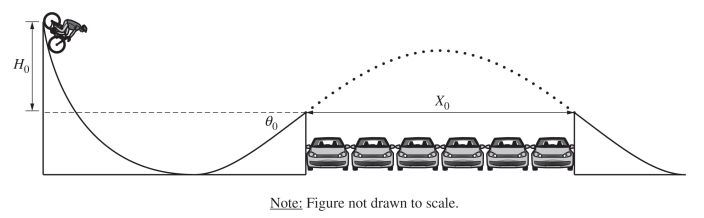
A stunt cyclist builds a ramp that will allow the cyclist to coast down the ramp and jump over several parked cars, as shown above. To test the ramp, the cyclist starts from rest at the top of the ramp, then leaves the ramp, jumps over six cars, and lands on a second ramp.
\(H_0\) is the vertical distance between the top of the first ramp and the launch point.
\(\theta_0\) is the angle of the ramp at the launch point from the horizontal.
\(X_0\) is the horizontal distance traveled while the cyclist and bicycle are in the air.
\(m_0\) is the combined mass of the stunt cyclist and bicycle.
(a) Derive an expression for the distance \(X_0\) in terms of \(H_0\), \(\theta_0\), \(m_0\), and physical constants, as appropriate.
(b) If the vertical distance between the top of the first ramp and the launch point were \(2H_0\) instead of \(H_0\), with no other changes to the first ramp, what is the maximum number of cars that the stunt cyclist could jump over? Justify your answer, using the expression you derived in part (a).
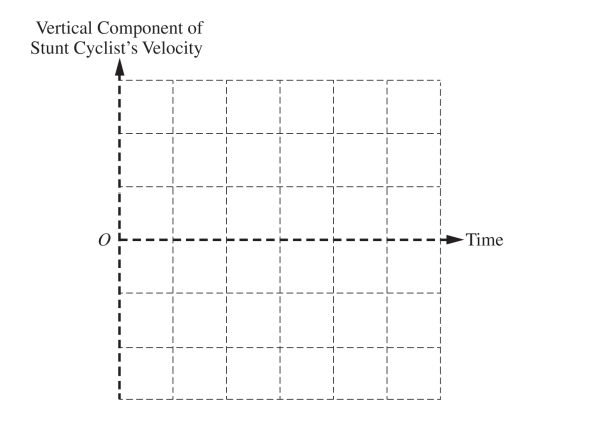
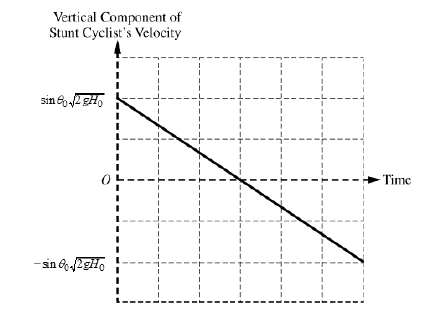
(c) On the axes below, sketch a graph of the vertical component of the stunt cyclist’s velocity as a function of time from immediately after the cyclist leaves the ramp to immediately before the cyclist lands on the second ramp. On the vertical axis, clearly indicate the initial and final vertical velocity components in terms of \(H_0\), \(\theta_0\), \(m_0\), and physical constants, as appropriate. Take the positive direction to be upward.

Most-appropriate topic codes (AP Physics \(1\)):

• Topic \(1.5\) — Vectors and Motion in Two Dimensions (Part \( \mathrm{(a)} \), Part \( \mathrm{(c)} \))
• Topic \(3.1\) — Translational Kinetic Energy (Part \( \mathrm{(a)} \), Part \( \mathrm{(b)} \))
• Topic \(3.3\) — Potential Energy (Part \( \mathrm{(a)} \), Part \( \mathrm{(b)} \))
• Topic \(3.4\) — Conservation of Energy (Part \( \mathrm{(a)} \), Part \( \mathrm{(b)} \))
▶️ Answer/Explanation

(a)
Use conservation of energy to find the speed of the cyclist at the launch point.

The cyclist starts from rest, so the loss in gravitational potential energy becomes kinetic energy:

\(m_0gH_0=\dfrac{1}{2}m_0v^2\)

The mass \(m_0\) cancels:

\(gH_0=\dfrac{1}{2}v^2\)

\(v=\sqrt{2gH_0}\)

The horizontal and vertical components of the launch velocity are

\(v_x=v\cos\theta_0=\sqrt{2gH_0}\cos\theta_0\)

\(v_y=v\sin\theta_0=\sqrt{2gH_0}\sin\theta_0\)

Since the cyclist lands at the same vertical height as the launch point, the total time in the air is

\(t=\dfrac{2v_y}{g}\)

\(t=\dfrac{2\sqrt{2gH_0}\sin\theta_0}{g}\)

The horizontal distance is

\(X_0=v_xt\)

\(X_0=\left(\sqrt{2gH_0}\cos\theta_0\right)\left(\dfrac{2\sqrt{2gH_0}\sin\theta_0}{g}\right)\)

\(X_0=4H_0\sin\theta_0\cos\theta_0\)

\(\boxed{X_0=4H_0\sin\theta_0\cos\theta_0}\)

Equivalently, using \(\sin(2\theta_0)=2\sin\theta_0\cos\theta_0\),

\(\boxed{X_0=2H_0\sin(2\theta_0)}\)

(b)
From part (a),

\(X_0=4H_0\sin\theta_0\cos\theta_0\)

The horizontal distance is directly proportional to \(H_0\). If the height becomes \(2H_0\), then the new horizontal distance becomes

\(X_{\text{new}}=4(2H_0)\sin\theta_0\cos\theta_0\)

\(X_{\text{new}}=2X_0\)

The original ramp allowed the cyclist to jump over \(6\) cars. Doubling the horizontal distance allows the cyclist to jump over

\(2(6)=12\text{ cars}\)

\(\boxed{12\text{ cars}}\)

(c)
The vertical component of velocity changes at a constant rate because the vertical acceleration is constant:

\(a_y=-g\)

Therefore, the graph of \(v_y\) versus time is a straight line with constant negative slope.

The initial vertical velocity is

\(v_{y,i}=v\sin\theta_0=\sqrt{2gH_0}\sin\theta_0\)

Since the cyclist lands at the same vertical height as the launch point, the final vertical velocity has the same magnitude but opposite sign:

\(v_{y,f}=-\sqrt{2gH_0}\sin\theta_0\)

So the graph should start at \(+\sqrt{2gH_0}\sin\theta_0\), decrease linearly with slope \(-g\), cross \(v_y=0\) at the top of the flight, and end at \(-\sqrt{2gH_0}\sin\theta_0\).

\(\boxed{v_{y,i}=+\sqrt{2gH_0}\sin\theta_0,\qquad v_{y,f}=-\sqrt{2gH_0}\sin\theta_0}\)

Question (12 points, suggested time 25 minutes)  – Out of syllabus

A group of students is investigating how the thickness of a plastic rod affects the maximum force Fmax with which the rod can be pulled without breaking. Two students are discussing models to represent how Fmax depends on rod thickness.
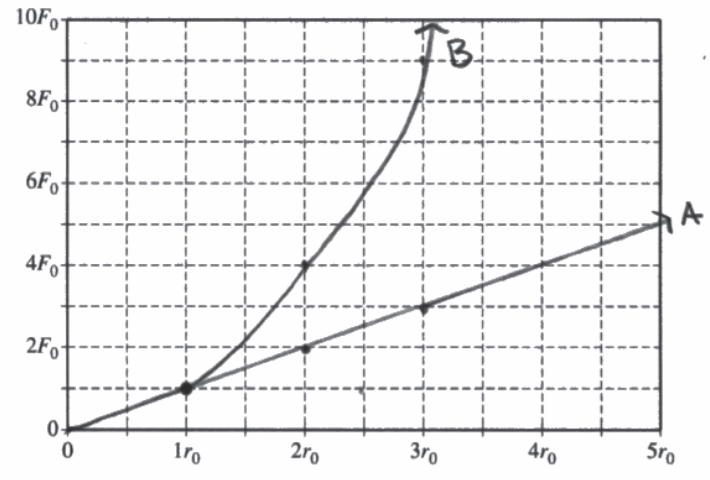
Student A claims that Fmax is directly proportional to the radius of the rod.
Student B claims that Fmax is directly proportional to the cross-sectional area of the rod—the area of the base of the cylinder, shaded gray in the figure above.
(a) The students have a collection of many rods of the same material. The rods are all the same length but come in a range of six different thicknesses. Design an experimental procedure to determine which student’s model,  if either, correctly represents how Fmax depends on rod thickness. In the table below, list the quantities that would be measured in your experiment. Define a symbol to represent each quantity, and also list the equipment that would be used to measure each quantity. You do not need to fill in every row. If you need additional rows, you may add them to the space just below the table.
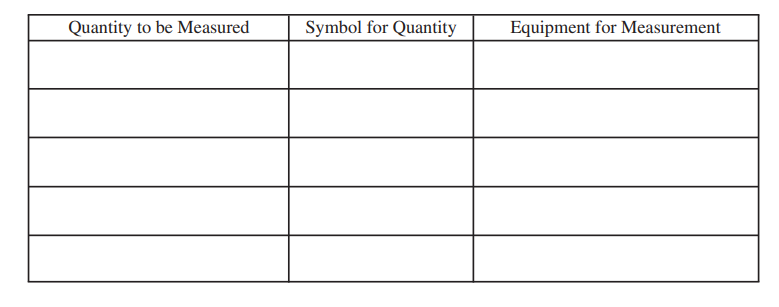
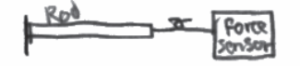
Describe the overall procedure to be used, referring to the table. Provide enough detail so that another student could replicate the experiment, including any steps necessary to reduce experimental uncertainty. As needed, use the symbols defined in the table and/or include a simple diagram of the setup.

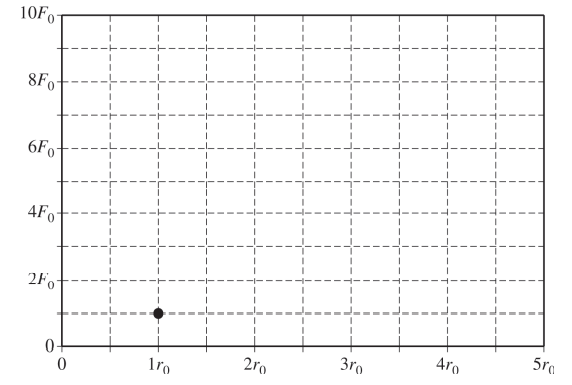
(b) For a rod of radius r0, it is determined that Fmax is F0, as indicated by the dot on the grid below. On the grid, draw and label graphs corresponding to the two students’ models of the dependence of Fmax on rod radius. Clearly label each graph “A” or “B,” corresponding to the appropriate model.
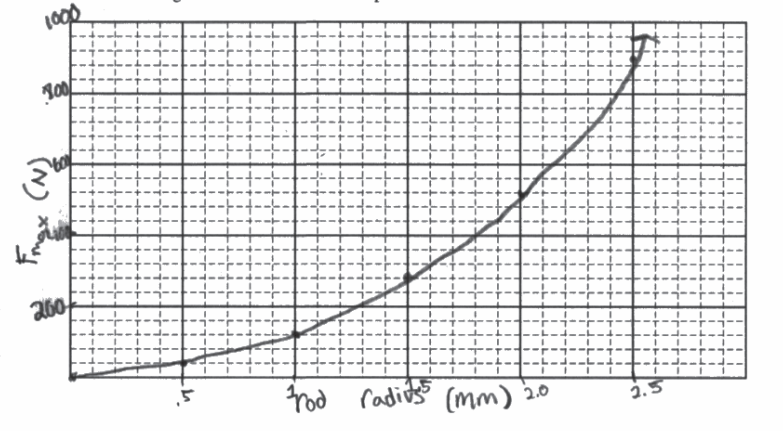
The table below shows results of measurements taken by another group of students for rods of different thicknesses.

(c) On the grid below, plot the data points from the table. Clearly scale and label all axes, including units. Draw either a straight line or a curve that best represents the data.

(d) Which student’s model is more closely represented by the evidence shown in the graph you drew in part (c) ?
____ Student A’s model: Fmax is directly proportional to the radius of the rod.
____ Student B’s model: Fmax is directly proportional to the cross-sectional area of the rod. Explain your reasoning.

Answer/Explanation

Ans:

(a)
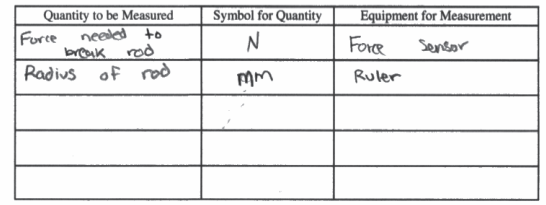
1)  Students would measure radius of rod and calevlate the cross section from this.

2)  Students would connect force sensor to one end of rod and pull until rod breaks. Record Nos. Repeat with rod of same thicknes,

3) Repeat steps I & Q with Rods of different material to reduce experimental uncertainty.

4) Students will then graph average N and r to Find the line of best Fit and analyze.
(b)
(c)
(d)

Student B claims Fmax is directly proportional r2. Fmax & r2 ‘s relationship would not be linear as shown in the graph.
Question 3

(a) A student of mass \(M_S\), standing on a smooth surface, uses a stick to push a disk of mass \(M_D\). The student exerts a constant horizontal force of magnitude \(F_H\) over the time interval from time \(t=0\) to \(t=t_f\) while pushing the disk. Assume there is negligible friction between the disk and the surface.
i. Assuming the disk begins at rest, determine an expression for the final speed \(v_D\) of the disk relative to the surface. Express your answer in terms of \(F_H\), \(t_f\), \(M_S\), \(M_D\), and physical constants, as appropriate.
ii. Assume there is negligible friction between the student’s shoes and the surface. After time \(t_f\), the student slides with speed \(v_S\). Derive an equation for the ratio \(v_D/v_S\). Express your answer in terms of \(M_S\), \(M_D\), and physical constants, as appropriate.
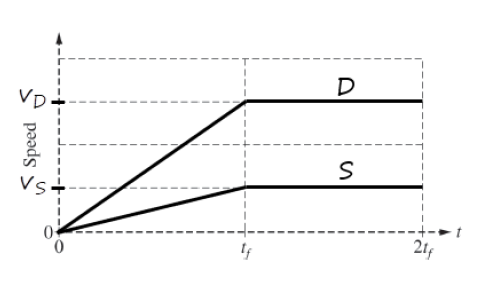
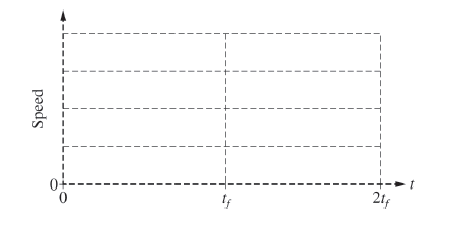
(b) Assume that the student’s mass is greater than that of the disk \(\left(M_S>M_D\right)\). On the grid below, sketch graphs of the speeds of both the student and the disk as functions of time from \(t=0\) and \(t=2t_f\). Assume that neither the disk nor the student collides with anything after \(t=t_f\). On the vertical axis, label \(v_D\) and \(v_S\). Label the graphs “S” and “D” for the student and the disk, respectively.
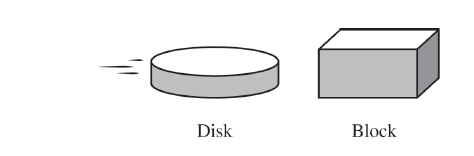
(c) The disk is now moving at a constant speed \(v_1\) on the surface toward a block of mass \(M_B\), which is at rest on the surface, as shown above. The disk and block collide head-on and stick together, and the center of mass of the disk-block system moves with speed \(v_{\text{cm}}\).
i. Suppose the mass of the disk is much greater than the mass of the block. Estimate the velocity of the center of mass of the disk-block system. Explain how you arrived at your prediction without deriving it mathematically.
ii. Suppose the mass of the disk is much less than the mass of the block. Estimate the velocity of the center of mass of the disk-block system. Explain how you arrived at your prediction without deriving it mathematically.
iii. Now suppose that neither object’s mass is much greater than the other but that they are not necessarily equal. Derive an equation for \(v_{\text{cm}}\). Express your answer in terms of \(v_1\), \(M_D\), \(M_B\), and physical constants, as appropriate.
iv. Consider the scenario from part (c)(i), where the mass of the disk was much greater than the mass of the block. Does your equation for \(v_{\text{cm}}\) from part (c)(iii) agree with your reasoning from part (c)(i)?
_____ Yes      _____ No
Explain your reasoning by addressing why, according to your equation, \(v_{\text{cm}}\) becomes or approaches a certain value when \(M_D\) is much greater than \(M_B\).

Most-appropriate topic codes (AP Physics \(1\)):

• Topic \(1.2\) — Displacement, Velocity, and Acceleration (Part \( \mathrm{(b)} \))
• Topic \(1.3\) — Representing Motion (Part \( \mathrm{(b)} \))
• Topic \(4.1\) — Linear Momentum (Part \( \mathrm{(a)} \), Part \( \mathrm{(c)} \))
• Topic \(4.2\) — Change in Momentum and Impulse (Part \( \mathrm{(a)} \))
• Topic \(4.3\) — Conservation of Linear Momentum (Part \( \mathrm{(a)(ii)} \), Part \( \mathrm{(c)} \))
• Topic \(4.4\) — Elastic and Inelastic Collisions (Part \( \mathrm{(c)} \))
▶️ Answer/Explanation

(a)(i)
The disk experiences a constant horizontal force \(F_H\) for a time \(t_f\). Use impulse-momentum:

\(J=\Delta p\)

\(F_Ht_f=M_Dv_D\)

Solve for \(v_D\):

\(\boxed{v_D=\dfrac{F_Ht_f}{M_D}}\)

(a)(ii)
With negligible friction, there is no external horizontal force on the student-disk system. Therefore, horizontal momentum is conserved.

The system starts from rest, so the initial total momentum is \(0\). After the push, the student and disk move in opposite directions.

Taking the disk’s direction as positive:

\(0=M_Dv_D-M_Sv_S\)

\(M_Dv_D=M_Sv_S\)

Divide both sides by \(M_Dv_S\):

\(\boxed{\dfrac{v_D}{v_S}=\dfrac{M_S}{M_D}}\)

Since \(M_S>M_D\), the disk has the larger speed.

(b)
From \(t=0\) to \(t=t_f\), both objects speed up from rest because the force is exerted during that time interval. Since the disk has smaller mass than the student, the disk’s speed increases more rapidly.

After \(t=t_f\), the push ends. With negligible friction and no collisions, both objects continue moving at constant speed.

Therefore, the graph for \(D\) should be a straight increasing line from \(0\) to \(v_D\) during \(0<t<t_f\), then horizontal from \(t_f\) to \(2t_f\). The graph for \(S\) should be a straight increasing line from \(0\) to \(v_S\), with a smaller slope, then horizontal. Since \(M_S>M_D\), \(v_D>v_S\).

\(\boxed{v_D>v_S}\)

(c)(i)
If the disk is much more massive than the block, the block has very little effect on the motion of the disk-block system. Most of the system’s mass is moving with the disk, so the center of mass moves at nearly the disk’s original speed.

\(\boxed{v_{\text{cm}}\approx v_1}\)

(c)(ii)
If the disk is much less massive than the block, most of the system’s mass is initially at rest. The small moving disk has little effect on the center of mass of the disk-block system, so the center of mass moves very slowly.

\(\boxed{v_{\text{cm}}\approx0}\)

(c)(iii)
The center-of-mass velocity is the total momentum of the system divided by the total mass.

Initially, the disk moves with speed \(v_1\), and the block is at rest. Therefore,

\(p_{\text{total}}=M_Dv_1+M_B\left(0\right)\)

\(p_{\text{total}}=M_Dv_1\)

The total mass is

\(M_D+M_B\)

Therefore,

\(v_{\text{cm}}=\dfrac{p_{\text{total}}}{M_D+M_B}\)

\(\boxed{v_{\text{cm}}=\dfrac{M_Dv_1}{M_D+M_B}}\)

This is also the speed of the stuck-together disk-block system immediately after the perfectly inelastic collision.

(c)(iv)
\(\boxed{\text{Yes}}\)

The equation from part (c)(iii) is

\(v_{\text{cm}}=\dfrac{M_Dv_1}{M_D+M_B}\)

If \(M_D\) is much greater than \(M_B\), then \(M_B\) is very small compared with \(M_D\). Therefore, the denominator approaches \(M_D\):

\(M_D+M_B\approx M_D\)

So

\(v_{\text{cm}}\approx\dfrac{M_Dv_1}{M_D}\)

\(\boxed{v_{\text{cm}}\approx v_1}\)

This agrees with the prediction in part (c)(i) that a very massive disk keeps the center of mass moving nearly at the disk’s original speed.

Question 4


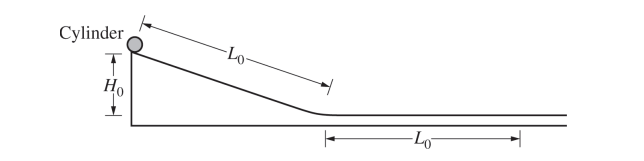
A cylinder of mass \(m_0\) is placed at the top of an incline of length \(L_0\) and height \(H_0\), as shown above, and released from rest. The cylinder rolls without slipping down the incline and then continues rolling along a horizontal surface.
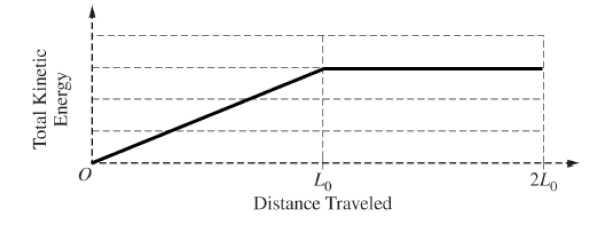
(a) On the grid below, sketch a graph that represents the total kinetic energy of the cylinder as a function of the distance traveled by the cylinder as it rolls down the incline and continues to roll across the horizontal surface.
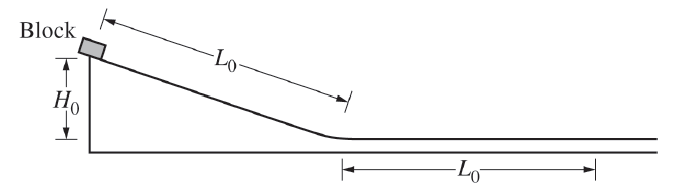
The cylinder is again placed at the top of the incline. A block, also of mass \(m_0\), is placed at the top of a separate rough incline of length \(L_0\) and height \(H_0\), as shown above. When the cylinder and block are released at the same time, the cylinder begins to roll without slipping while the block begins to accelerate uniformly. The cylinder and the block reach the bottoms of their respective inclines with the same translational speed.
(b) In terms of energy, explain why the two objects reach the bottom of their respective inclines with the same final translational speed. Provide your answer in a clear, coherent paragraph-length response that may also contain figures and/or equations.

Most-appropriate topic codes (AP Physics \(1\)):

• Topic \(3.1\) — Translational Kinetic Energy (Part \( \mathrm{(a)} \), Part \( \mathrm{(b)} \))
• Topic \(3.3\) — Potential Energy (Part \( \mathrm{(a)} \), Part \( \mathrm{(b)} \))
• Topic \(3.4\) — Conservation of Energy (Part \( \mathrm{(a)} \), Part \( \mathrm{(b)} \))
• Topic \(6.1\) — Rotational Kinetic Energy (Part \( \mathrm{(a)} \), Part \( \mathrm{(b)} \))
• Topic \(6.5\) — Rolling (Part \( \mathrm{(a)} \), Part \( \mathrm{(b)} \))
▶️ Answer/Explanation

(a)
As the cylinder rolls down the incline, gravitational potential energy is converted into total kinetic energy.

The total kinetic energy includes both translational and rotational kinetic energy:

\(K_{\text{total}}=K_{\text{trans}}+K_{\text{rot}}\)

Since the cylinder rolls without slipping and friction does not dissipate mechanical energy, the total kinetic energy gained is equal to the gravitational potential energy lost.

At the top, \(K_{\text{total}}=0\). At the bottom of the incline, after traveling distance \(L_0\), the cylinder has lost gravitational potential energy \(m_0gH_0\), so

\(K_{\text{total}}=m_0gH_0\)

Therefore, the graph should be a straight line increasing from \(0\) to \(m_0gH_0\) as the distance increases from \(0\) to \(L_0\). From \(L_0\) to \(2L_0\), the cylinder moves horizontally, so its height does not change and its total kinetic energy remains constant.

\(\boxed{\text{The graph rises linearly from }0\text{ to }m_0gH_0\text{, then remains horizontal.}}\)

(b)
Both objects start at the same height and have the same mass, so each object-Earth system starts with the same gravitational potential energy \(m_0gH_0\) available to be transformed into other forms of energy.

For the rolling cylinder, the decrease in gravitational potential energy becomes both translational kinetic energy and rotational kinetic energy:

\(m_0gH_0=K_{\text{trans,cyl}}+K_{\text{rot,cyl}}\)

For the block on the rough incline, the decrease in gravitational potential energy becomes translational kinetic energy plus thermal energy dissipated by friction:

\(m_0gH_0=K_{\text{trans,block}}+E_{\text{thermal}}\)

The cylinder and block reach the bottoms with the same translational speed because the energy not appearing as translational kinetic energy is the same amount in the two cases. For the cylinder, that energy is stored as rotational kinetic energy. For the block, that energy is dissipated by friction as thermal energy.

Since the remaining translational kinetic energies are equal,

\(K_{\text{trans,cyl}}=K_{\text{trans,block}}\)

and since both objects have the same mass \(m_0\),

\(\dfrac{1}{2}m_0v_{\text{cyl}}^2=\dfrac{1}{2}m_0v_{\text{block}}^2\)

Therefore,

\(\boxed{v_{\text{cyl}}=v_{\text{block}}}\)

In words, the cylinder’s “missing” translational kinetic energy is rotational kinetic energy, while the block’s “missing” translational kinetic energy is energy dissipated by friction. Because these amounts are equal, the two final translational speeds are equal.

Question 5

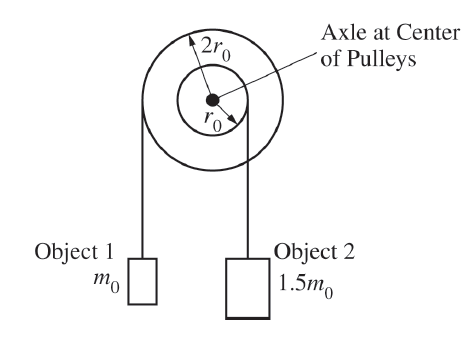
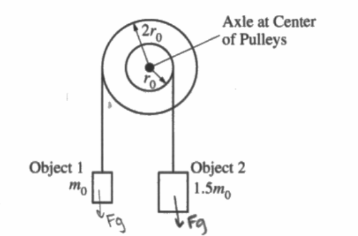
Two pulleys with different radii are attached to each other so that they rotate together about a horizontal axle through their common center. There is negligible friction in the axle. Object \(1\) hangs from a light string wrapped around the larger pulley, while object \(2\) hangs from another light string wrapped around the smaller pulley, as shown in the figure above.
\(m_0\) is the mass of object \(1\).
\(1.5m_0\) is the mass of object \(2\).
\(r_0\) is the radius of the smaller pulley.
\(2r_0\) is the radius of the larger pulley.
(a) At time \(t=0\), the pulleys are released from rest and the objects begin to accelerate.
i. Derive an expression for the magnitude of the net torque exerted on the objects-pulleys system about the axle after the pulleys are released. Express your answer in terms of \(m_0\), \(r_0\), and physical constants, as appropriate.
ii. Object \(1\) accelerates downward after the pulleys are released. Briefly explain why.
(b) At a later time \(t=t_c\), the string of object \(1\) is cut while the objects are still moving and the pulley is still rotating. Immediately after the string is cut, how do the directions of the angular velocity and angular acceleration of the pulley compare to each other?
_____ Same direction      _____ Opposite directions
Briefly explain your reasoning.
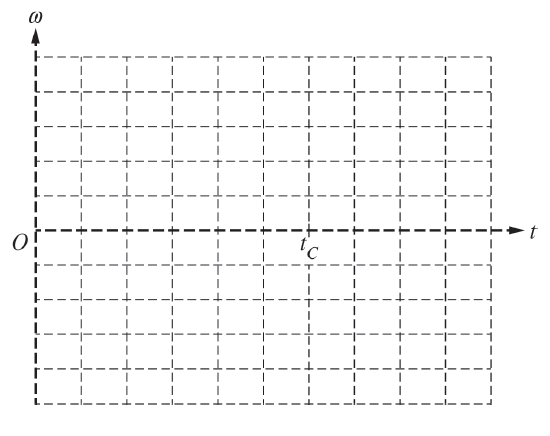
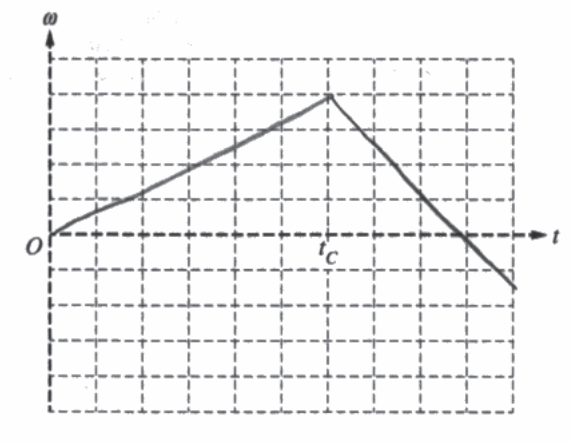
(c) On the axes below, sketch a graph of the angular velocity \(\omega\) of the system consisting of the two pulleys as a function of time \(t\). Include the entire time interval shown. The pulleys are released at \(t=0\), and the string is cut at \(t=t_c\).

Most-appropriate topic codes (AP Physics \(1\)):

• Topic \(5.1\) — Rotational Kinematics (Part \( \mathrm{(b)} \), Part \( \mathrm{(c)} \))
• Topic \(5.3\) — Torque (Part \( \mathrm{(a)} \), Part \( \mathrm{(b)} \))
• Topic \(5.6\) — Newton’s Second Law in Rotational Form (Part \( \mathrm{(a)} \), Part \( \mathrm{(b)} \), Part \( \mathrm{(c)} \))
▶️ Answer/Explanation

(a)(i)
The torque from each object is found using

\(\tau=rF\)

Object \(1\) has weight \(m_0g\) and acts at radius \(2r_0\), so its torque magnitude is

\(\tau_1=\left(2r_0\right)\left(m_0g\right)=2m_0gr_0\)

Object \(2\) has weight \(1.5m_0g\) and acts at radius \(r_0\), so its torque magnitude is

\(\tau_2=\left(r_0\right)\left(1.5m_0g\right)=1.5m_0gr_0\)

The two torques act in opposite rotational directions, so the net torque magnitude is

\(\tau_{\text{net}}=\tau_1-\tau_2\)

\(\tau_{\text{net}}=2m_0gr_0-1.5m_0gr_0\)

\(\tau_{\text{net}}=0.5m_0gr_0\)

\(\boxed{\tau_{\text{net}}=0.5m_0gr_0}\)

(a)(ii)
Object \(1\) accelerates downward because it creates the larger torque about the axle. Even though object \(2\) has the larger weight, object \(1\) acts at twice the radius.

The torque from object \(1\) is \(2m_0gr_0\), while the torque from object \(2\) is only \(1.5m_0gr_0\). Therefore, the net torque is in the direction that makes object \(1\) move downward.

(b)
\(\boxed{\text{Opposite directions}}\)

Before the string is cut, object \(1\) produces the larger torque, so the pulleys rotate in the direction that makes object \(1\) move downward.

Immediately after the string for object \(1\) is cut, only object \(2\) continues to exert a torque on the pulley system. That torque is in the opposite direction from the original net torque.

The pulley’s angular velocity does not change direction instantly, so it is still rotating in its original direction. However, the angular acceleration is now in the direction of object \(2\)’s torque. Thus, the angular velocity and angular acceleration are in opposite directions.

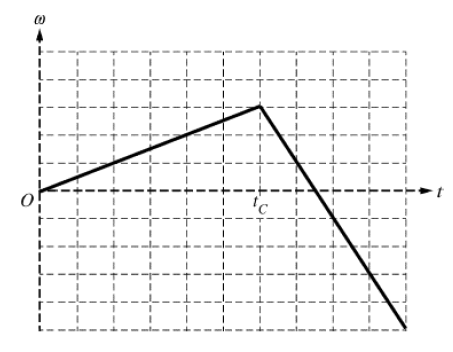
(c)
From \(t=0\) to \(t=t_c\), the net torque is constant, so the angular acceleration is constant. Since the pulleys start from rest, \(\omega\) increases linearly from zero.

At \(t=t_c\), the string of object \(1\) is cut. The pulley does not instantly stop, so \(\omega\) is continuous at \(t_c\). However, the net torque reverses direction, so the angular acceleration changes sign. Therefore, after \(t_c\), the slope of the \(\omega\)-versus-\(t\) graph becomes negative.

\(\boxed{\text{The graph rises linearly from }0\text{ to }t_c\text{, then changes to a negative slope with no discontinuity.}}\)

Question: (7 points, suggested time 13 minutes)
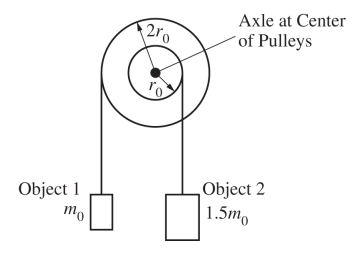
Two pulleys with different radii are attached to each other so that they rotate together about a horizontal axle through their common center. There is negligible friction in the axle. Object 1 hangs from a light string wrapped around the larger pulley, while object 2 hangs from another light string wrapped around the smaller pulley, as shown in the figure above.
m0 is the mass of object 1.
1.5m0 is the mass of object 2.
r0 is the radius of the smaller pulley.
2r0 is the radius of the larger pulley.
(a) At time t = 0, the pulleys are released from rest and the objects begin to accelerate.
i. Derive an expression for the magnitude of the net torque exerted on the objects-pulleys system about the axle after the pulleys are released. Express your answer in terms of m0, r0, and physical constants, as appropriate.

ii. Object 1 accelerates downward after the pulleys are released. Briefly explain why.

(b) At a later time t = tC, the string of object 1 is cut while the objects are still moving and the pulley is still rotating. Immediately after the string is cut, how do the directions of the angular velocity and angular acceleration of the pulley compare to each other?
________ Same direction __________ Opposite directions
Briefly explain your reasoning.

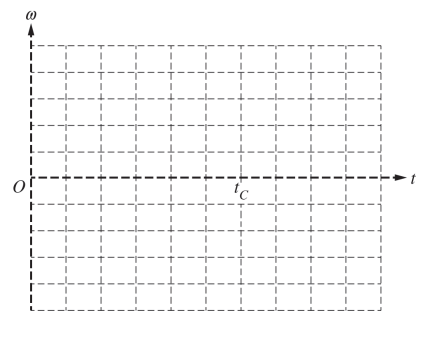
(c) On the axes below, sketch a graph of the angular velocity ω of the system consisting of the two pulleys as a function of time t. Include the entire time interval shown. The pulleys are released at t = 0, and the string is cut at t = tC.
Answer/Explanation

Ans:
(a) (i)

τ = Fx.r                                  \(\sum \imath = \imath _{Fg_{1}} – \imath _{Fg_{2}}\)

                                                \(\sum \imath = m_{0}g \left ( 2r_{0} \right ) – 1.5 m_{0}g(r_{0})\)

                                                 \(\sum \imath = 2m_{0}gr_{0} – 1.5 m_{0}gr_{0}\)

\(\sum \imath = \frac{1}{2} m_{0}gr_{0}\)

(ii)

Object 1 has a greater radius than object 2, and while object 2 has a greater mass, object 1’s radius is greater than object 2’s mass, so object 1 has a greater torque, so it accelerates downward.

(b) 

After the string is cut the pulley will begin to rotate it the opposite direction towards object 2 because of it’s mass, so both the angular velocity and acceleration would go in the same direction.

(c)
Scroll to Top