
Question 1
(ii) Does the least-squares regression line overestimate or underestimate the mass of the bullfrog identified in part (d-i)? Explain your answer.
Most-appropriate topic codes (AP Statistics):
• Topic \(5.3\) — Linear Regression Models (Parts \( \mathrm{b} \), \( \mathrm{c} \), \( \mathrm{d} \))
▶️ Answer/Explanation
(a)
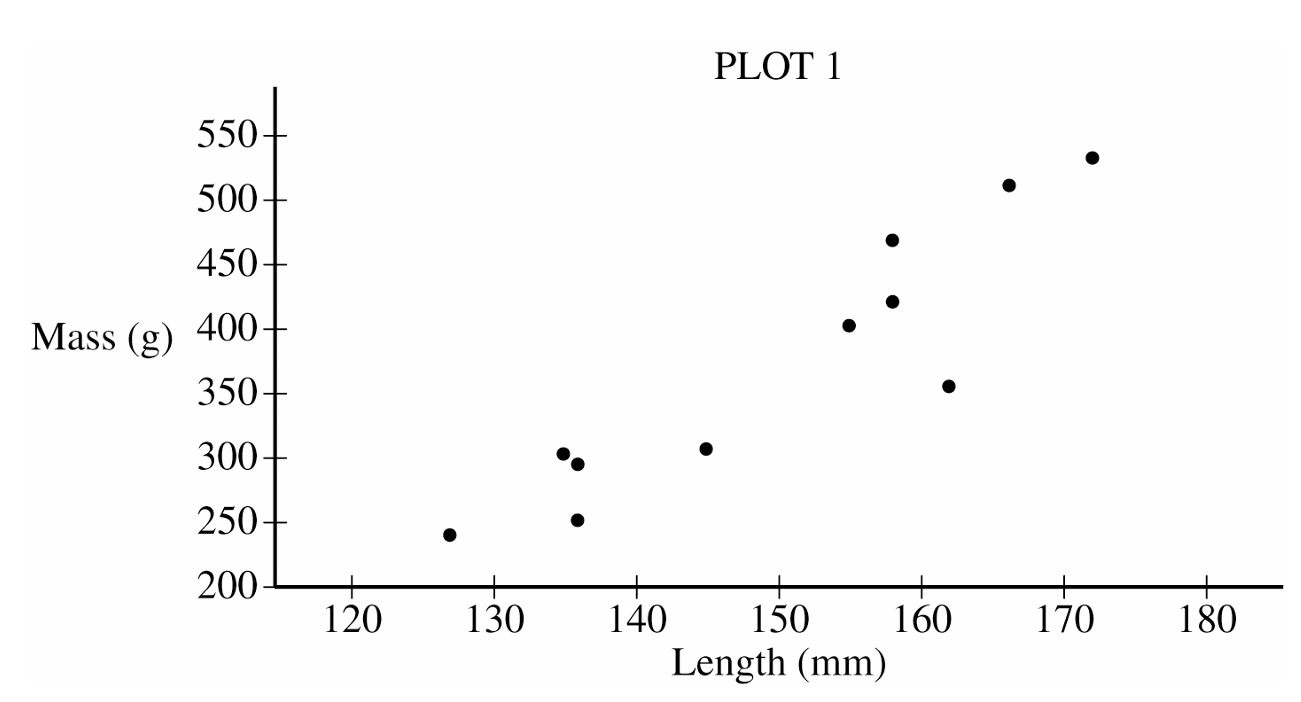
The scatterplot reveals a strong, positive, roughly linear association between the mass and length of bullfrogs. There are no points that seriously deviate from the straight-line pattern of the points in the plot.
(b)
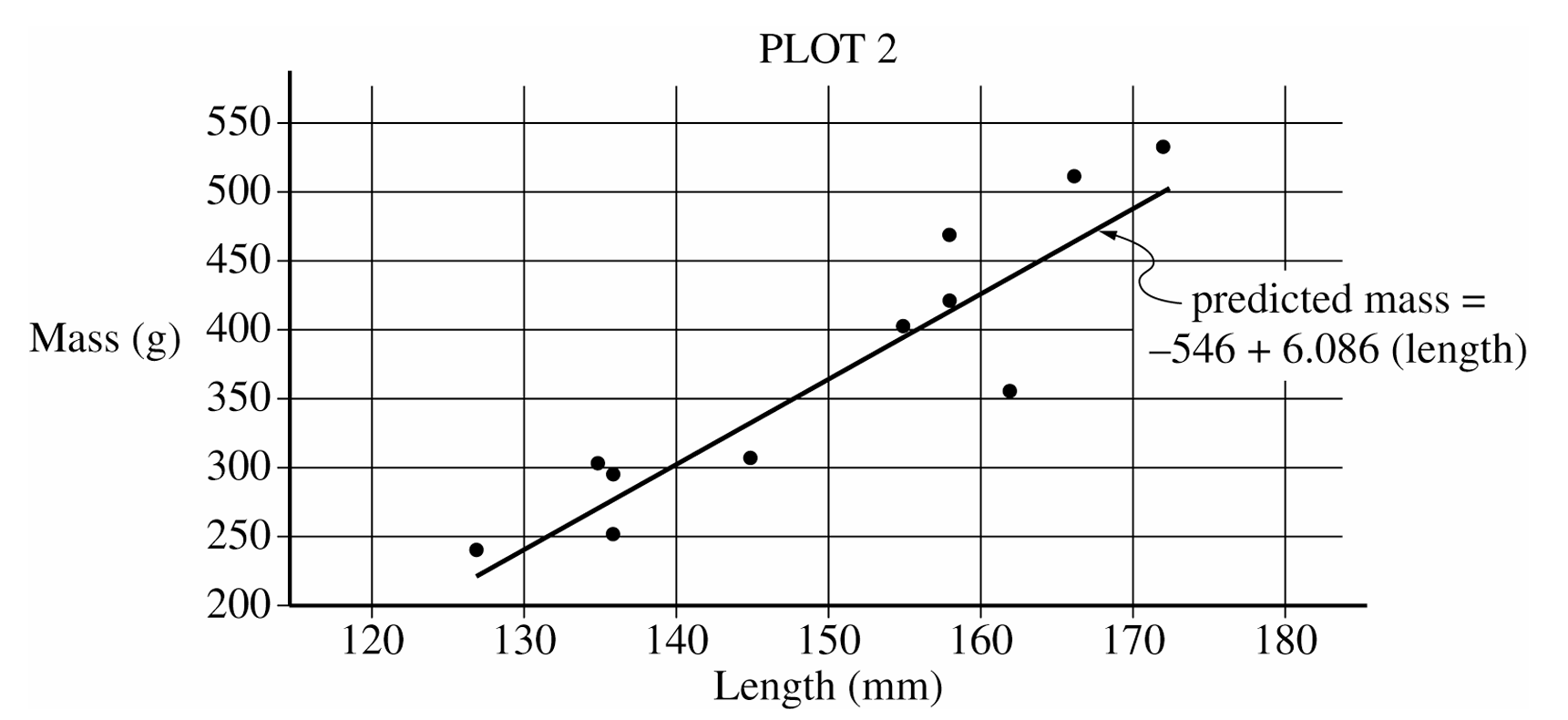
The value of the slope of the least-squares regression line is 6.086. This value indicates that the predicted mass of a bullfrog increases by 6.086 grams for each additional millimeter of length.
(c)
The coefficient of determination is $r^2 \approx 0.819$. This value indicates that 81.9% of the variation in bullfrog mass can be explained by variation in bullfrog length as described by the least-squares line.
(d)(i)
The largest residual in absolute value belongs to the bullfrog with length 162 mm and mass 356 grams.
(d)(ii)
The least-squares regression line overestimates the mass of the bullfrog with length 162 mm. Plot 2 shows that the point for the bullfrog with length 162 mm is below the least-squares regression line.
Question 2
• Experimental units:
• Response variable:
Most-appropriate topic codes (AP Statistics):
• Topic \(1.13\) — Experimental Design (Parts \( \mathrm{b} \), \( \mathrm{c} \))
▶️ Answer/Explanation
(a)
• Treatments: The new drug and the placebo.
• Experimental units: The 72 individual people (the 36 pairs of identical twins) participating in the experiment.
• Response variable: The improvement in acne severity, measured on a scale from 0 to 100.
(b)
A matched-pairs design controls for the variation in baseline acne severity and genetic/environmental factors among the subjects. Because identical twins share these traits, the difference in their acne improvement can be more directly attributed to the respective treatments rather than individual skin differences. This reduces the variability in the response and increases the statistical power to detect a true difference in effectiveness between the new drug and the placebo.
(c)
For each pair of identical twins, flip a fair coin. If the coin lands on heads, assign Twin A to receive the new drug and Twin B to receive the placebo. If the coin lands on tails, assign Twin A to receive the placebo and Twin B to receive the new drug. Repeat this random assignment process independently for all 36 pairs of twins.
Question 3
(ii) Determine the probability that a crate will be rejected by the warehouse manager. Show your work.
Most-appropriate topic codes (AP Statistics):
• Topic \(2.11\) — The Normal Distribution (Parts \( \mathrm{a} \), \( \mathrm{c} \))
▶️ Answer/Explanation
(a)
Let $A$ be the amount of shampoo in a bottle. We need to find $P(A < 0.50)$.
$z = \frac{0.50 – 0.60}{0.04} = -2.5$
$P(A < 0.50) = P(Z < -2.5) = 0.0062$
(b)(i)
Let $X$ represent the number of underfilled bottles in a randomly selected box of 10 bottles. Because each bottle’s volume is independent and has the same probability of being underfilled, the random variable $X$ has a binomial distribution with $n = 10$ trials and probability of success $p = 0.0062$.
(b)(ii)
The probability that a crate will be rejected is the probability of finding 2 or more underfilled bottles in a box: $P(X \ge 2)$.
$P(X \ge 2) = 1 – P(X \le 1) = 1 – [P(X = 0) + P(X = 1)]$
$P(X \ge 2) = 1 – \left[\binom{10}{0}(0.0062)^0(0.9938)^{10} + \binom{10}{1}(0.0062)^1(0.9938)^9\right]$
$P(X \ge 2) \approx 1 – [0.9397 + 0.0586] \approx 1 – 0.9983 = 0.0017$
(c)
Under the adjusted programming, the new mean is $0.56$ and the standard deviation is $0.03$. The new probability of a bottle being underfilled is:
$z = \frac{0.50 – 0.56}{0.03} = -2.0$
$P(Z < -2.0) \approx 0.02275$
Because the probability of an underfilled bottle is much greater for the adjusted programming ($0.0228$) than for the original programming ($0.0062$), the manufacturing company should keep the original programming. Using the adjusted settings would actually result in more underfilled bottles, thereby increasing the number of rejected crates.
Question 4
Most-appropriate topic codes (AP Statistics):
• Topic \(3.4\) — Justifying a Claim Based on a Confidence Interval for a Population Proportion (Part \( \mathrm{b} \))
▶️ Answer/Explanation
(a)
State: We will construct a one-sample z-interval for $p$, the true proportion of all teenagers in the United States who would respond that they use a video streaming service every day.
Plan:
• Random condition: The problem states that the data came from a “random sample.”
• 10% condition: $n = 920$, which is less than 10% of all teenagers in the United States.
• Large counts condition: The number of successes is $920(0.59) = 542.8 \ge 10$ and the number of failures is $920(0.41) = 377.2 \ge 10$. Both are at least 10, so the sampling distribution of $\hat{p}$ is approximately normal.
Do: The formula for the confidence interval is:
$ \hat{p} \pm z^* \sqrt{\frac{\hat{p}(1-\hat{p})}{n}} $
For a 95% confidence level, the critical value is $z^* = 1.96$. Substituting the values:
$ 0.59 \pm 1.96 \sqrt{\frac{0.59(0.41)}{920}} $
$ 0.59 \pm 1.96(0.0162) $
$ 0.59 \pm 0.0318 $
The 95% confidence interval is $(0.558, 0.622)$.
Conclude: We are 95% confident that the interval from 0.558 to 0.622 captures the true proportion of all teenagers in the United States who would respond that they use a video streaming service every day.
(b)
Yes, the sample data provide convincing statistical evidence that the true proportion is not 0.5.
Justification: The value 0.5 is not contained within the 95% confidence interval of $(0.558, 0.622)$ calculated in part (a). Because all plausible values in the confidence interval are strictly greater than 0.5, we have convincing evidence that the true proportion of teenagers who use a streaming service every day is different from 0.5.
Question 5


Most-appropriate topic codes (AP Statistics):
• Topic \(1.1\) — Introducing Statistics: Do the Data We Collected Match What We Expected? (Parts \( \mathrm{b} \), \( \mathrm{c} \))
▶️ Answer/Explanation
(a)
The median reduction in blood pressure for the dark chocolate group is 7 mmHg, and the median reduction in blood pressure for the white chocolate group is 0 mmHg. Therefore, the median reduction for the dark chocolate group is greater than the median reduction for the white chocolate group.
(b)
The researcher’s conclusion might not be true because the difference in sample means could simply be due to sampling variability (chance variation) arising from the random assignment of participants to the two groups. A difference of 5.66 mmHg can sometimes occur by chance even if the treatments are equally effective, so a statistical simulation or hypothesis test is necessary to determine if the result is statistically significant.
(c)
Yes, the results provide convincing statistical evidence. The observed difference in sample means is $6.08 – 0.42 = 5.66$ mmHg. According to the simulation dotplot, a simulated difference of 5.66 or greater occurred in only 3 of the 120 trials. The estimated p-value is $\frac{3}{120} = 0.025$. Because the p-value ($0.025$) is less than the significance level ($\alpha = 0.05$), we reject the null hypothesis and conclude there is convincing evidence that dark chocolate results in a greater reduction in blood pressure on average than white chocolate.
Question 6
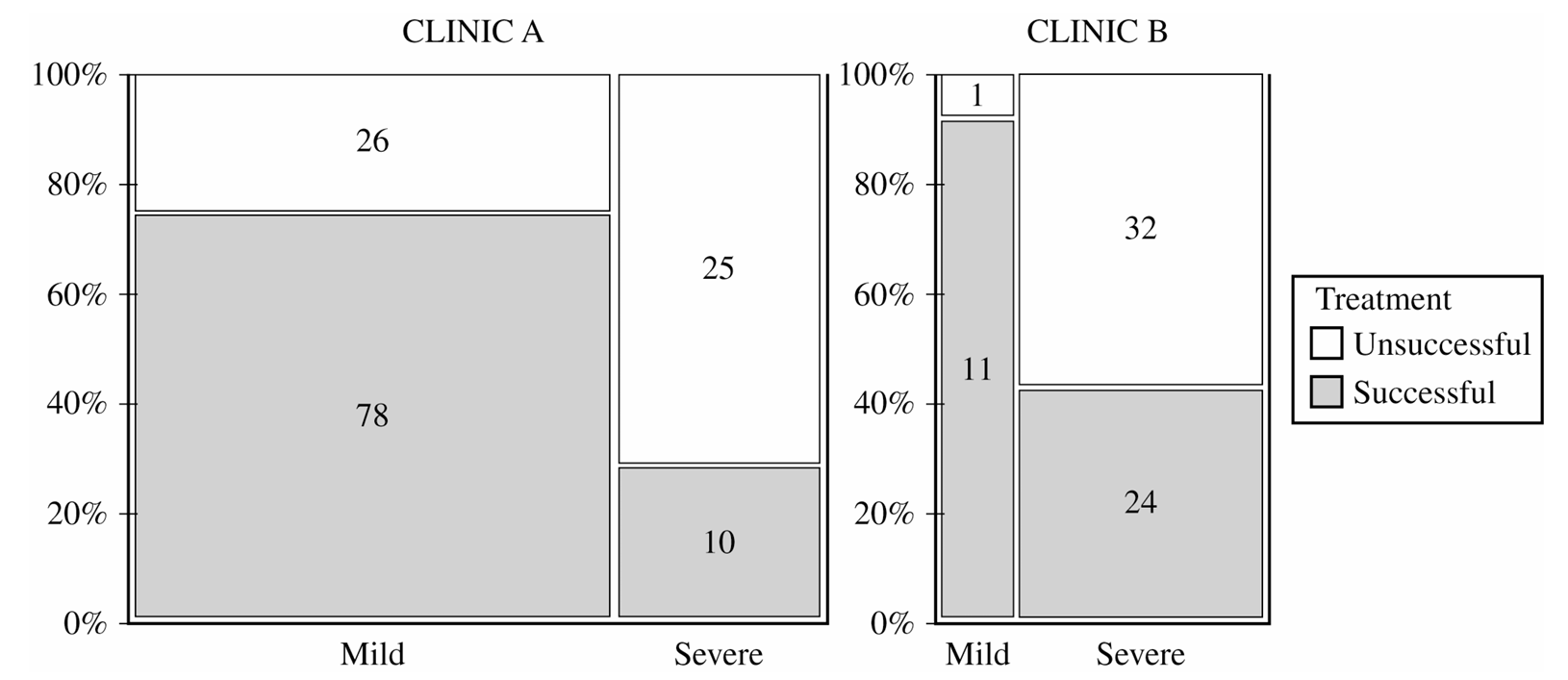
For mild allergy sufferers, Clinic B was more successful in treating allergies.
For severe allergy sufferers, Clinic B was more successful in treating allergies.
• Clinic B:
• Clinic B:
Most-appropriate topic codes (AP Statistics):
• Topic \(2.1\) — Tabular and Graphical Representations for the Distributions of Two Categorical Variables (Parts \( \mathrm{a}\), \( \mathrm{c} \))
• Topic \(2.2\) — Summary Statistics for Two Categorical Variables (Parts \( \mathrm{a} \), \( \mathrm{c} \), \( \mathrm{d} \))
▶️ Answer/Explanation
(a)(i)
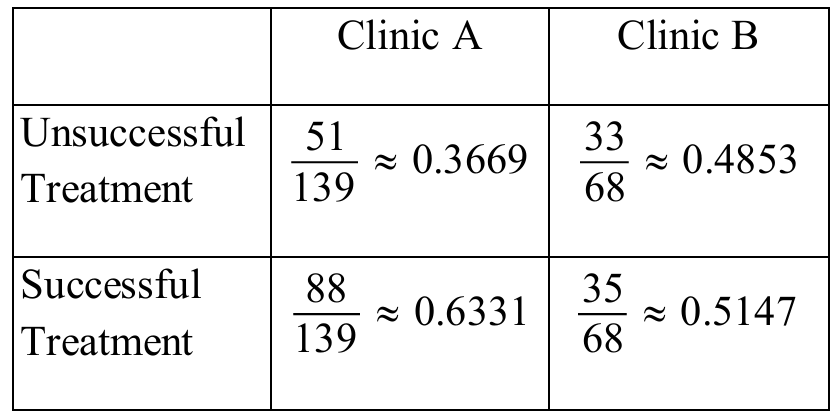
(a)(ii)
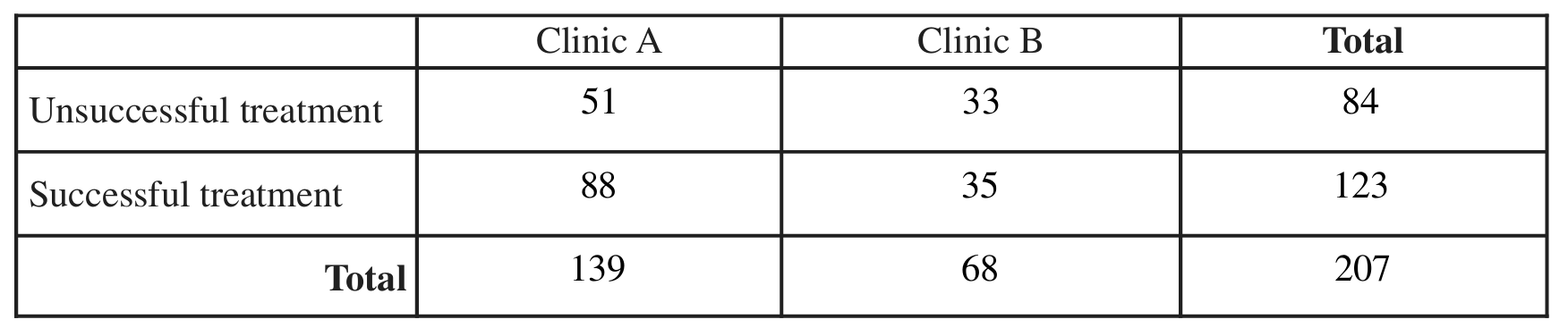
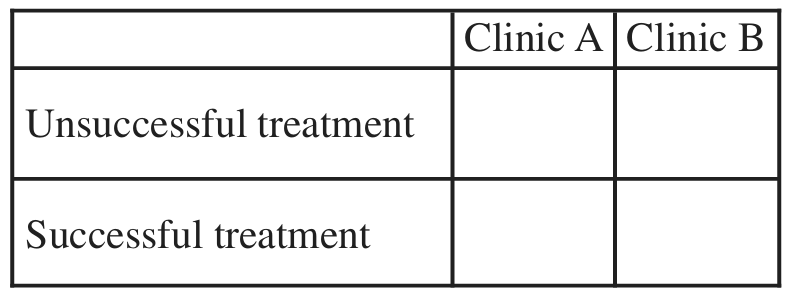
Clinic A is more successful. The relative frequency of successful treatments for Clinic A ($0.633$ or $63.3\%$) is greater than the relative frequency of successful treatments for Clinic B ($0.515$ or $51.5\%$).
(b)
No. The researchers selected random samples of patient records, which means this is an observational study, not a randomized experiment. Because patients were not randomly assigned to Clinic A or Clinic B, we cannot establish a cause-and-effect relationship due to the potential presence of confounding variables.
(c)(i)
• Clinic A: Mild allergies are treated more successfully. The success rate for mild is $78 / (78 + 26) = 75\%$, while the success rate for severe is $11 / (11 + 24) = 31.4\%$.
• Clinic B: Mild allergies are treated more successfully. The success rate for mild is $32 / (32 + 1) = 97\%$, while the success rate for severe is $10 / (10 + 25) = 28.6\%$.
(c)(ii)
• Clinic A: Mild allergies are more likely to be treated. Clinic A treated 104 mild cases ($78+26$) compared to only 35 severe cases ($11+24$).
• Clinic B: Severe allergies are more likely to be treated. Clinic B treated 35 severe cases ($10+25$) compared to only 33 mild cases ($32+1$).
(d)
The conclusion is different because of Simpson’s Paradox. Clinic A’s overall success rate is higher because it treats a much larger proportion of mild allergy cases, which naturally have a higher success rate regardless of the clinic. Conversely, Clinic B treats a higher proportion of severe cases, which brings its overall average down, even though it performs better than Clinic A within each specific severity group.