Home / ap24-frq-precalculus

Question 1

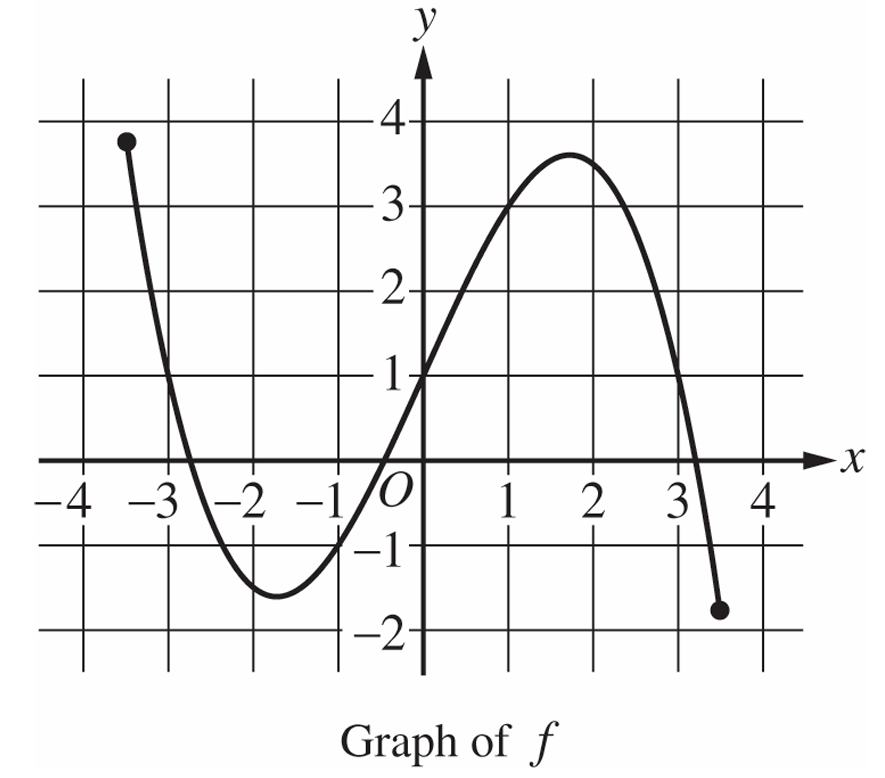
The figure shows the graph of the function \( f \) on its domain of \( -3.5 \le x \le 3.5 \). The points \( (-3,1) \), \( (0,1) \), and \( (3,1) \) are on the graph of \( f \). The function \( g \) is given by \( g(x)=2.916\cdot(0.7)^x \).
(A)
(i) The function \( h \) is defined by \( h(x)=(g\circ f)(x)=g(f(x)) \). Find the value of \( h(3) \) as a decimal approximation, or indicate that it is not defined.
(ii) Find all values of \( x \) for which \( f(x)=1 \), or indicate that there are no such values.
(B)
(i) Find all values of \( x \), as decimal approximations, for which \( g(x)=2 \), or indicate that there are no such values.
(ii) Determine the end behavior of \( g \) as \( x \) increases without bound. Express your answer using the mathematical notation of a limit.
(C)
(i) Determine if \( f \) has an inverse function.
(ii) Give a reason for your answer based on the definition of a function and the graph of \( y=f(x) \).

Most-appropriate topic codes (CED):

TOPIC 1.7: Composition of Functions — part (A)
TOPIC 2.3: Exponential Functions — part (B)
TOPIC 1.5: Inverse Functions — part (C)
▶️ Answer/Explanation
Concise solution

(A)(i)
From the graph, \( f(3)=1 \).
\( h(3)=g(f(3))=g(1)=2.916(0.7)=2.041 \).

(A)(ii)
From the graph, \( f(x)=1 \) at \( x=-3,0,3 \).

(B)(i)
\( 2.916(0.7)^x=2 \)
\( (0.7)^x=\frac{2}{2.916} \)
Taking logarithms,
\( x=\frac{\ln(\frac{2}{2.916})}{\ln(0.7)}\approx1.057 \).

(B)(ii)
Since \( 0.7<1 \), \( (0.7)^x \to 0 \) as \( x \to \infty \).
\( \lim_{x\to\infty} g(x)=0 \).

(C)
\( f \) does not have an inverse because it is not one-to-one.
For example, \( f(-3)=f(0)=f(3)=1 \).
Question 2

On the initial day of sales (\( t=0 \)) for a new video game, there were \( 40 \) thousand units of the game sold that day. Ninety-one days later (\( t=91 \)), there were \( 76 \) thousand units of the game sold that day. The number of units of the video game sold on a given day can be modeled by the function \( G(t)=\ln(a+bt+1) \), where \( G(t) \) is the number of units sold, in thousands, on day \( t \) since the initial day of sales.
(A)
(i) Use the given data to write two equations that can be used to find the values for constants \( a \) and \( b \) in the expression for \( G(t) \).
(ii) Find the values for \( a \) and \( b \) as decimal approximations.
(B)
(i) Use the given data to find the average rate of change of the number of units of the video game sold, in thousands per day, from \( t=0 \) to \( t=91 \) days. Express your answer as a decimal approximation. Show the computations that lead to your answer.
(ii) Use the average rate of change found in part (i) to estimate the number of units of the video game sold, in thousands, on day \( t=50 \). Show the work that leads to your answer.
(iii) Let \( A_t \) represent the estimate of the number of units of the video game sold, in thousands, using the average rate of change found in part (i). For \( A_{50} \), found in part (ii), it can be shown that \( A_{50} < G(50) \). Explain why, in general, \( A_t < G(t) \) for all \( 0<t<91 \).
(C)
The makers of the video game reported that daily sales of the video game decreased each day after \( t=91 \). Explain why the error in the model \( G \) increases after \( t=91 \).

Most-appropriate topic codes (CED):

TOPIC 2.11: Logarithmic Models — part (A)
TOPIC 1.2: Average Rate of Change — part (B)
TOPIC 1.4: Function Behavior — part (C)
▶️ Answer/Explanation
Concise solution

(A)(i)
\( G(0)=\ln(a+1)=40 \)
\( G(91)=\ln(a+91b+1)=76 \)

(A)(ii)
From \( \ln(a+1)=40 \Rightarrow a+1=e^{40} \).
From \( \ln(a+91b+1)=76 \Rightarrow a+91b+1=e^{76} \).
Subtracting gives \( 91b=e^{76}-e^{40} \Rightarrow b=\frac{e^{76}-e^{40}}{91} \).

(B)(i)
Average rate of change \(=\frac{76-40}{91}=\frac{36}{91}\approx0.396 \).

(B)(ii)
\( A_{50}=40+0.396(50)=59.8 \).

(B)(iii)
\( G(t) \) is increasing and concave down, so the secant line from \( t=0 \) to \( t=91 \) lies below the graph for \( 0<t<91 \).

(C)
After \( t=91 \), actual sales decrease while the model \( G \) continues to increase, so the difference between actual values and model values grows.

Question 3

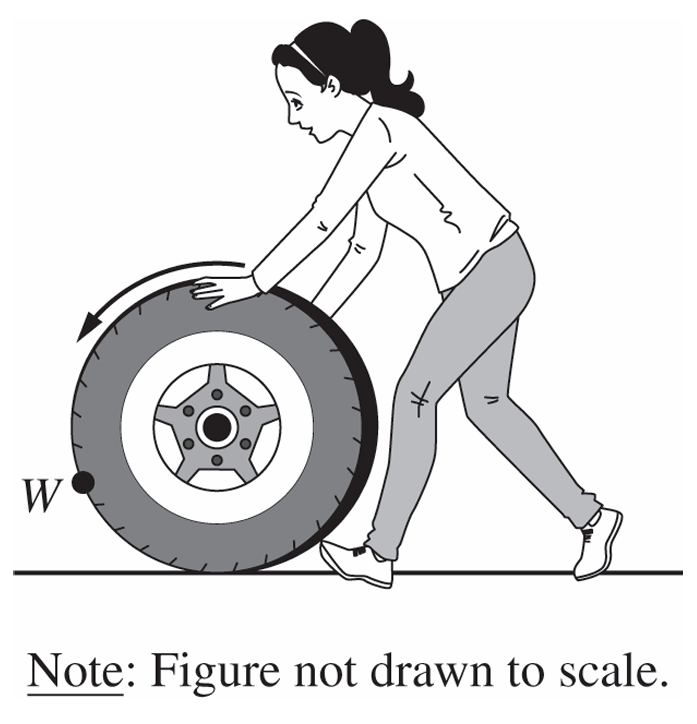
The tire of a car has a radius of \(9\) inches, and a person rolls the tire forward at a constant rate on level ground, as shown in the figure. Point \(W\) on the edge of the tire touches the ground at time \(t=\frac{1}{2}\) second. The tire completes a full rotation, and the next time \(W\) touches the ground is at time \(t=\frac{5}{2}\) seconds. The maximum height of \(W\) above the ground is \(18\) inches. As the tire rolls, the height of \(W\) above the ground periodically increases and decreases.
The sinusoidal function \(h\) models the height of point \(W\) above the ground, in inches, as a function of time \(t\), in seconds.
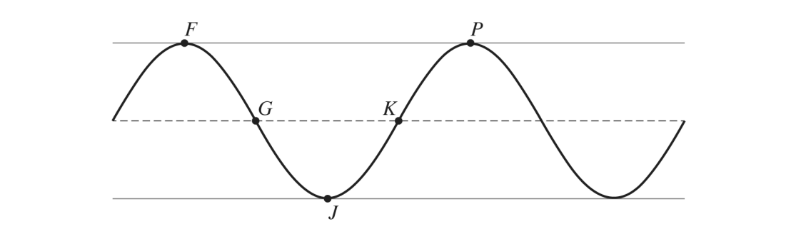
(A) The graph of \(h\) and its dashed midline for two full cycles is shown. Five points, \(F\), \(G\), \(J\), \(K\), and \(P\), are labeled on the graph. No scale is indicated, and no axes are presented. Determine possible coordinates \((t,h(t))\) for the five points: \(F\), \(G\), \(J\), \(K\), and \(P\).
(B) The function \(h\) can be written in the form \(h(t)=a\sin(b(t+c))+d\). Find values of constants \(a\), \(b\), \(c\), and \(d\).
(C) Refer to the graph of \(h\) in part (A). The \(t\)-coordinate of \(K\) is \(t_1\), and the \(t\)-coordinate of \(P\) is \(t_2\).
(i) On the interval \((t_1,t_2)\), which of the following is true about \(h\)?
a. \(h\) is positive and increasing.
b. \(h\) is positive and decreasing.
c. \(h\) is negative and increasing.
d. \(h\) is negative and decreasing.
(ii) Describe how the rate of change of \(h\) is changing on the interval \((t_1,t_2)\).

Most-appropriate topic codes (CED):

TOPIC 3.5: Sinusoidal Graphs — part (A)
TOPIC 3.6: Sinusoidal Models — part (B)
TOPIC 3.3: Rates of Change — part (C)
▶️ Answer/Explanation
Concise solution

(A)
Radius \(=9\Rightarrow\) minimum height \(=0\), maximum height \(=18\).
Midline \(=\frac{18+0}{2}=9\).
Ground contacts at \(t=\frac{1}{2}\) and \(t=\frac{5}{2}\Rightarrow\) period \(=2\).
One valid set of points (consistent with the graph):
\(F\!\left(1,18\right)\), \(G\!\left(\frac{3}{2},9\right)\), \(J\!\left(2,0\right)\), \(K\!\left(\frac{5}{2},9\right)\), \(P\!\left(3,18\right)\).

(B)
Amplitude \(a=9\).
Period \(=2\Rightarrow b=\frac{2\pi}{2}=\pi\).
Midline \(d=9\).
Minimum at \(t=\frac{1}{2}\Rightarrow c=-\frac{1}{2}\).
\(h(t)=9\sin\!\left(\pi\left(t-\frac{1}{2}\right)\right)+9\).

(C)
(i) On \((t_1,t_2)\), \(h\) is positive and increasing \(\Rightarrow\) choice (a).
(ii) As the graph approaches a maximum, the slope decreases; the rate of change is decreasing.
Question 4

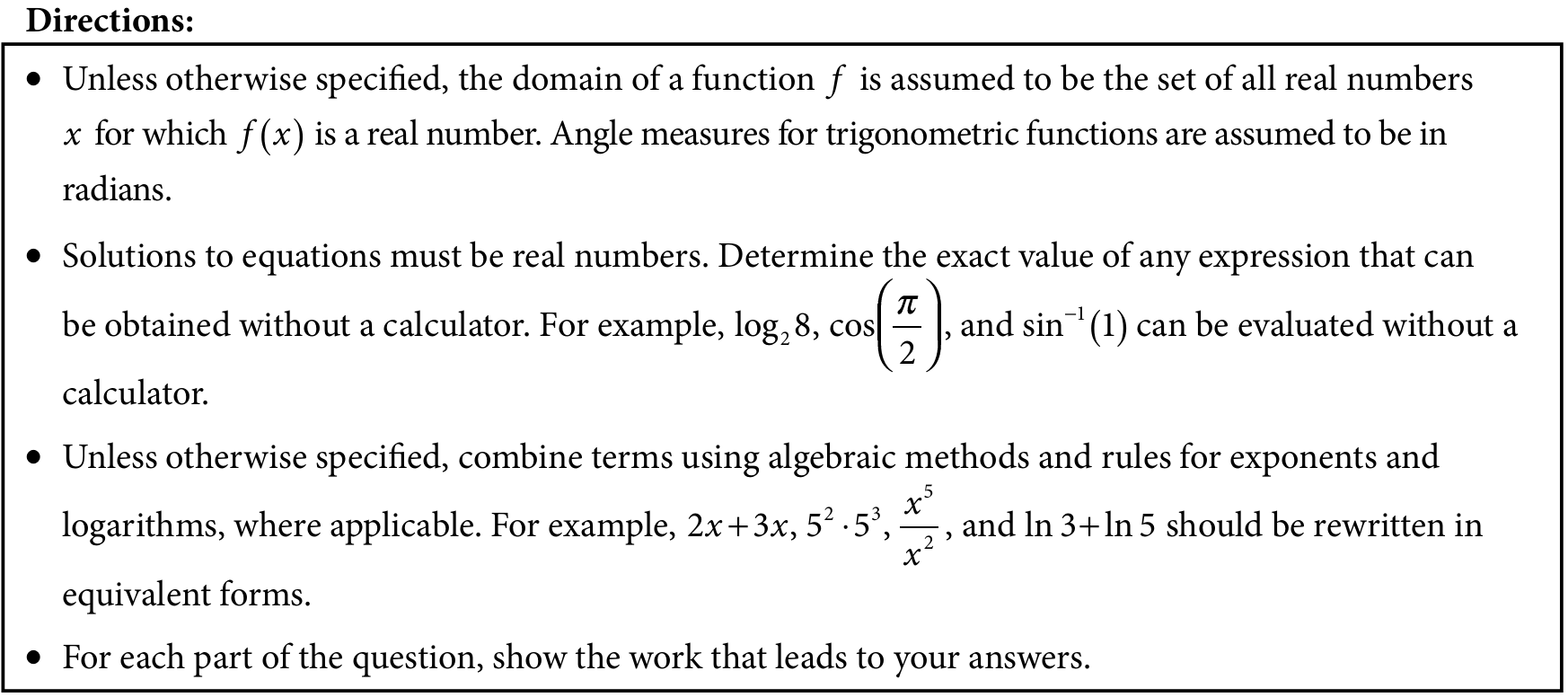
Directions:
• Unless otherwise specified, the domain of a function \(f\) is assumed to be the set of all real numbers \(x\) for which \(f(x)\) is a real number. Angle measures for trigonometric functions are assumed to be in radians.
• Solutions to equations must be real numbers. Determine the exact value of any expression that can be obtained without a calculator.
• Unless otherwise specified, combine terms using algebraic methods and rules for exponents and logarithms, where applicable.
• For each part of the question, show the work that leads to your answers.
(A) The functions \(g\) and \(h\) are given by
\( g(x)=e^{2x} \)
\( h(x)=\arcsin(x+3) \).
(i) Solve \( g(x)=10 \) for values of \(x\) in the domain of \(g\).
(ii) Solve \( h(x)=\frac{\pi}{4} \) for values of \(x\) in the domain of \(h\).
(B) The functions \(j\) and \(k\) are given by
\( j(x)=\log_{10}(8)+\log_{10}(x^9)-\log_{10}(2x^3) \)
\( k(x)=\dfrac{\sin x}{\sec x} \).
(i) Rewrite \( j(x) \) as a single logarithm base \(10\) without negative exponents.
(ii) Rewrite \( k(x) \) as a single term involving \( \tan x \).
(C) The function \(m\) is given by
\( m(x)=\cos(\tan(2x-1)) \).
Find all values in the domain of \(m\) that yield an output value of \(0\).

Most-appropriate topic codes (CED):

TOPIC 2.8: Inverse Trigonometric Functions — part (A)
TOPIC 2.9: Logarithmic Properties — part (B)
TOPIC 3.10: Trigonometric Equations — part (C)
▶️ Answer/Explanation
Concise solution

(A)(i)
\( e^{2x}=10 \)
\( 2x=\ln(10) \)
\( x=\frac{1}{2}\ln(10) \).

(A)(ii)
\( \arcsin(x+3)=\frac{\pi}{4} \)
\( x+3=\sin\!\left(\frac{\pi}{4}\right)=\frac{\sqrt{2}}{2} \)
\( x=\frac{\sqrt{2}}{2}-3 \).

(B)(i)
\( j(x)=\log_{10}\!\left(\frac{8x^9}{2x^3}\right) \)
\( =\log_{10}(4x^6) \).

(B)(ii)
\( k(x)=\frac{\sin x}{\sec x}=\sin x\cos x \)
\( =\frac{\sin x}{\cos x}\cos^2 x=\tan x \).

(C)
\( \cos(\tan(2x-1))=0 \)
\( \tan(2x-1)=\frac{\pi}{2}+k\pi \)
\( 2x-1=\arctan\!\left(\frac{\pi}{2}+k\pi\right) \), where defined.

Scroll to Top