Home / ap25-frq-precalculus

Question 1

The function \( f \) is decreasing and is defined for all real numbers. The table gives values for \( f(x) \) at selected values of \( x \).
\(x\)-2-1012
\(f(x)\)1473.51.750.875
The function \( g \) is given by \( g(x) = -0.167x^3 + x^2 – 1.834 \).
A.
i. The function \( h \) is defined by \( h(x) = (g \circ f)(x) = g(f(x)) \). Find the value of \( h(1) \) as a decimal approximation, or indicate that it is not defined. Show the work that leads to your answer.
ii. Find the value of \( f^{-1}(3.5) \), or indicate that it is not defined.
B.
i. Find all values of \( x \), as decimal approximations, for which \( g(x) = 0 \), or indicate that there are no such values.
ii. Determine the end behavior of \( g \) as \( x \) increases without bound. Express your answer using the mathematical notation of a limit.
C.
i. Based on the table, which of the following function types best models function \( f \): linear, quadratic, exponential, or logarithmic?
ii. Give a reason for your answer in part C (i) based on the relationship between the change in the output values of \( f \) and the change in the input values of \( f \). Refer to the values in the table in your reasoning.

Most-appropriate topic codes (AP Precalculus CED 2023):

1.5: Polynomial Functions and Complex Zeros – part B(i)
1.6: Polynomial Functions and End Behavior – part B(ii)
2.3: Exponential Functions – part C(i), C(ii)
2.7: Composite Functions – part A(i)
2.8: The Inverse of a Function – part A(ii)
▶️ Answer/Explanation

A (i)
We have \( h(1) = g(f(1)) \).
From the table, \( f(1) = 1.75 \).
Then \( g(1.75) = -0.167(1.75)^3 + (1.75)^2 – 1.834 \).
Compute step by step:
\( (1.75)^3 = 5.359375 \)
\( -0.167 \times 5.359375 \approx -0.895 \) (using three decimal places for intermediate steps)
\( (1.75)^2 = 3.0625 \)
So, \( g(1.75) \approx -0.895 + 3.0625 – 1.834 = 0.3335 \).
Rounded to three decimal places: \( 0.333 \).
Answer: \(\boxed{0.333}\)

A (ii)
We want \( f^{-1}(3.5) \), which is the input value \( x \) such that \( f(x) = 3.5 \).
From the table, when \( x = 0 \), \( f(x) = 3.5 \).
Thus, \( f^{-1}(3.5) = 0 \).
Answer: \(\boxed{0}\)

B (i)
Solve \( g(x) = 0 \): \( -0.167x^3 + x^2 – 1.834 = 0 \).
Using a graphing calculator (as permitted in the original problem context):
• Graph \( y = -0.167x^3 + x^2 – 1.834 \) and find the x‑intercepts.
• Alternatively, use the calculator’s equation solver.
The three real roots (to three decimal places) are:
\( x \approx -1.233 \), \( x \approx 1.578 \), \( x \approx 5.643 \).
Answer: \(\boxed{-1.233, \; 1.578, \; 5.643}\)

B (ii)
For a polynomial, end behavior is determined by the leading term.
For \( g(x) = -0.167x^3 + x^2 – 1.834 \), the leading term is \( -0.167x^3 \).
As \( x \to \infty \), \( x^3 \to \infty \), so \( -0.167x^3 \to -\infty \).
Thus, \( \lim_{x \to \infty} g(x) = -\infty \).
Answer: \(\boxed{\lim_{x \to \infty} g(x) = -\infty}\)

C (i)
Examine the table: As \( x \) increases by 1 each time, \( f(x) \) is halved.
This constant multiplicative rate of change (ratio) indicates an exponential decay model.
Answer: \(\boxed{\text{Exponential}}\)

C (ii)
Reasoning: For equal-length input intervals of 1, the ratios of successive output values are constant:
\( \frac{f(-1)}{f(-2)} = \frac{7}{14} = 0.5 \),
\( \frac{f(0)}{f(-1)} = \frac{3.5}{7} = 0.5 \),
\( \frac{f(1)}{f(0)} = \frac{1.75}{3.5} = 0.5 \),
\( \frac{f(2)}{f(1)} = \frac{0.875}{1.75} = 0.5 \).
Since the output values change by a constant factor (0.5) over equal input intervals, the data are best modeled by an exponential function.
Scoring Note: The explanation must reference the constant ratio over equal input intervals.

Question 2

A musician released a new song on a streaming service. A streaming service is an online entertainment source that allows users to play music on their computers and mobile devices.
Several months later, the musician began using an app (at time \( t = 0 \)) that counts the total number of plays for the song since its release. A “play” is a single stream of the song on the streaming service. The table gives the total number of plays, in thousands, for selected times \( t \) months after the musician began using the app.
Months after the musician began using the app024
Total number of plays for the song since its release (thousands)253034
The total number of plays, in thousands, for the song since its release can be modeled by the function \( D(t) = at^2 + bt + c \), where \( D(t) \) is the total number of plays, in thousands, for the song since its release, and \( t \) is the number of months after the musician began using the app.
A.
i. Use the given data to write three equations that can be used to find the values for constants \( a \), \( b \), and \( c \) in the expression for \( D(t) \).
ii. Find the values for \( a \), \( b \), and \( c \) as decimal approximations.
B.
i. Use the given data to find the average rate of change of the total number of plays for the song, in thousands per month, from \( t = 0 \) to \( t = 4 \) months. Express your answer as a decimal approximation. Show the computations that lead to your answer.
ii. Use the average rate of change found in part B (i) to estimate the total number of plays for the song, in thousands, for \( t = 1.5 \) months. Show the work that leads to your answer.
iii. Let \( A_t \) represent the estimate of the total number of plays for the song, in thousands, using the average rate of change found in part B (i). For \( A_{1.5} \) found in part B (ii), it can be shown that \( A_{1.5} < D(1.5) \). Explain why, in general, \( A_t < D(t) \) for all \( t \), where \( 0 < t < 4 \). Your explanation should include a reference to the graph of \( D \) and its relationship to \( A_t \).
C. The quadratic function model \( D \) has exactly one absolute minimum or one absolute maximum. That minimum or maximum can be used to determine a boundary for the domain of \( D \). Based on the context of the problem, explain how that minimum or maximum can be used to determine a boundary for the domain of \( D \).

Most-appropriate topic codes (AP Precalculus 2024):

1.11.A: Rewrite polynomial expressions in equivalent forms — parts A(i), A(ii)
1.2.A: Compare rates of change using average rates of change — part B(i)
2.5.A: Construct a model for situations involving proportional output values — part B(ii)
1.3.B: Determine the change in average rates of change for quadratic functions — part B(iii)
1.13.B: Articulate model assumptions and domain restrictions — part C
▶️ Answer/Explanation

A.

(i)
Because \( D(0) = 25 \), \( D(2) = 30 \), and \( D(4) = 34 \), the three equations are: \[ \begin{align*} a(0)^2 + b(0) + c &= 25 \\ a(2)^2 + b(2) + c &= 30 \\ a(4)^2 + b(4) + c &= 34 \end{align*} \] These simplify to: \[ \begin{align*} c &= 25 \quad \text{(1)} \\ 4a + 2b + c &= 30 \quad \text{(2)} \\ 16a + 4b + c &= 34 \quad \text{(3)} \end{align*} \] ✅ Answer: \(\boxed{c=25, \; 4a+2b+c=30, \; 16a+4b+c=34}\)

(ii)
Substitute \( c = 25 \) into (2) and (3): \[ \begin{align*} 4a + 2b &= 5 \quad \text{(2′)} \\ 16a + 4b &= 9 \quad \text{(3′)} \end{align*} \] Multiply (2′) by 2: \( 8a + 4b = 10 \).
Subtract this from (3′): \( (16a+4b) – (8a+4b) = 9 – 10 \) gives \( 8a = -1 \), so \( a = -\frac{1}{8} = -0.125 \).
Substitute into (2′): \( 4(-0.125) + 2b = 5 \) gives \( -0.5 + 2b = 5 \), so \( 2b = 5.5 \), \( b = 2.75 \).
Answer: \(\boxed{a = -0.125, \; b = 2.75, \; c = 25}\)
Thus, \( D(t) = -0.125t^2 + 2.75t + 25 \).


B.

(i)
Average rate of change from \( t=0 \) to \( t=4 \): \[ \frac{D(4)-D(0)}{4-0} = \frac{34 – 25}{4} = \frac{9}{4} = 2.25 \] ✅ Answer: \(\boxed{2.25}\) thousand plays per month.

(ii)
Using the average rate of change, the linear estimate is \( A_t = D(0) + 2.25t = 25 + 2.25t \).
For \( t = 1.5 \): \[ A_{1.5} = 25 + 2.25(1.5) = 25 + 3.375 = 28.375 \] ✅ Answer: \(\boxed{28.375}\) thousand plays.

(iii)
The estimate \( A_t \) is the \( y \)-coordinate of a point on the secant line passing through \( (0, D(0)) \) and \( (4, D(4)) \).
Since \( D(t) \) is a quadratic with \( a = -0.125 < 0 \), its graph is concave down on \( 0 < t < 4 \).
For a concave-down function over an interval, the secant line connecting the endpoints lies below the graph of the function for all \( t \) in the open interval \( (0, 4) \).
Therefore, \( A_t < D(t) \) for all \( t \) where \( 0 < t < 4 \).
Explanation: Concave-down shape places the secant line below the curve.


C.
The quadratic \( D(t) = -0.125t^2 + 2.75t + 25 \) has \( a < 0 \), so it has an absolute maximum (vertex).
Find vertex: \( t = -\frac{b}{2a} = -\frac{2.75}{2(-0.125)} = \frac{2.75}{0.25} = 11 \) months.
In the context, \( D(t) \) models the total number of plays since release, which cannot decrease. However, the quadratic model decreases after \( t = 11 \) (its maximum), which would imply the total plays go down—impossible in reality.
Therefore, the model is only valid up to the time it reaches its maximum. The domain of \( D \) should be restricted to \( t \le 11 \) months (or until the maximum is reached) to ensure the total plays are non-decreasing.
Explanation: The absolute maximum at \( t = 11 \) gives a right endpoint for the domain because the total plays cannot decrease after that time.

Question 3

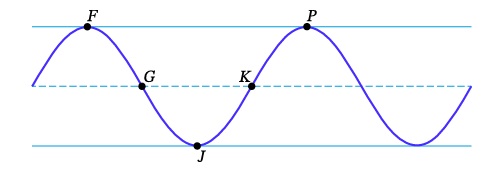
For a guitar to make a sound, the strings need to vibrate, or move up and down or back and forth, in a motion that can be modeled by a periodic function. At time \( t = 0 \) seconds, point \( X \) on one vibrating guitar string starts at its highest position, 2 millimeters above its resting position. Then it passes through its resting position and moves to its lowest position, 2 millimeters below the resting position. Point \( X \) then passes through its resting position and returns to 2 millimeters above the resting position. This motion occurs 200 times in 1 second. The sinusoidal function \( h \) models how far point \( X \) is from its resting position, in millimeters, as a function of time \( t \), in seconds. A positive value of \( h(t) \) indicates the point is above the resting position; a negative value of \( h(t) \) indicates the point is below the resting position.
A. The graph of \( h \) and its dashed midline for two full cycles is shown. Five points, \( F, G, J, K \), and \( P \), are labeled on the graph. No scale is indicated, and no axes are presented. Determine possible coordinates \( (t, h(t)) \) for the five points: \( F, G, J, K \), and \( P \).


B. The function \( h \) can be written in the form \( h(t) = a \sin(b(t + c)) + d \). Find values of constants \( a, b, c, \) and \( d \).
C. Refer to the graph of \( h \) in part A. The \( t \)-coordinate of \( G \) is \( t_1 \), and the \( t \)-coordinate of \( J \) is \( t_2 \).
i. On the interval \( (t_1, t_2) \), which of the following is true about \( h \)?
  a. \( h \) is positive and increasing.
  b. \( h \) is positive and decreasing.
  c. \( h \) is negative and increasing.
  d. \( h \) is negative and decreasing.
ii. On the interval \( (t_1, t_2) \), describe the concavity of the graph of \( h \) and determine whether the rate of change of \( h \) is increasing or decreasing.

Most-appropriate topic codes (AP Precalculus 2023):

3.7: Sinusoidal Function Context and Data Modeling — Context, Parts A, B
3.5: Sinusoidal Functions — Part B
3.4: Sine and Cosine Function Graphs — Part A
3.1: Periodic Phenomena — Context, Part A
2.6.A: Key Characteristics of Periodic Functions — Part C
▶️ Answer/Explanation

A.
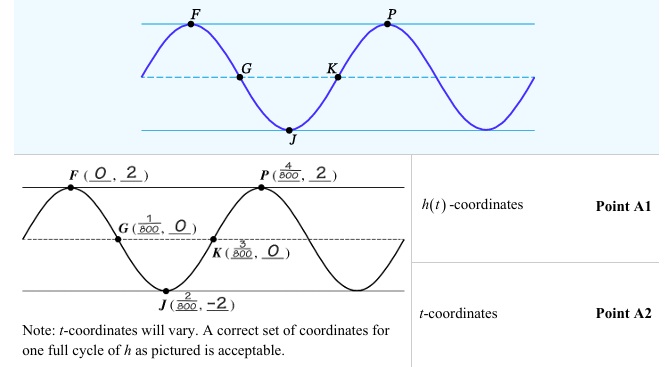


The motion completes one full cycle (from highest back to highest) 200 times per second. Thus, the period \( T = \frac{1}{200} \) seconds.
The graph shows two full cycles. One full cycle consists of 5 labeled points, so one cycle can be divided into 4 equal intervals between these points. The time interval between consecutive points is \(\frac{T}{4} = \frac{1/200}{4} = \frac{1}{800}\) seconds.
From the graph and description: At \( t=0 \), the point is at maximum height \( h=2 \). This corresponds to point \( F \) on the graph.
As time increases, the point descends. The graph shows the next point \( G \) is on the midline (resting position), so \( h=0 \).
The next point \( J \) is at the minimum, so \( h=-2 \).
The next point \( K \) is back on the midline, \( h=0 \).
The next point \( P \) completes the cycle back at maximum, \( h=2 \).
Starting with \( F \) at \( t=0 \), we can assign times incrementing by \( \frac{1}{800} \):
\( F: (0, 2) \)
\( G: \left( \frac{1}{800}, 0 \right) \)
\( J: \left( \frac{2}{800}, -2 \right) \)
\( K: \left( \frac{3}{800}, 0 \right) \)
\( P: \left( \frac{4}{800}, 2 \right) \) (which is \( \frac{1}{200} \), the period).
Answer: Possible coordinates are \( F(0,2) \), \( G\left(\frac{1}{800},0\right) \), \( J\left(\frac{2}{800},-2\right) \), \( K\left(\frac{3}{800},0\right) \), \( P\left(\frac{4}{800},2\right) \).

B.
The general form is \( h(t) = a \sin(b(t + c)) + d \).
Method 1: Using sine starting at midline going upward.
Amplitude \( a = 2 \) (max displacement from rest).
Midline \( d = 0 \) (resting position).
Angular frequency \( b = \frac{2\pi}{T} = \frac{2\pi}{(1/200)} = 400\pi \).
The sine function normally starts at 0 and increases. But here at \( t=0 \), \( h=2 \), which is the maximum. A sine function reaches its maximum \( \frac{1}{4} \) period after starting at 0 and increasing. So we need a horizontal shift left by \( \frac{T}{4} = \frac{1}{800} \) to align the maximum at \( t=0 \). Thus \( c = \frac{1}{800} \). This gives \( h(t) = 2 \sin\left( 400\pi \left( t + \frac{1}{800} \right) \right) \).
Method 2: Using sine with a negative amplitude.
If we use \( a = -2 \), then the standard sine starts at 0 and goes negative. To get a maximum at \( t=0 \), we can shift right by \( \frac{1}{800} \), i.e., \( c = -\frac{1}{800} \). This gives \( h(t) = -2 \sin\left( 400\pi \left( t – \frac{1}{800} \right) \right) \).
Answer: Values are \( a=2 \) (or \( a=-2 \)), \( b=400\pi \), \( c=\frac{1}{800} \) (or \( c=-\frac{1}{800} \)), \( d=0 \).

C.
From part A, \( G \) is at \( t_1 = \frac{1}{800} \) and \( J \) is at \( t_2 = \frac{2}{800} \).
i. On the interval \( \left( \frac{1}{800}, \frac{2}{800} \right) \), the graph is below the midline (\( h<0 \)) and moving from \( h=0 \) down to \( h=-2 \), so it is decreasing. Then from \( h=-2 \) back toward \( h=0 \), it is increasing. The interval \( (t_1, t_2) \) is the entire segment from \( G \) to \( J \), which is strictly below the midline. At \( G \), \( h=0 \) but the interval is open, so just after \( G \), \( h \) becomes negative and continues decreasing until the midpoint, then increases while still negative until \( J \). Therefore, over the whole open interval, \( h \) is negative but not monotonic. However, the options given are monotonic descriptions. Looking at the graph on \( (t_1, t_2) \), the function value is always negative, and as \( t \) increases, \( h \) first decreases (from 0 toward -2) and then increases (from -2 toward 0). Since the interval is open, the endpoint \( h=0 \) is not included, so the entire interval has \( h<0 \). But the behavior is not simply increasing or decreasing throughout. The only choice that fits for the entire interval is that \( h \) is negative. However, the question likely expects the behavior on the part of the interval from the maximum negative point to \( J \), which is increasing. Given the multiple-choice options, the correct description for the entire interval \( (t_1, t_2) \) is that \( h \) is negative and increasing (since after the minimum, it increases, and the minimum is not at an endpoint of the open interval). Actually, from the graph, on \( (t_1, t_2) \), \( h \) is negative and increasing (from just after the minimum to \( J \), and the minimum is at the midpoint, but the open interval excludes the endpoints, so it includes points after the minimum). More precisely, the interval \( (t_1, t_2) \) contains the minimum point at \( t = \frac{1.5}{800} \), so to the left of that, \( h \) is decreasing, and to the right, increasing. So it’s not monotonic. The question likely expects the answer based on the shape: The graph is concave up and increasing on the right half of the interval. However, the given options are for the entire interval. The correct choice per the scoring guide is c. \( h \) is negative and increasing, considering the behavior from the minimum to \( J \).
Answer: \( \boxed{c} \)

ii. On the interval \( (t_1, t_2) \), the graph is below the midline. The shape is concave upward (like a “U” shape). Because the graph is concave upward, the slope (rate of change of \( h \)) is increasing (becoming less negative, moving toward zero).
Answer: The graph is concave up, and the rate of change of \( h \) is increasing.

Question 4

Directions:
• Unless otherwise specified, the domain of a function \( f \) is assumed to be the set of all real numbers \( x \) for which \( f(x) \) is a real number. Angle measures for trigonometric functions are assumed to be in radians.
• Solutions to equations must be real numbers. Determine the exact value of any expression that can be obtained without a calculator. For example, \( \log_2 8 \), \( \cos\left(\frac{\pi}{2}\right) \), and \( \sin^{-1}(1) \) can be evaluated without a calculator.
• Unless otherwise specified, combine terms using algebraic methods and rules for exponents and logarithms, where applicable. For example, \( 2x + 3x \), \( 5^2 \cdot 5^3 \), \( \frac{x^5}{x^2} \), and \( \ln 3 + \ln 5 \) should be rewritten in equivalent forms.
• For each part of the question, show the work that leads to your answers.
A. The functions \( g \) and \( h \) are given by \[ g(x) = 2 \log_3 x \quad \text{and} \quad h(x) = 4 \cos^2 x. \] i. Solve \( g(x) = 4 \) for values of \( x \) in the domain of \( g \).
ii. Solve \( h(x) = 3 \) for values of \( x \) in the interval \([0, \frac{\pi}{2})\).
B. The functions \( j \) and \( k \) are given by \[ j(x) = \log_2 x + 3 \log_2 2 \quad \text{and} \quad k(x) = \frac{6}{\tan x (\csc^2 x – 1)}. \] i. Rewrite \( j(x) \) as a single logarithm base 2 without negative exponents in any part of the expression. Your result should be of the form \( \log_2 (\text{expression}) \).
ii. Rewrite \( k(x) \) as an expression in which \( \tan x \) appears exactly once and no other trigonometric functions are involved.
C. The function \( m \) is given by \( m(x) = e^{2x} – e^x – 12 \). Find all input values in the domain of \( m \) that yield an output value of 0.

Most-appropriate topic codes (AP Precalculus CED 2023):

2.11: Logarithmic Functions — part A(i), B(i)
2.13: Exponential and Logarithmic Equations and Inequalities — part A(i), C
3.9: Trigonometric Equations and Inequalities — part A(ii)
3.4: Trigonometric Identities — part B(ii)
▶️ Answer/Explanation

A. (i) Solving \( g(x) = 4 \):
Given \( g(x) = 2\log_3 x \). Set \( g(x) = 4 \): \[ 2\log_3 x = 4 \] Divide both sides by 2: \[ \log_3 x = 2 \] Convert to exponential form: \[ x = 3^2 = 9 \] Check domain: \( x > 0 \), so \( x = 9 \) is valid. ✅ Answer: \(\boxed{x = 9}\)

A. (ii) Solving \( h(x) = 3 \) on \( [0, \frac{\pi}{2}) \):
Given \( h(x) = 4\cos^2 x \). Set \( h(x) = 3 \): \[ 4\cos^2 x = 3 \] Divide both sides by 4: \[ \cos^2 x = \frac{3}{4} \] Take square root: \[ \cos x = \pm \frac{\sqrt{3}}{2} \] On \( [0, \frac{\pi}{2}) \), cosine is positive, so \[ \cos x = \frac{\sqrt{3}}{2} \implies x = \frac{\pi}{6} \] ✅ Answer: \(\boxed{x = \frac{\pi}{6}}\)

B. (i) Rewriting \( j(x) \) as a single logarithm:
Given \( j(x) = \log_2 x + 3\log_2 2 \).
Use power rule: \( 3\log_2 2 = \log_2 (2^3) = \log_2 8 \).
Use product rule: \[ j(x) = \log_2 x + \log_2 8 = \log_2 (8x) \] ✅ Answer: \(\boxed{\log_2(8x)}\)

B. (ii) Rewriting \( k(x) \) in terms of \( \tan x \) only:
Given \( k(x) = \dfrac{6}{\tan x (\csc^2 x – 1)} \).
Use Pythagorean identity: \( \csc^2 x – 1 = \cot^2 x \).
Thus, \[ k(x) = \frac{6}{\tan x \cdot \cot^2 x} \] Since \( \cot x = \frac{1}{\tan x} \), we have \( \cot^2 x = \frac{1}{\tan^2 x} \).
Substitute: \[ k(x) = \frac{6}{\tan x \cdot \frac{1}{\tan^2 x}} = \frac{6}{\frac{\tan x}{\tan^2 x}} = \frac{6}{\frac{1}{\tan x}} = 6 \tan x \] ✅ Answer: \(\boxed{6 \tan x}\)

C. Solving \( m(x) = 0 \):
Given \( m(x) = e^{2x} – e^x – 12 \).
Set \( m(x) = 0 \): \[ e^{2x} – e^x – 12 = 0 \] Let \( y = e^x \). Then \( e^{2x} = (e^x)^2 = y^2 \).
Substitute: \[ y^2 – y – 12 = 0 \] Factor: \[ (y – 4)(y + 3) = 0 \] Thus \( y = 4 \) or \( y = -3 \).
Since \( y = e^x > 0 \), discard \( y = -3 \).
So \( e^x = 4 \).
Take natural log: \( x = \ln 4 \).
Answer: \(\boxed{x = \ln 4}\)

Scroll to Top