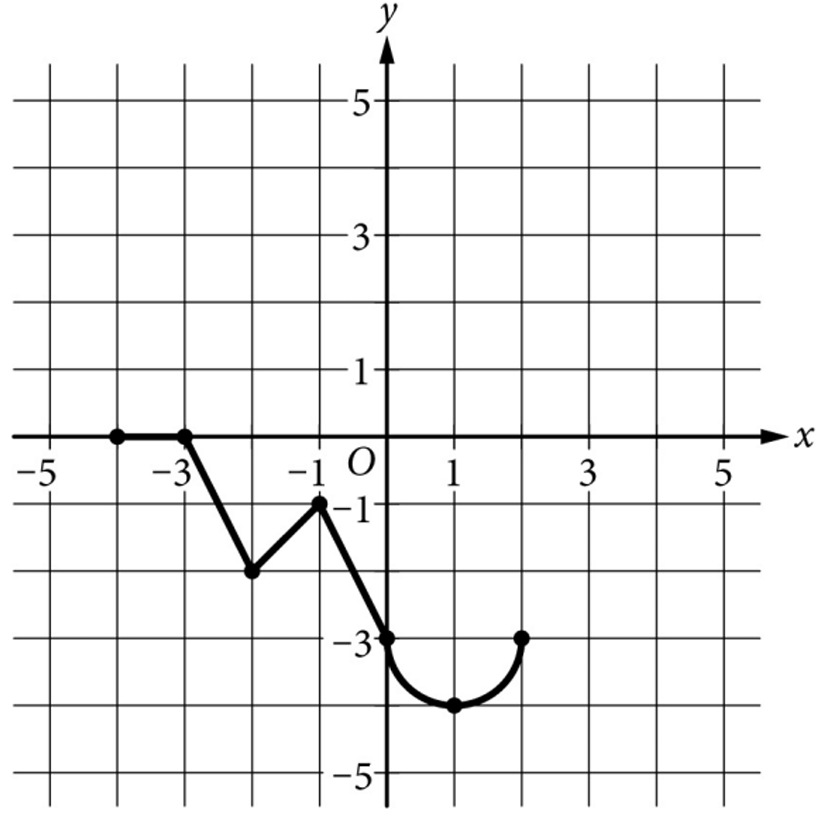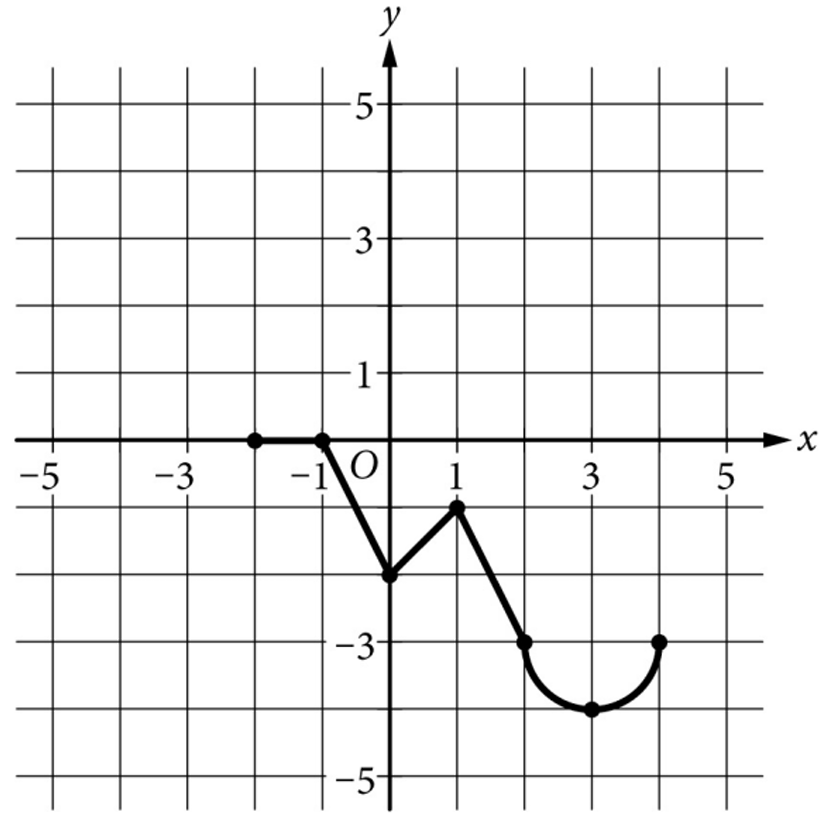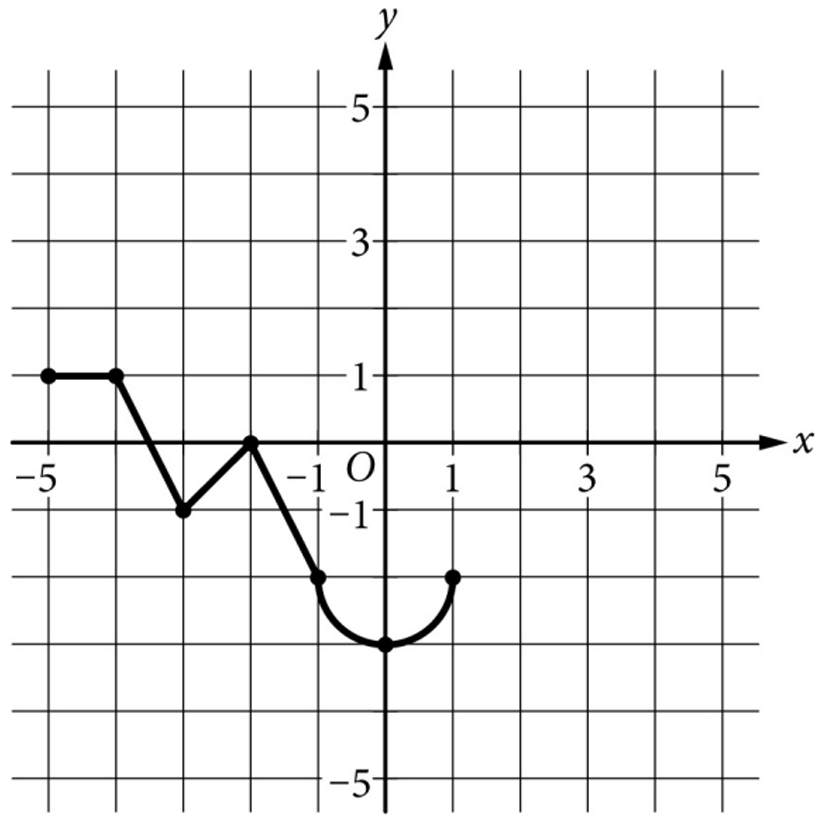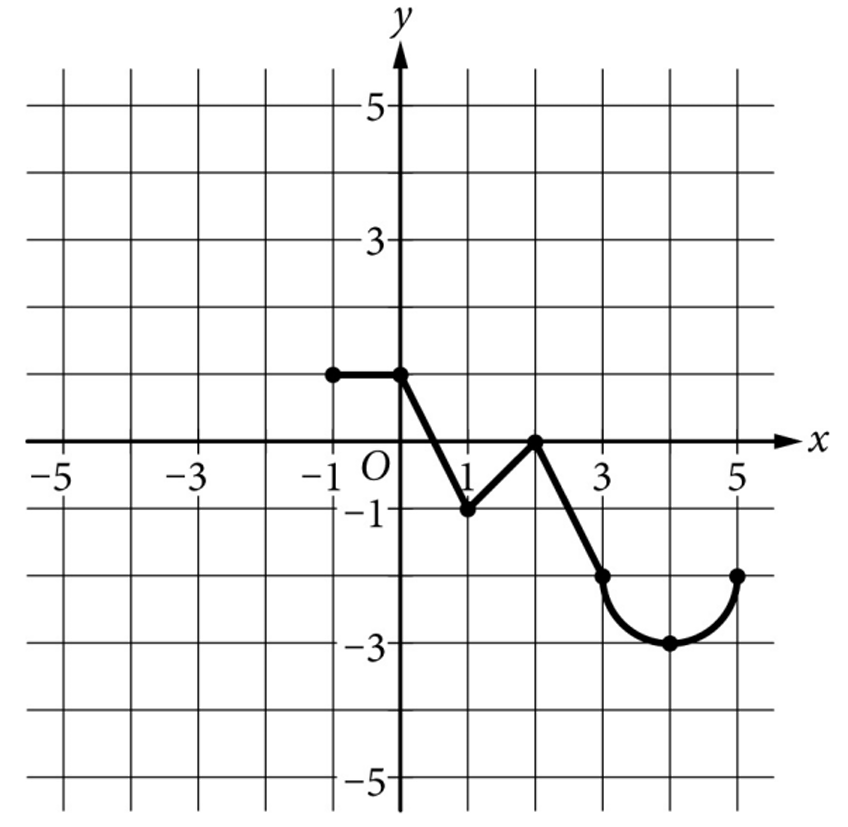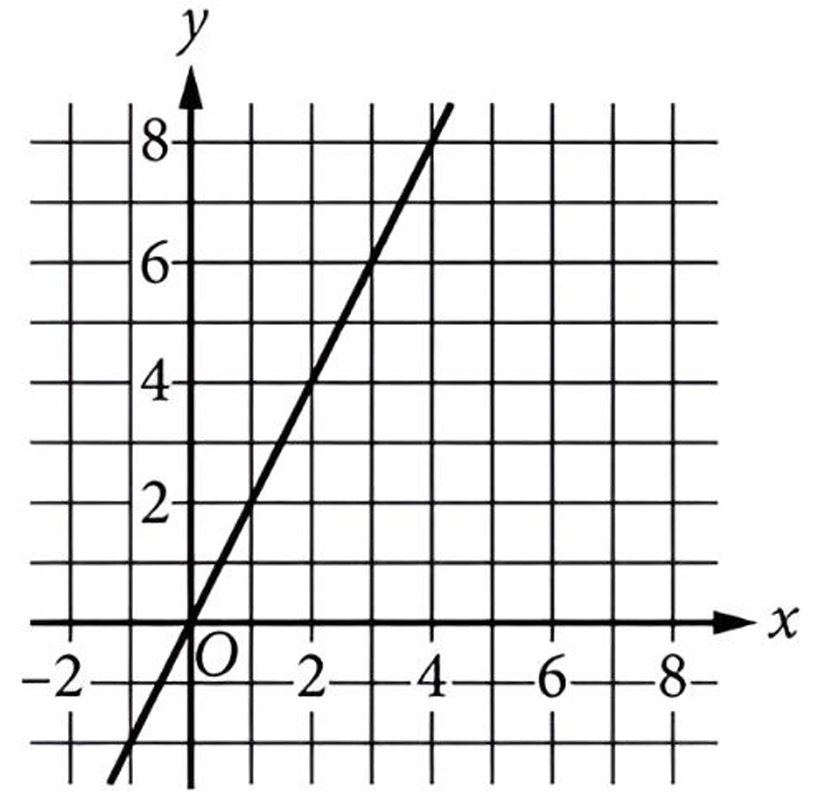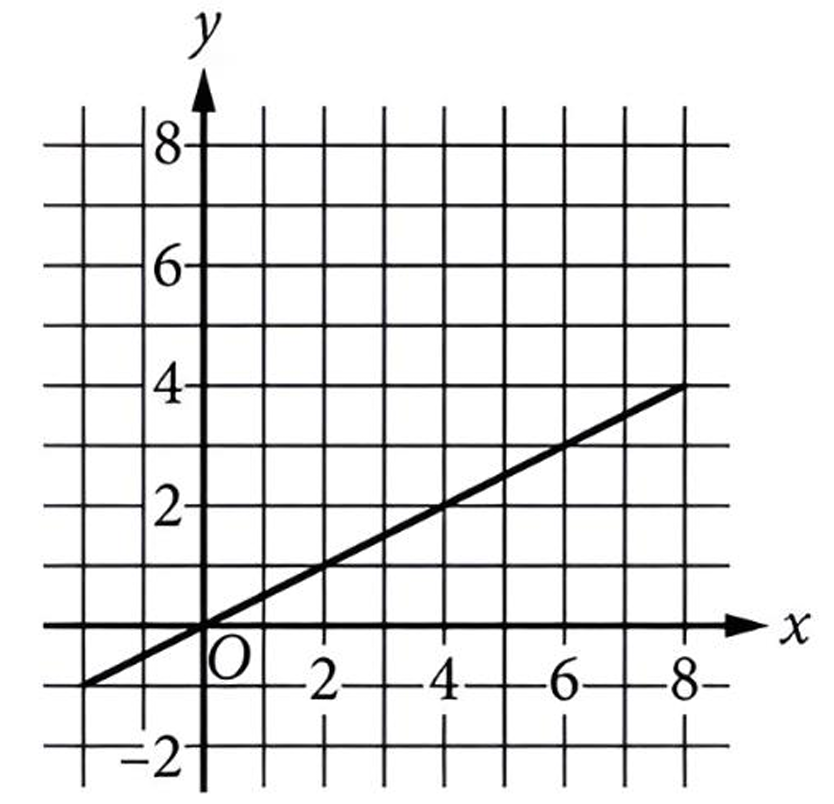
Question 1
▶️ Answer/Explanation
Use the double-angle identity \(\sin(2x) = 2\sin(x)\cos(x)\) to rewrite the equation:
\(2\sin(x)\cos(x) + \sin(x) = 0\)
Factor out \(\sin(x)\):
\(\sin(x)(2\cos(x) + 1) = 0\)
This gives two cases: \(\sin(x) = 0\) or \(2\cos(x) + 1 = 0\).
Case 1: \(\sin(x) = 0 \implies x = 0, \pi\) (in the given interval).
Case 2: \(\cos(x) = -\frac{1}{2} \implies x = \frac{2\pi}{3}, \frac{4\pi}{3}\) (cosine is negative in Q2 and Q3).
The complete solution set is \(\{0, \frac{2\pi}{3}, \pi, \frac{4\pi}{3}\}\).
Note: Option (C) is the closest match, likely containing a typo where \(\pi\) was misprinted as \(\frac{\pi}{3}\).
Question 2
▶️ Answer/Explanation
The horizontal distance between a minimum point and the consecutive maximum point on a sine wave represents half of the period.
Given the x-coordinates of the minimum at \( x=2 \) and the maximum at \( x=4 \), the distance is \( 4 – 2 = 2 \).
Since the half-period is \( 2 \), the full period \( T \) is \( 2 \times 2 = 4 \).
The relationship between the period \( T \) and the coefficient \( b \) is given by the formula \( T = \frac{2\pi}{b} \).
Substituting the known period: \( 4 = \frac{2\pi}{b} \).
Solving for \( b \): \( b = \frac{2\pi}{4} = \frac{\pi}{2} \).
Therefore, the correct option is (C).
Question 3
(B) The maximum height of the tide occurs at (t = 6) hours
(C) The minimum height of the tide is 1 ft
(D) The minimum height of the tide occurs at (t = 12) hours
▶️ Answer/Explanation
The function (h(t) = A\cos(Bt) + K) models the tide, where (A=6.3) and (B=\frac{\pi}{6}).
The period is \(\frac{2\pi}{B} = \frac{2\pi}{\pi/6} = 12\) hours.
A positive cosine function starts at its maximum at (t=0) and reaches the maximum again at (t=12).
The minimum value of a positive cosine function occurs halfway through the period at (t=6).
This incorrect phase behavior eliminates option (B) (which claims max at (t=6)) and option (D) (which claims min at (t=12)).
For option (A) to be true, the maximum height (K + 6.3) must equal (13.8), implying a vertical shift (K = 7.5).
Using (K=7.5), the minimum height would be (7.5 – 6.3 = 1.2), which makes option (C) incorrect (as it states 1 ft).
Thus, assuming the implied vertical shift, option (A) is the correct statement.
Correct Option: (A)
Question 4
▶️ Answer/Explanation
The end behavior of a polynomial function is determined by its leading term (the term with the highest degree).
Since \(\lim_{x\to\infty} g(x) = -\infty\) and \(\lim_{x\to-\infty} g(x) = -\infty\), the graph points downwards on both ends.
This behavior indicates that the polynomial must have an even degree and a negative leading coefficient.
(A) simplifies to \(x^2 + 1\): Even degree, positive coefficient (Ends \(\to \infty\)). Incorrect.
(B) \(-x^4 + 2x^3 + 6\): Even degree (4), negative coefficient (-1). Ends \(\to -\infty\). Correct.
(C) \(2x^3 – 7x^2 + 4x\): Odd degree. Ends go in opposite directions. Incorrect.
(D) \(4x^6 + x^3 – 5\): Even degree, positive coefficient (Ends \(\to \infty\)). Incorrect.
Question 5
▶️ Answer/Explanation
To find the domain, we must determine for which values of \( x \) the denominator is zero.
Set the denominator equal to zero: \( x^3 + 10x^2 + 16x = 0 \).
Factor out the common term \( x \): \( x(x^2 + 10x + 16) = 0 \).
Factor the quadratic expression: \( x(x + 8)(x + 2) = 0 \).
Solve for \( x \): \( x = 0 \), \( x + 8 = 0 \Rightarrow x = -8 \), or \( x + 2 = 0 \Rightarrow x = -2 \).
The function is undefined at these values, so the domain is all real numbers except \( 0, -8, \) and \( -2 \).
Correct Option: (C)
Question 6
▶️ Answer/Explanation
The correct option is (A).
To convert rectangular coordinates \( (x, y) = (3, 3) \) to polar form, we must find the modulus \( r \) and the argument \( \theta \).
1. Calculate the modulus \( r \) using the formula \( r = \sqrt{x^2 + y^2} \).
2. Substitute the given values: \( r = \sqrt{3^2 + 3^2} = \sqrt{9 + 9} = \sqrt{18} \).
3. Simplify the radical: \( \sqrt{18} = \sqrt{9 \cdot 2} = 3\sqrt{2} \).
4. Calculate the angle \( \theta \) using \( \tan(\theta) = \frac{y}{x} \).
5. Substitute values: \( \tan(\theta) = \frac{3}{3} = 1 \). Since the point is in the first quadrant, \( \theta = \frac{\pi}{4} \).
6. The polar form of a complex number is \( z = r \cos(\theta) + i (r \sin(\theta)) \).
7. Substituting \( r = 3\sqrt{2} \) and \( \theta = \frac{\pi}{4} \), we get: \( \left(3\sqrt{2} \cos \left(\frac{\pi}{4}\right)\right) + i \left(3\sqrt{2} \sin \left(\frac{\pi}{4}\right)\right) \).
Question 7
▶️ Answer/Explanation
We need to find the equation \( g_k \) such that the second term (where \( k=2 \)) equals \( ae^2 \). We verify this by substituting \( k=2 \) into each option.
(A) \( g_2 = a(e^2) = ae^2 \). This matches the given term exactly. (Also, \( k=5 \) yields \( ae^5 \)).
(B) \( g_2 = a(e)^{2-1} = ae^1 = ae \). This is incorrect.
(C) \( g_2 = a(e^2) – 2 \). This is incorrect.
(D) \( g_2 = a(e+2)^{2-1} = a(e+2) \). This is incorrect.
Since only option (A) yields the correct value \( ae^2 \) for the second term, it is the correct equation.
Question 8
▶️ Answer/Explanation
The problem describes a population changing by a fixed percentage each year, which requires an exponential model.
The general formula for exponential decay is \(y = a(1 – r)^t\), where \(a\) is the initial amount and \(r\) is the rate.
The initial population is given as \(23,144\).
The population decreases by \(4\%\) per year, so the rate \(r = 0.04\).
The decay factor is calculated as \(1 – 0.04 = 0.96\).
Substituting these values into the formula gives \(23,144(0.96)^t\).
This corresponds to option (C).
Question 9

▶️ Answer/Explanation
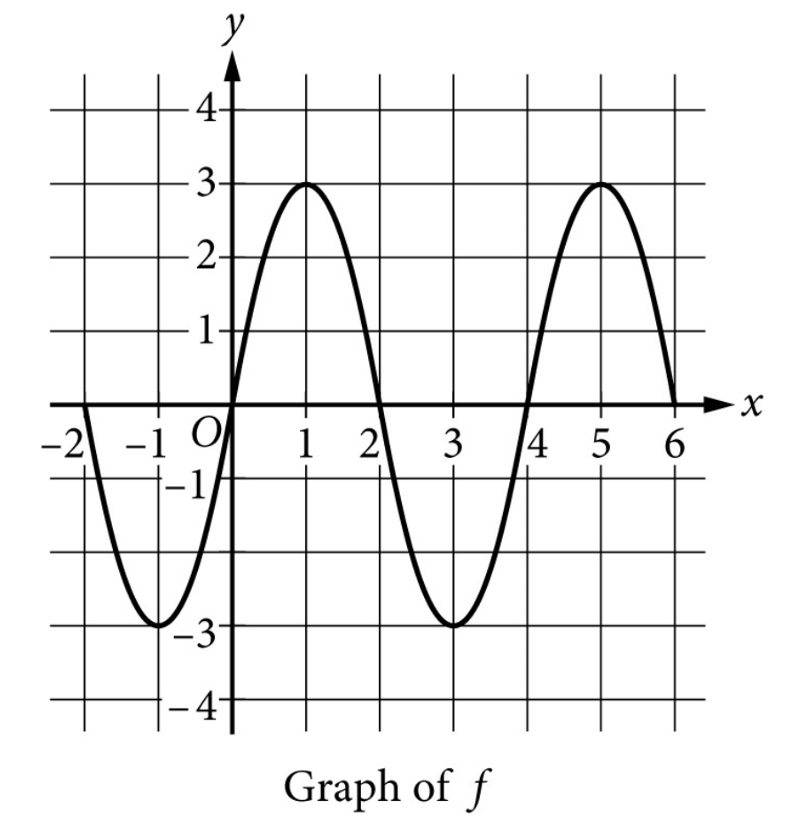
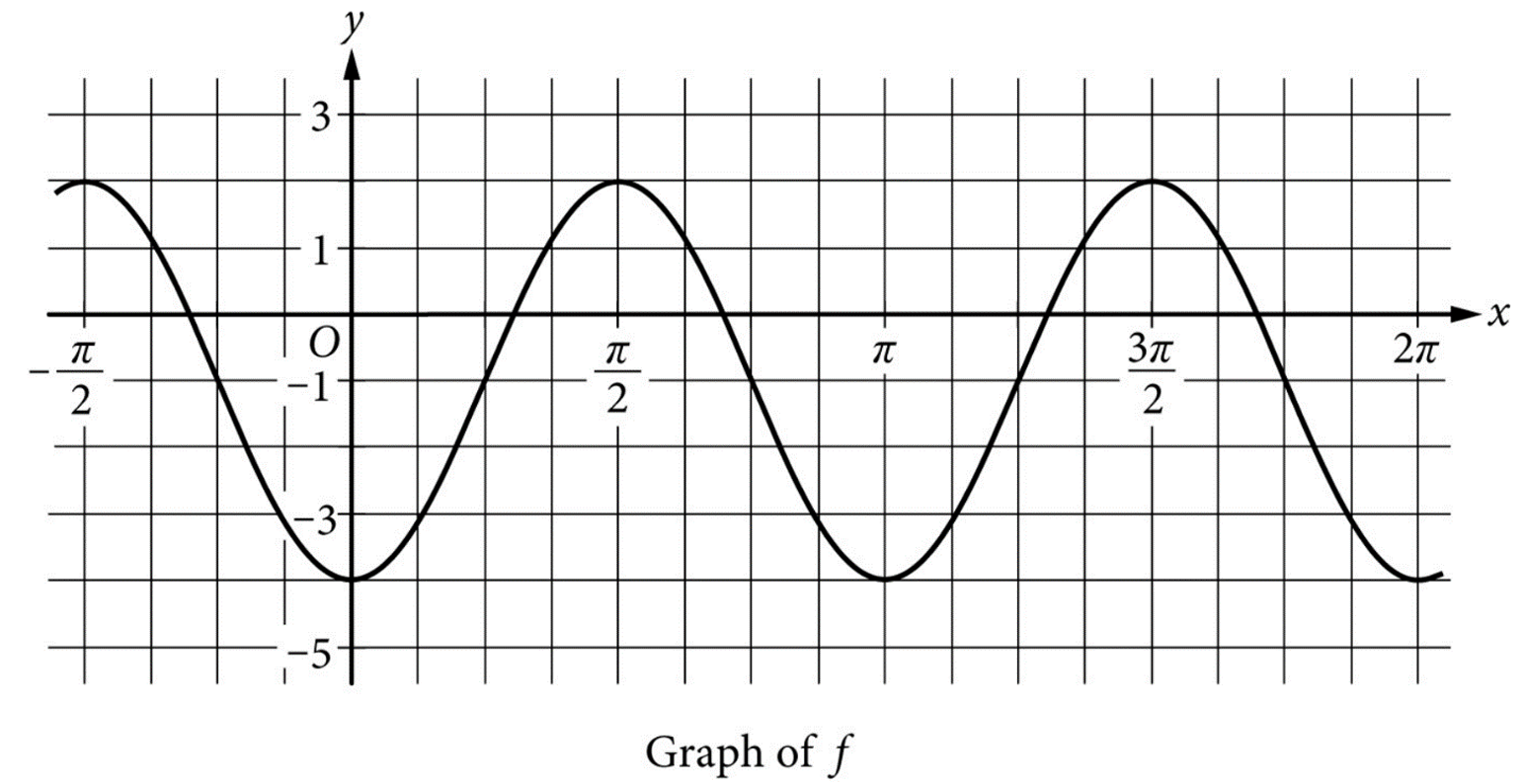
The period is the horizontal length of one complete cycle of the function’s graph.
We can find this by measuring the distance between two consecutive peaks (maximums).
Looking at the graph, the first peak is located at \( x = 1 \).
The next consecutive peak is located at \( x = 5 \).
The period is calculated as the difference between these x-values: \( 5 – 1 = 4 \).
Alternatively, a full cycle starting from the origin at \( x = 0 \) completes at \( x = 4 \).
Thus, the period of \( f \) is \( 4 \).
Correct Answer: (C)
Question 10

▶️ Answer/Explanation
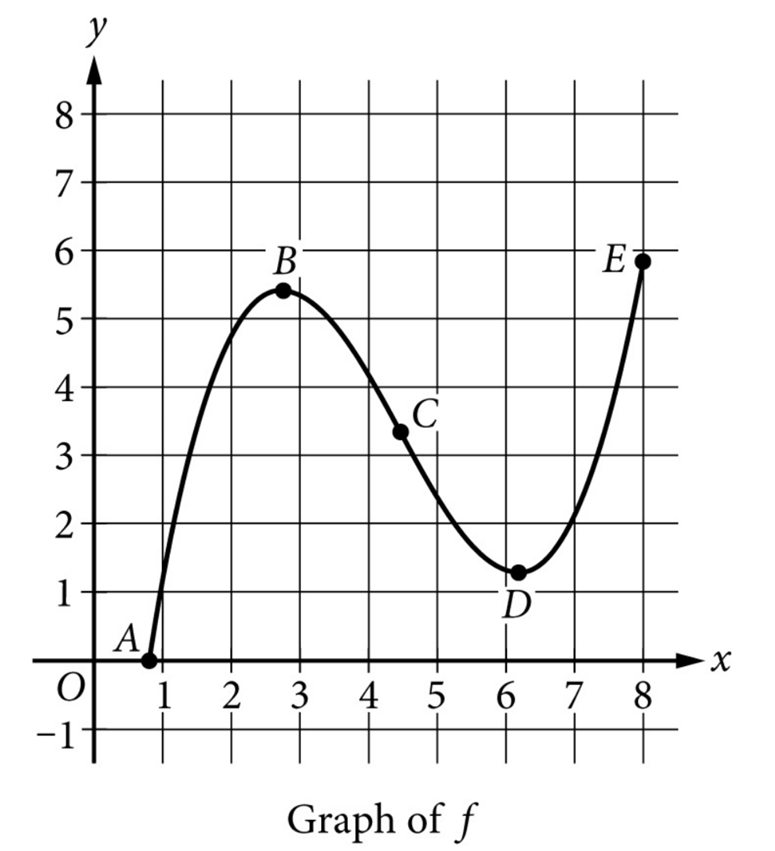
The problem asks for an interval where the function \( f \) is both increasing and concave down.
1. Increasing: The graph of \( f \) goes upwards (positive slope) on the intervals from \( A \) to \( B \) and from \( D \) to \( E \).
2. Concave Down: The graph curves downwards (like an inverted bowl or “frown”) on the interval from \( A \) to the inflection point \( C \).
3. Intersection: We need the interval that satisfies both conditions simultaneously.
4. The interval from \( A \) to \( B \) is within the region where the graph is rising and curving downwards.
5. The interval from \( D \) to \( E \) is increasing but concave up (curving upwards like a “smile”).
6. Therefore, the only interval that meets both criteria is from \( A \) to \( B \).
Correct Option: (A)
Question 11
▶️ Answer/Explanation
The given function is \( b(t) = 42 \cos\left(\frac{\pi}{30}t\right) + 45 \).
Identify the midline vertical shift, which is the constant term: \( 45 \).
Identify the amplitude, which is the coefficient of the cosine function: \( 42 \).
The minimum value of the function occurs when the cosine term is \( -1 \).
Minimum number of people \( = \text{Midline} – \text{Amplitude} = 45 – 42 = 3 \).
Since the minimum value (\( 3 \)) is greater than \( 0 \), the line never reaches \( 0 \).
This happens specifically because the vertical shift (\( 45 \)) is larger than the amplitude (\( 42 \)).
Therefore, option (A) is the correct answer.
Question 12
▶️ Answer/Explanation
The binomial expansion of \((x + 3y)^5\) is found using the formula \((a + b)^n = \sum_{k=0}^{n} \binom{n}{k} a^{n-k} b^k\), with \(n=5\).
The binomial coefficients for the 5th power (Row 5 of Pascal’s Triangle) are \(1, 5, 10, 10, 5, 1\).
The correct theoretical expansion is: \(1(x)^5 + 5(x)^4(3y)^1 + 10(x)^3(3y)^2 + 10(x)^2(3y)^3 + 5(x)^1(3y)^4 + 1(3y)^5\).
We compare this pattern with the given options by checking the coefficients.
Option (A) is missing terms, Option (B) has incorrect coefficients (all are \(1\)), and Option (C) uses coefficients for \(n=4\) (\(1, 4, 6, 4, 1\)).
Option (D) correctly matches the coefficients \(1, 5, 10, 10, 5, 1\). Note that while the question image contains typographical errors in the exponents, (D) is the only option with the correct binomial structure.
Therefore, the correct option is (D).
Question 13

▶️ Answer/Explanation
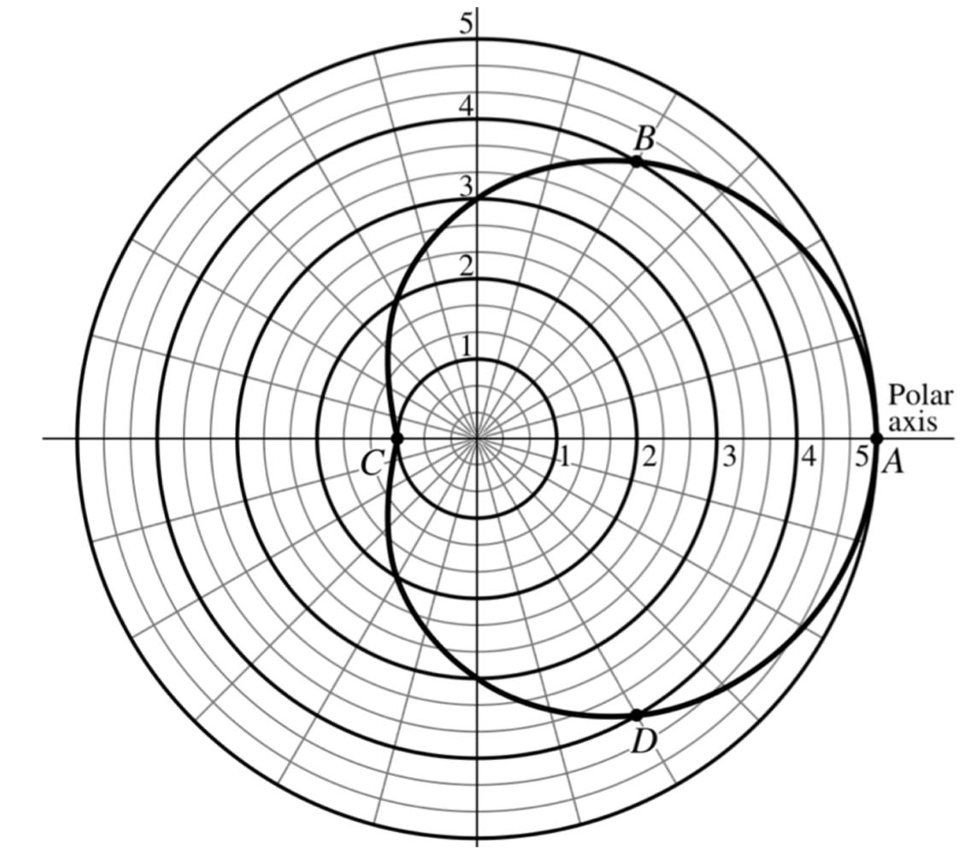
The average rate of change of $r$ with respect to $\theta$ is given by the ratio: $$\frac{\Delta r}{\Delta \theta} = \frac{r_{final} – r_{initial}}{\theta_{final} – \theta_{initial}}$$
Based on the grid, we can estimate the radius $r$ at each point:
• A: $r = 5$
• B: $r \approx 4$
• C: $r = 1$
• D: $r \approx 4$
For intervals (A) From $A$ to $C$ and (B) From $B$ to $C$, the radius $r$ decreases ($5 \to 1$ and $4 \to 1$), so the rate of change is negative.
For interval (C) From $B$ to $D$, the radius starts at $r \approx 4$ and returns to $r \approx 4$, meaning the net change $\Delta r$ is near zero, so the rate is approximately zero.
For interval (D) From $C$ to $D$, the radius increases from $r = 1$ to $r \approx 4$. Since $\Delta r > 0$ and $\Delta \theta > 0$, the rate of change is positive.
Since a positive value is greater than zero or a negative value, the greatest average rate of change occurs on the interval from $C$ to $D$.
Question 14
▶️ Answer/Explanation
Detailed solution
To verify option (B), we calculate the function values at $t=5$, $t=10$, and $t=15$.
Using $W(t) = 125 – 0.2t^2$, we find $W(5) = 120$, $W(10) = 105$, and $W(15) = 80$.
The average rate of change for $5 \le t \le 10$ is $\frac{105 – 120}{10 – 5} = \frac{-15}{5} = -3$.
The average rate of change for $10 \le t \le 15$ is $\frac{80 – 105}{15 – 10} = \frac{-25}{5} = -5$.
Comparing the values, we see that $-5 < -3$.
Thus, the average rate of change for $10 \le t \le 15$ is less than that for $5 \le t \le 10$.
Question 15
▶️ Answer/Explanation
The standard tangent function, \(y = \tan(\theta)\), has vertical asymptotes when \(\theta = \frac{\pi}{2} + \pi k\), where \(k\) is an integer.
For the given function \(j(x) = 8 – 7 \tan\left(\frac{x}{4}\right)\), the argument of the tangent is \(\frac{x}{4}\).
To find the vertical asymptotes, we set the argument equal to the asymptotic values: \(\frac{x}{4} = \frac{\pi}{2} + \pi k\).
Now, solve for \(x\) by multiplying both sides of the equation by \(4\).
\(x = 4\left(\frac{\pi}{2}\right) + 4(\pi k)\)
Simplifying the expression gives \(x = 2\pi + 4\pi k\).
Therefore, the vertical asymptotes occur at \(x = 2\pi + 4\pi k\), where \(k\) is an integer.
Correct Option: (C)
Question 16

▶️ Answer/Explanation
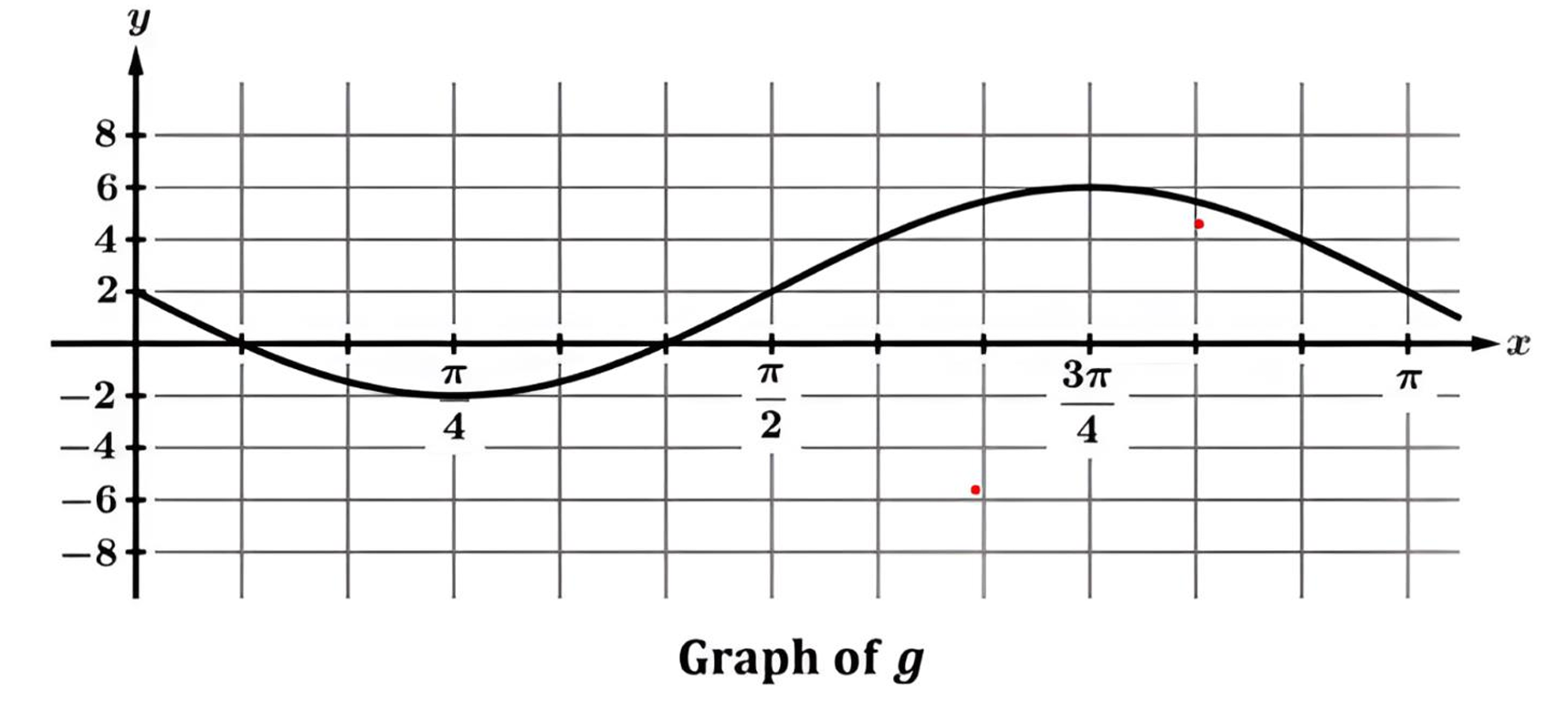
Analyze the graph to determine the parameters for the general form \( g(x) = A \cos(b(x – h)) + k \):
- Midline (\( k \)): The vertical center between the max (\( 6 \)) and min (\( -2 \)) is \( \frac{6 + (-2)}{2} = 2 \).
- Amplitude (\( A \)): The distance from the midline to a peak is \( 6 – 2 = 4 \).
- Period and Frequency (\( b \)): The distance from the minimum (\( \frac{\pi}{4} \)) to the maximum (\( \frac{3\pi}{4} \)) is half the period (\( \frac{\pi}{2} \)). Thus, the full period is \( \pi \), making \( b = \frac{2\pi}{\pi} = 2 \).
- Phase Shift (\( h \)): A positive cosine graph peaks at its phase shift. The graph shows a maximum at \( x = \frac{3\pi}{4} \).
Substituting these values gives: \( g(x) = 4 \cos\left(2\left(x – \frac{3\pi}{4}\right)\right) + 2 \).
This corresponds to Option (D).
Question 17

(B) Three
(C) Four
(D) Five
▶️ Answer/Explanation
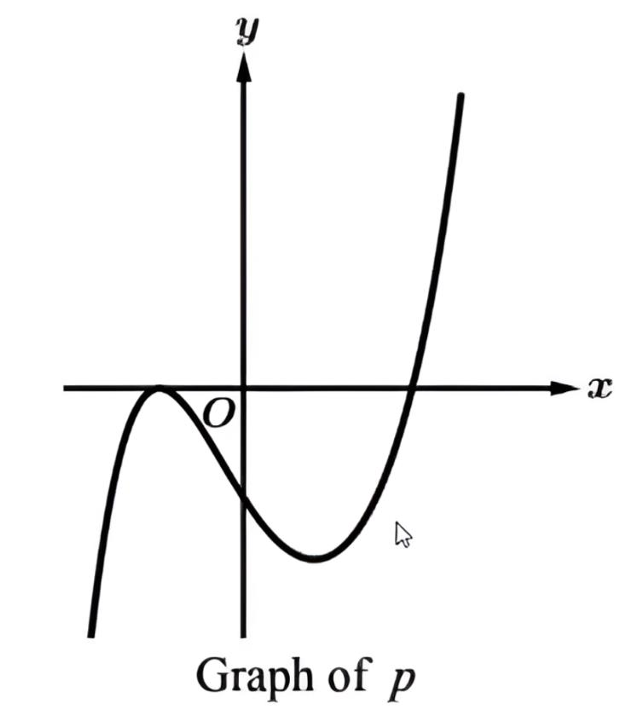
The degree of a polynomial is the sum of the multiplicities of all its roots. We analyze the graph and the given information to find the minimum values:
- Tangent Real Root: The graph touches the \( x \)-axis and turns around at a negative value. This indicates a root with an even multiplicity, so the minimum is 2.
- Crossing Real Root: The graph crosses the \( x \)-axis at a positive value. This indicates a root with an odd multiplicity, so the minimum is 1.
- Complex Roots: Given \( 2 – 3i \) is a zero, its conjugate \( 2 + 3i \) must also be a zero (Complex Conjugate Root Theorem). This accounts for 2 roots.
Total Least Degree: Summing these gives \( 2 + 1 + 2 = 5 \).
The correct option is (D).
Question 18

▶️ Answer/Explanation
The correct option is (D).
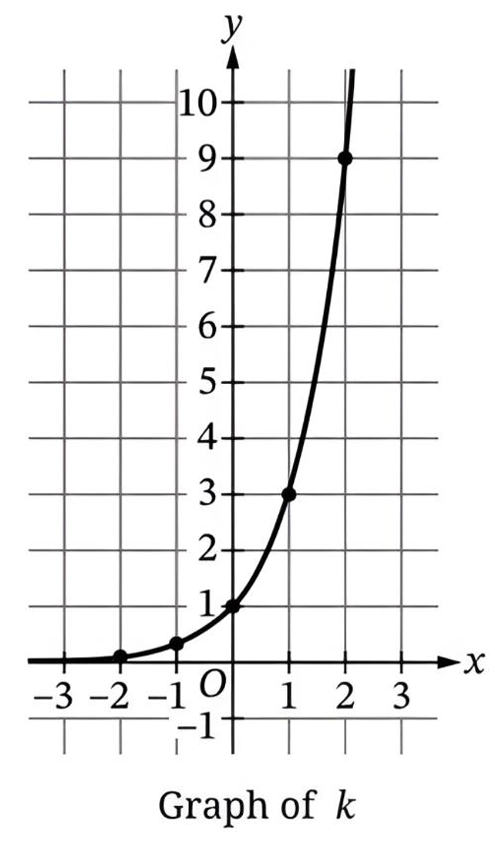
1. First, identify the base \(b\) of the exponential function \(k(x) = b^x\) using points from the graph.
2. The graph passes through the point \((1, 3)\). Substituting this into the equation gives \(3 = b^1\), so \(b = 3\).
3. The function \(h\) is defined as \(h(x) = \log_b x\), which becomes \(h(x) = \log_3 x\).
4. Since logarithmic and exponential functions are inverses, if \((x, y)\) is on the graph of \(k\), then \((y, x)\) is on the graph of \(h\).
5. The graph of \(k\) contains the points \((1, 3)\) and \((2, 9)\).
6. Swapping the coordinates to find points on \(h\), we get \((3, 1)\) and \((9, 2)\).
7. We can verify this algebraically: \(h(3) = \log_3(3) = 1\) and \(h(9) = \log_3(9) = 2\).
Question 19

▶️ Answer/Explanation
To determine the behavior of the function, we must find the values of \(a\) and \(b\).
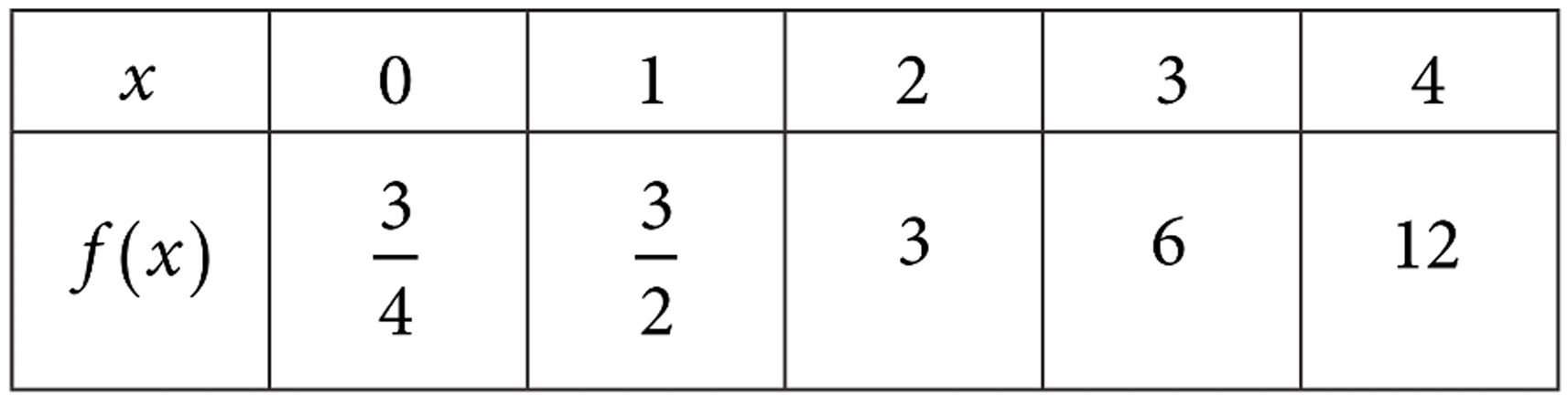
First, substitute \(x = 0\) into \(f(x) = ab^x\). Since \(f(0) = \frac{3}{4}\), we have \(a(b)^0 = a = \frac{3}{4}\). Thus, \(a > 0\).
Next, substitute \(x = 1\) to find \(b\). Since \(f(1) = \frac{3}{2}\), we have \(f(1) = a(b)^1 \Rightarrow \frac{3}{4}(b) = \frac{3}{2}\).
Solving for \(b\), we multiply both sides by \(\frac{4}{3}\): \(b = \frac{3}{2} \cdot \frac{4}{3} = 2\).
An exponential function exhibits growth when the base \(b > 1\) and decay when \(0 < b < 1\) (given \(a > 0\)).
Since we calculated that \(b = 2\), which is greater than \(1\), the function demonstrates exponential growth.
Therefore, statement (D) is the correct description.
Correct Option: (D)
Question 20
▶️ Answer/Explanation
The polynomial \(k(x)\) has real coefficients, so by the Complex Conjugate Root Theorem, if \(-0.478 – 0.801i\) is a root, its conjugate \(-0.478 + 0.801i\) must also be a root.
Since the polynomial is of degree 4, it must have exactly 4 roots. We have identified two complex roots and one real root (\(x = 17.997\)).
The fourth root must be real because any additional complex root would require a conjugate pair, which would exceed the degree of 4. Thus, there are exactly 2 real roots and 2 complex roots.
Statement (A) is false because there are 2 real roots (2 \(x\)-intercepts), not 3.
Statement (C) is false because there are only 2 real solutions, not 4.
Statement (D) is false because the multiplicity is 1, meaning the graph crosses the axis rather than being tangent to it.
Therefore, by elimination (and the premise given), statement (B) is the correct answer.
Question 21
▶️ Answer/Explanation
The horizontal distance between the minimum at \(x=\pi\) and the maximum at \(x=2\pi\) is \(\pi\), which represents half of the period (\(\frac{T}{2}\)).
Therefore, the full period is \(T = 2\pi\). Using the formula \(T = \frac{2\pi}{b}\), we solve \(2\pi = \frac{2\pi}{b}\) to find that \(b = 1\).
The vertical shift \(d\) is the midpoint (average) of the maximum and minimum values: \(d = \frac{\text{Max} + \text{Min}}{2}\).
Using the printed values, \(d = \frac{10 + 6}{2} = 8\). However, this does not match any option, suggesting a typo in the question text.
If the minimum value was intended to be \(-6\) (missing negative sign), then \(d = \frac{10 + (-6)}{2} = 2\).
Since \(b=1\) is definite, and \(d=2\) matches option (B) under the assumption of a sign error, (B) is the intended answer.
Question 22
▶️ Answer/Explanation
The correct answer is (D).
Step 1: Identify the Pythagorean identity in the numerator. We know that \(\tan^2 x + 1 = \sec^2 x\), therefore \(\sec^2 x – 1 = \tan^2 x\).
Step 2: Substitute this into the expression: \(\frac{\tan^2 x}{\sec^2 x}\).
Step 3: Rewrite in terms of sine and cosine: \(\tan^2 x = \frac{\sin^2 x}{\cos^2 x}\) and \(\sec^2 x = \frac{1}{\cos^2 x}\).
Step 4: Divide the fractions: \(\frac{\sin^2 x}{\cos^2 x} \div \frac{1}{\cos^2 x} = \frac{\sin^2 x}{\cos^2 x} \cdot \cos^2 x\).
Step 5: Cancel the \(\cos^2 x\) terms to get the final result: \(\sin^2 x\).
Question 23
▶️ Answer/Explanation
To convert from polar coordinates \((r, \theta)\) to rectangular coordinates \((x, y)\), we use the formulas \(x = r \cos \theta\) and \(y = r \sin \theta\).
Given the point \(\left(1, \frac{5\pi}{6}\right)\), substitute \(r = 1\) and \(\theta = \frac{5\pi}{6}\) into the equations.
First, find the \(x\)-coordinate: \(x = 1 \cdot \cos\left(\frac{5\pi}{6}\right) = -\frac{\sqrt{3}}{2}\).
Next, find the \(y\)-coordinate: \(y = 1 \cdot \sin\left(\frac{5\pi}{6}\right) = \frac{1}{2}\).
Combining these values gives the rectangular coordinates \(\left(-\frac{\sqrt{3}}{2}, \frac{1}{2}\right)\).
Therefore, the correct option corresponds to (A).
Question 24
▶️ Answer/Explanation
The correct answer is (B).
We need to evaluate the composite function \( h(t) = f(g(t)) \).
Substitute \( g(t) = 7 \ln t \) into the function \( f \):
\( h(t) = f(7 \ln t) = e^{7 \ln t} \)
Apply the power rule for logarithms, \( a \ln b = \ln(b^a) \), to the exponent:
\( h(t) = e^{\ln(t^7)} \)
Use the inverse property of exponential and logarithmic functions, \( e^{\ln x} = x \):
\( h(t) = t^7 \)
Question 25


▶️ Answer/Explanation
The correct option is (A).
The transformation \(y = f(x + 1) – 2\) involves two shifts applied to the parent function \(f(x)\):
- Horizontal Shift: \(f(x + 1)\) shifts the graph 1 unit left.
- Vertical Shift: \(- 2\) shifts the graph 2 units down.
By applying the rule \((x, y) \to (x – 1, y – 2)\) to key points:
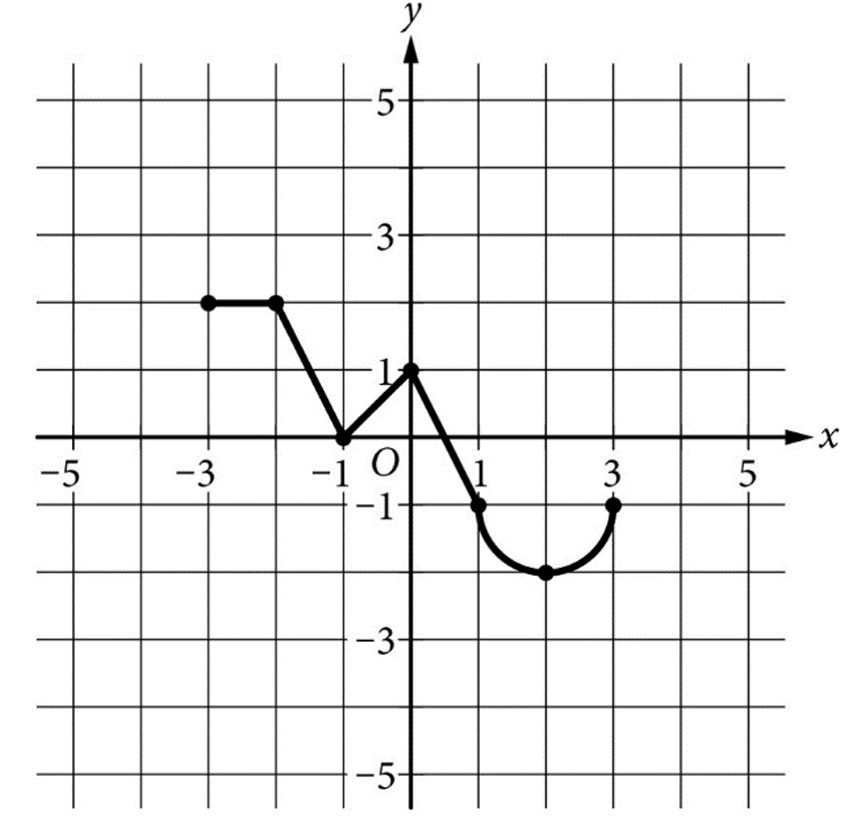
| Original Point | Transformed Point |
|---|---|
| \((-3, 2)\) (Start) | \((-4, 0)\) |
| \((-1, 0)\) (V-minimum) | \((-2, -2)\) |
| \((2, -2)\) (Semicircle bottom) | \((1, -4)\) |
Graph (A) is the only option that matches these coordinates and the overall shape.
Question 26
▶️ Answer/Explanation
To determine the behavior, we calculate the first derivative \( B'(t) \) (rate of change) and the second derivative \( B”(t) \) (rate of the rate).
\( B'(t) = \frac{d}{dt}\left(115 + 9\cos\left[\frac{t+12\pi}{20}\right]\right) = -\frac{9}{20}\sin\left(\frac{t+12\pi}{20}\right) \)
\( B”(t) = \frac{d}{dt}\left(B'(t)\right) = -\frac{9}{400}\cos\left(\frac{t+12\pi}{20}\right) \)
At \( t = 60 \), the angle is \( \theta = \frac{60+12\pi}{20} = 3 + 0.6\pi \approx 4.88 \) radians. Since \( \frac{3\pi}{2} \approx 4.71 < 4.88 < 2\pi \), the angle is in the 4th Quadrant.
In Q4, sine is negative and cosine is positive. Therefore:
\( B'(60) = -\text{ve} \times \sin(\text{Q4}) = -\text{ve} \times (-\text{ve}) = \text{Positive} \) (Temperature is increasing).
\( B”(60) = -\text{ve} \times \cos(\text{Q4}) = -\text{ve} \times (+\text{ve}) = \text{Negative} \) (Rate is decreasing).
Thus, the temperature is increasing at a decreasing rate.
Correct Option: (B)
Question 27
▶️ Answer/Explanation
Question 28

▶️ Answer/Explanation
The correct answer is (C).
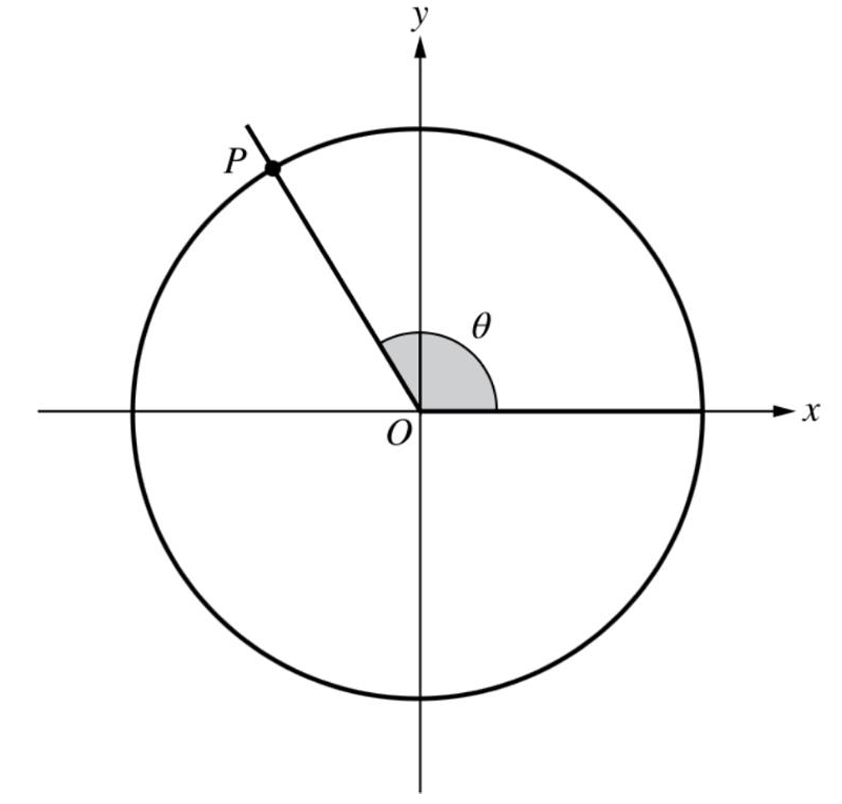
1. From the figure, the terminal ray of \(\theta\) lies in the second quadrant. Thus, \(\frac{\pi}{2} < \theta < \pi\).
2. The problem states that \(\theta < \alpha < \pi\). This implies that \(\alpha\) is also in the second quadrant but represents a larger rotation than \(\theta\).
3. The function is defined as \(f(k) = \cos k\). In the unit circle, the cosine of an angle corresponds to the \(x\)-coordinate of the point on the circle.
4. In the interval \((0, \pi)\), the cosine function is strictly decreasing. This means as the angle increases, the \(x\)-coordinate moves to the left (becomes more negative).
5. Since \(\theta < \alpha\), the \(x\)-coordinate for angle \(\alpha\) will be less than the \(x\)-coordinate for angle \(\theta\).
6. Therefore, \(\cos \theta > \cos \alpha\), which means \(f(\theta) > f(\alpha)\).

Question 29

▶️ Answer/Explanation
The differences between consecutive \(P(t)\) values (\(30-20=10\), \(45-30=15\)) are not constant, so the model is not linear (eliminates A and B).
Calculate the ratio of consecutive terms: \(\frac{30}{20} = 1.5\) and \(\frac{45}{30} = 1.5\).
Since the ratio is constant at \(1.5\) or \(\frac{3}{2}\), the data represents an exponential growth model.
An exponential function has the form \(y = a(b)^t\), where \(a\) is the initial value and \(b\) is the growth factor.
From the table, at \(t=0\), the value is \(20\), so the initial value \(a = 20\).
The growth factor \(b\) is the constant ratio \(\frac{3}{2}\).
Therefore, the function is \(y = 20 \left(\frac{3}{2}\right)^t\), which corresponds to option (D).
Question 30
▶️ Answer/Explanation
To simplify the expression \(\ln \left(\frac{5e^2}{\sqrt{x}}\right)\), apply the laws of logarithms step-by-step.
1. Use the quotient rule \(\ln(\frac{a}{b}) = \ln(a) – \ln(b)\):
\(\quad \ln(5e^2) – \ln(\sqrt{x})\)
2. Use the product rule \(\ln(ab) = \ln(a) + \ln(b)\) on the first term:
\(\quad \ln(5) + \ln(e^2) – \ln(\sqrt{x})\)
3. Simplify \(\ln(e^2) = 2\) (since \(\ln e = 1\)) and rewrite \(\sqrt{x}\) as \(x^{1/2}\):
\(\quad \ln(5) + 2 – \ln(x^{1/2})\)
4. Use the power rule \(\ln(a^k) = k \ln(a)\) on the last term:
\(\quad 2 + \ln(5) – \frac{1}{2}\ln(x)\)
This matches option (A).
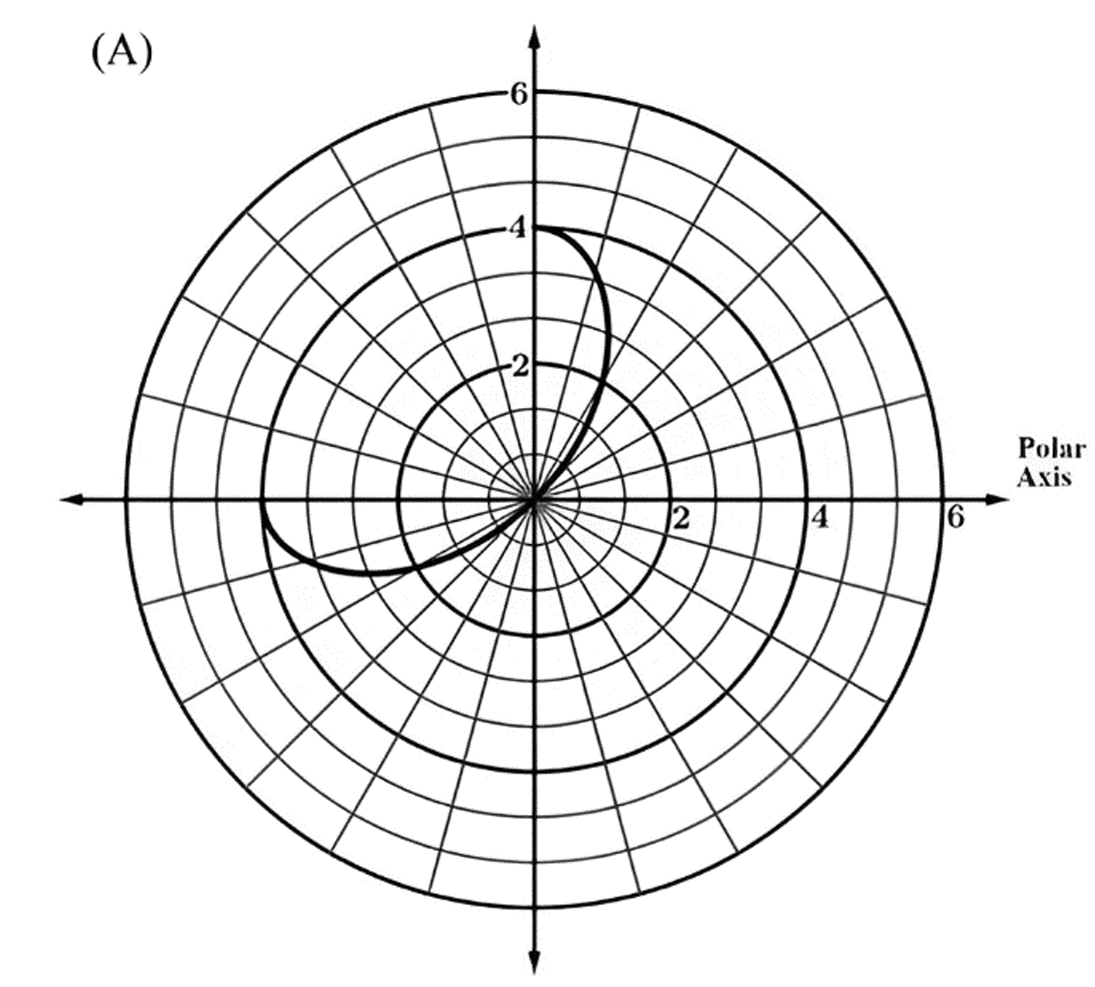
Question 31


▶️ Answer/Explanation
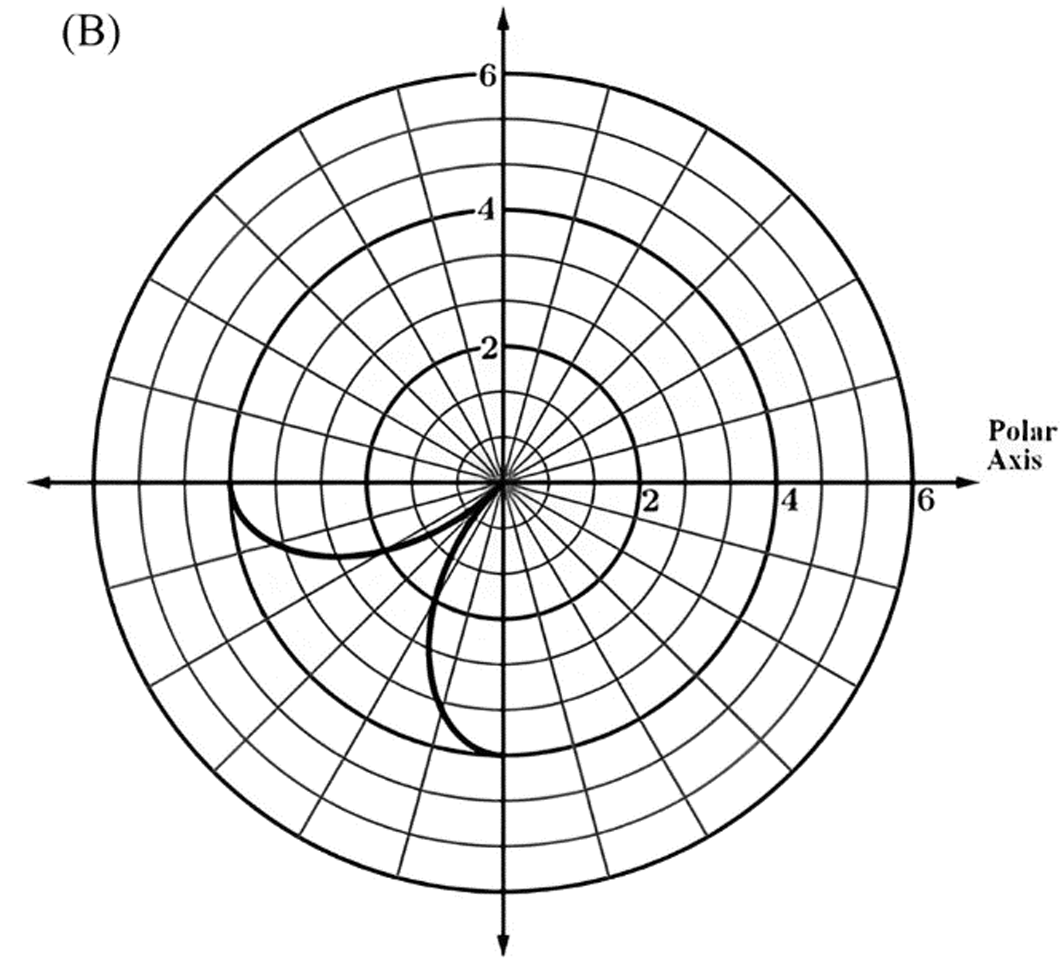
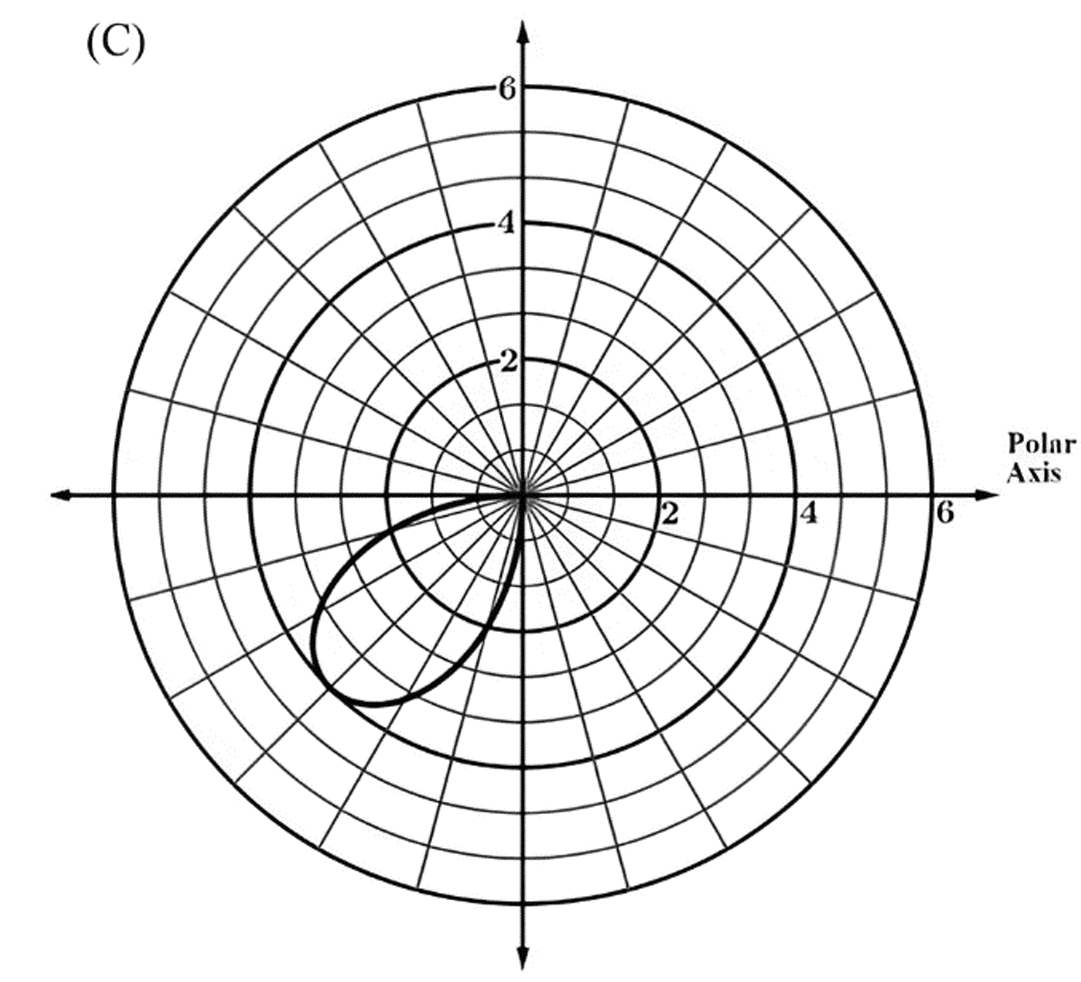
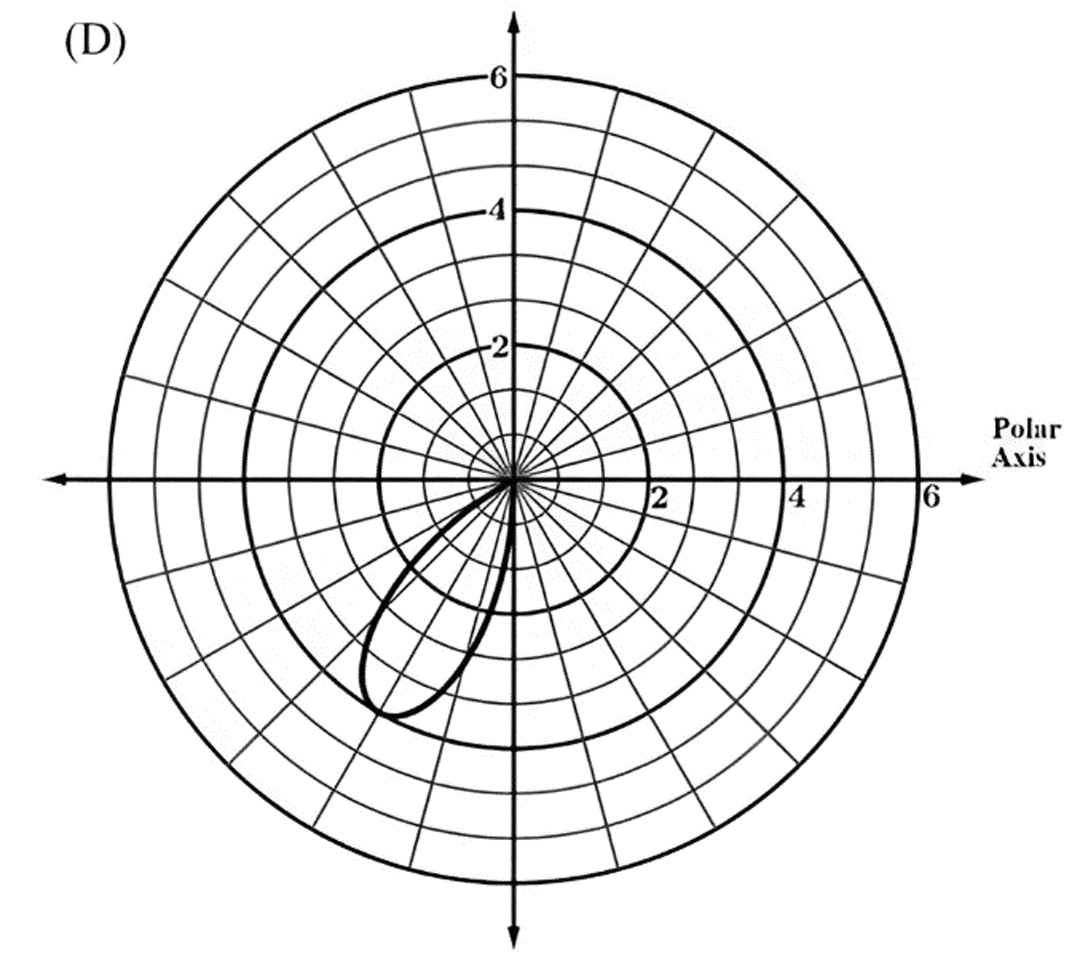
The correct graph corresponds to option (B).
To determine the correct graph, we evaluate the function \(r = 4 \cos(2\theta)\) at the starting value of the given interval, \(\theta = \pi\).
Substitute \(\theta = \pi\) into the equation:
\(r = 4 \cos(2(\pi)) = 4 \cos(2\pi)\)
Since \(\cos(2\pi) = 1\), we have:
\(r = 4(1) = 4\)
This corresponds to the polar point \((4, \pi)\). In the polar coordinate system, this point is located 4 units away from the pole (origin) along the ray \(\theta = \pi\), which lies on the negative x-axis.
Question 32
(B) \(25\)
(C) \(972\)
(D) \(2,916\)
▶️ Answer/Explanation
The formula for the \(n\)-th term of an arithmetic sequence is given by \(a_n = a_1 + (n – 1)d\).
Here, the first term is \(a_1 = 4\), the common difference is \(d = 3\), and we need to find the seventh term (\(n = 7\)).
Substituting these values into the formula gives:
\(a_7 = 4 + (7 – 1)3\)
Simplify the expression inside the parentheses:
\(a_7 = 4 + (6)3\)
Multiply the terms:
\(a_7 = 4 + 18\)
Add to find the final result:
\(a_7 = 22\)
Question 33
▶️ Answer/Explanation
The function \(P\) takes time as the input and outputs the amount of water.
Therefore, the inverse function \(P^{-1}\) must swap these roles: it takes the amount of water as the input and outputs time.
Since \(P\) is an increasing function (more time equals more water), its inverse must also be increasing.
Logically, to reach a greater amount of water (input for \(P^{-1}\)), a greater amount of time (output for \(P^{-1}\)) is required.
Thus, \(P^{-1}\) is an increasing function of the amount of water in the pool.
This description matches option (C).
Question 34
▶️ Answer/Explanation
Question 35

▶️ Answer/Explanation
The correct option is (C).
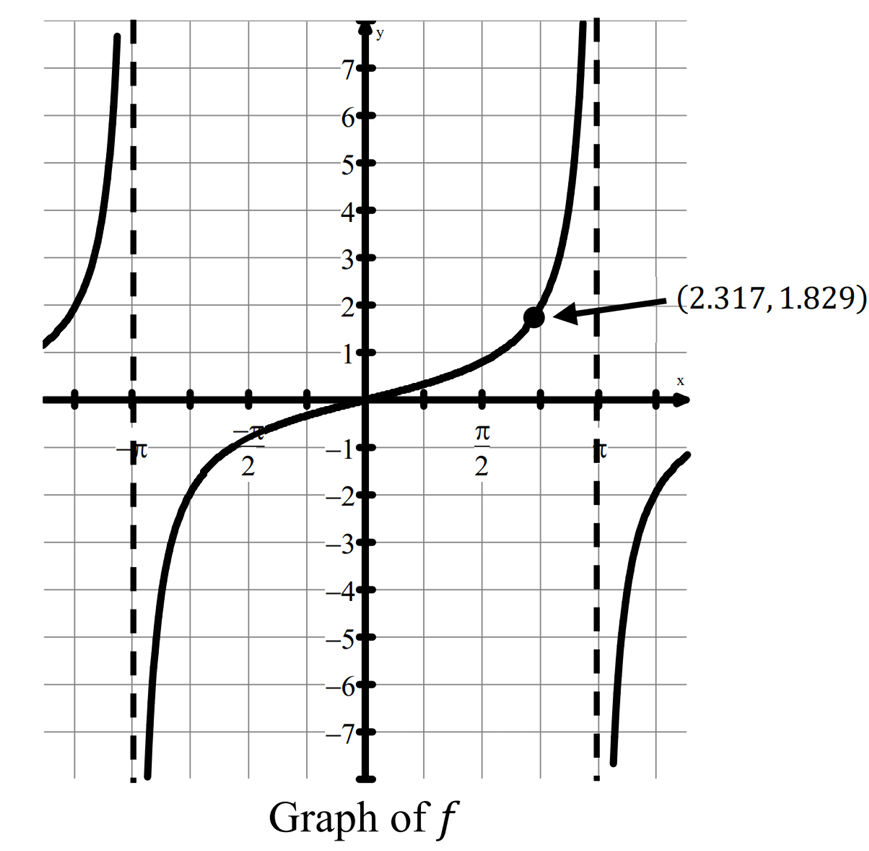
The period of a tangent function is determined by the horizontal distance between consecutive vertical asymptotes.
From the given graph, the vertical asymptotes are located at \( x = -\pi \) and \( x = \pi \).
Therefore, the period of the function \( f(x) \) is the difference: \( \pi – (-\pi) = 2\pi \).
We are given a specific point on the curve where \( f(2.317) = 1.829 \), meaning \( x = 2.317 \) is one valid solution.
Since the tangent function is periodic, the values of \( f(x) \) repeat every period.
Thus, the general solution for \( f(x) = 1.829 \) is the initial x-value plus integer multiples of the period.
This gives the expression: \( x = 2.317 + 2\pi k \), where \( k \) is any integer.

Question 36
▶️ Answer/Explanation
To find the intersection, we must ensure \( x \) exists in the domains of both functions.
First, for \( f(x) = \ln(-x + 8) \), the argument must be positive: \( -x + 8 > 0 \Rightarrow x < 8 \).
Second, for \( g(x) = \ln(x + 2) + \ln(x – 8) \), both arguments must be positive.
This requires \( x > -2 \) and \( x > 8 \). The combined condition for \( g(x) \) is \( x > 8 \).
Comparing the domains, \( f(x) \) requires \( x < 8 \) while \( g(x) \) requires \( x > 8 \).
Since no real number is simultaneously less than 8 and greater than 8, the domains do not overlap.
Therefore, there are no points of intersection. (Note: \( x=-3 \) is an extraneous algebraic solution).
Question 37
▶️ Answer/Explanation
The correct option is (B).
The rectangular coordinates are given as \((x, y) = (1, -\sqrt{3})\).
First, calculate the modulus \(r\) using the formula \(r = \sqrt{x^2 + y^2}\).
Substituting the values: \(r = \sqrt{1^2 + (-\sqrt{3})^2} = \sqrt{1 + 3} = \sqrt{4} = 2\).
Next, determine the argument \(\theta\) using \(\tan(\theta) = \frac{y}{x} = \frac{-\sqrt{3}}{1} = -\sqrt{3}\).
Since \(x\) is positive and \(y\) is negative, the point lies in the fourth quadrant.
The reference angle is \(\frac{\pi}{3}\), so the angle in the fourth quadrant corresponds to \(\theta = -\frac{\pi}{3}\).
Thus, the polar form is \(r(\cos \theta + i \sin \theta) = 2\left(\cos\left(-\frac{\pi}{3}\right) + i \sin\left(-\frac{\pi}{3}\right)\right)\).
Question 38

▶️ Answer/Explanation
The midline is the average of the maximum (\(6\)) and minimum (\(-4\)) values: \(\frac{6 + (-4)}{2} = 1\).
The amplitude is the difference between the maximum value and the midline: \(6 – 1 = 5\).
The period is given as \(6\). Using the formula \(\text{Period} = \frac{2\pi}{b}\), we get \(6 = \frac{2\pi}{b}\), solving for \(b\) gives \(b = \frac{\pi}{3}\).
At \(x = 0\), the function value is the minimum (\(-4\)), which indicates a reflected cosine function (negative coefficient).
Therefore, the function is modeled by \(f(x) = -5 \cos\left(\frac{\pi}{3}x\right) + 1\).
Comparing this with the given options, it matches option (D).
Question 39
II. Because ( p ) is positive and constant, the graph ( g ) is concave up
III. Because ( p ) is positive and constant, ( g ) is increasing
(B) II only
(C) III only
(D) I and III only
▶️ Answer/Explanation
The condition \( g(x+1) – g(x) = 2 \) defines a constant average rate of change over an interval of 1, not the instantaneous slope (derivative).
Statement I is false: A function can oscillate while trending up (e.g., \( g(x) = 2x + \sin(2\pi x) \)). Its slope \( g'(x) \) can be negative in certain intervals despite the net increase.
Statement II is false: A linear function like \( g(x) = 2x \) satisfies the condition (since \( 2(x+1) – 2x = 2 \)) but has zero concavity, meaning it is not concave up.
Statement III is true (by elimination): Since I and II are false via counter-examples, III is the only plausible option, referring to the function’s net increasing trend.
Therefore, the correct choice is (C) III only.
Question 40
▶️ Answer/Explanation
The correct option is (B).
The initial population is given as 700, and the growth rate is 5% per day, meaning the daily growth factor is \( 1 + 0.05 = 1.05 \).
The population after \( d \) days can be modeled by the function \( P(d) = 700(1.05)^d \).
The problem asks for a function \( g(t) \) in terms of weeks \( t \), not days.
Since there are 7 days in one week, we can convert weeks to days using the relationship \( d = 7t \).
Substituting \( 7t \) for \( d \) in the original equation gives \( g(t) = 700(1.05)^{7t} \).
Comparing this result to the choices provided, it matches option (B).
Question 41
▶️ Answer/Explanation
We are looking for an equation equivalent to \( g(x) = 1 \), where \( g(x) = \sin \left( x + \frac{\pi}{3} \right) \).
Using the sum identity for sine, \( \sin(A + B) = \sin A \cos B + \cos A \sin B \), we expand the left side:
\( \sin x \cos \left( \frac{\pi}{3} \right) + \cos x \sin \left( \frac{\pi}{3} \right) = 1 \)
Substitute the known trigonometric values \( \cos \left( \frac{\pi}{3} \right) = \frac{1}{2} \) and \( \sin \left( \frac{\pi}{3} \right) = \frac{\sqrt{3}}{2} \):
\( \sin x \left( \frac{1}{2} \right) + \cos x \left( \frac{\sqrt{3}}{2} \right) = 1 \)
Multiplying the entire equation by 2 to eliminate the denominators gives:
\( \sin x + \sqrt{3} \cos x = 2 \)
Therefore, the correct option is (A).
Question 42
▶️ Answer/Explanation
Question 43
▶️ Answer/Explanation
Given the logistic function \(S(t) = \frac{500,000}{1+0.4e^{kt}}\) and the condition \(S(4) = 300,000\):
First, substitute \(t=4\) to solve for the exponential term:
\(300,000 = \frac{500,000}{1+0.4e^{4k}} \Rightarrow 1+0.4e^{4k} = \frac{5}{3} \Rightarrow 0.4e^{4k} = \frac{2}{3}\)
Solving for \(e^{4k}\), we get \(e^{4k} = \frac{2}{3} \div 0.4 = \frac{5}{3}\).
Next, find \(S(12)\). Note that \(e^{12k} = (e^{4k})^3\):
\(e^{12k} = (\frac{5}{3})^3 = \frac{125}{27}\)
Substitute this back into the equation for \(S(12)\):
\(S(12) = \frac{500,000}{1+0.4(\frac{125}{27})} = \frac{500,000}{1+\frac{2}{5}(\frac{125}{27})} = \frac{500,000}{1+\frac{50}{27}}\)
Simplify the final expression:
\(S(12) = \frac{500,000}{\frac{77}{27}} = \frac{500,000 \times 27}{77} \approx 175,324.67\)
Rounding to the nearest integer, the value is 175,325.
Correct Option: (A)
Question 44
▶️ Answer/Explanation
The period of the term \( \sin(4x) \) is \( \frac{2\pi}{4} = \frac{\pi}{2} \).
The period of the term \( \cos(2x) \) is \( \frac{2\pi}{2} = \pi \).
The fundamental period of \( f(x) \) is the least common multiple (LCM) of \( \frac{\pi}{2} \) and \( \pi \), which is \( \pi \).
The total length of the given interval is \( 1000 – 0 = 1000 \).
The number of cycles is found by dividing the interval length by the period: \( \frac{1000}{\pi} \).
Using the approximation \( \pi \approx 3.14159 \), we get \( \frac{1000}{3.14159} \approx 318.31 \).
Therefore, the number of complete cycles is the integer part, which is \( 318 \).
Correct Option: (B)
Question 45

▶️ Answer/Explanation
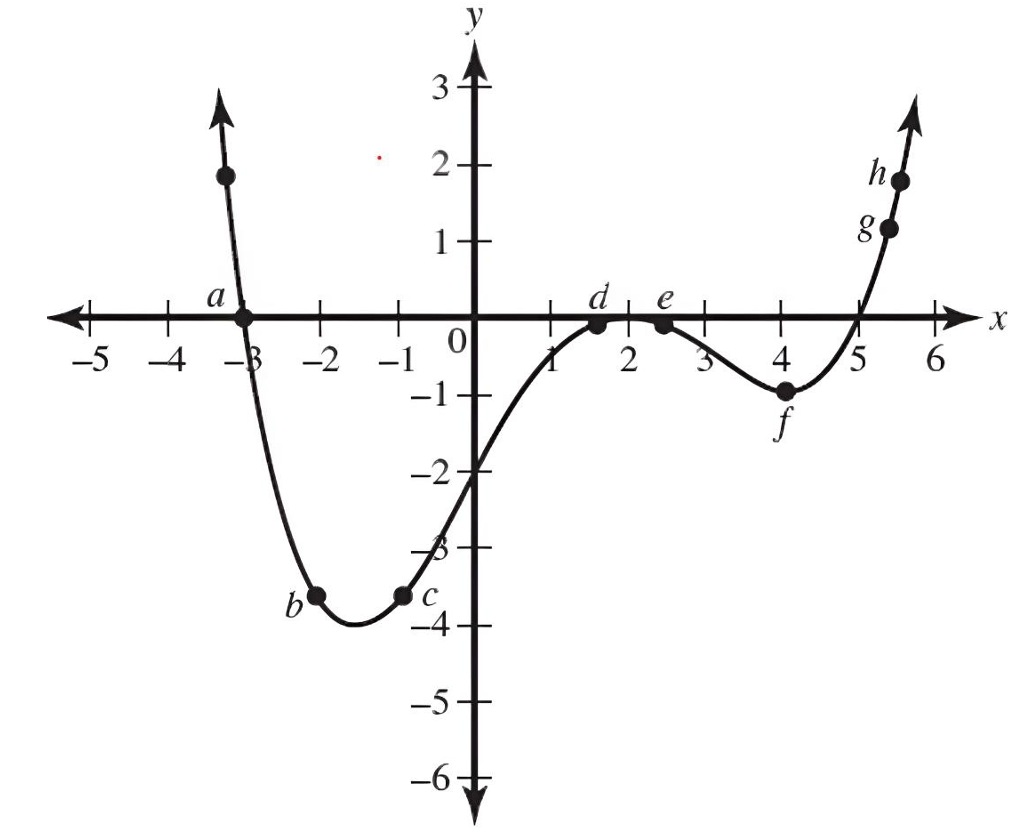
The average rate of change between two points is equivalent to the slope of the line connecting them, calculated as \(m = \frac{y_2 – y_1}{x_2 – x_1}\).
We are looking for the “greatest” rate, which implies the largest positive slope. Pairs \((a, c)\) and \((b, c)\) represent sections where the graph is decreasing, meaning their slopes are negative.
For option (C), we identify the coordinates from the grid: point \(c\) is at \((-1, -4)\) and point \(d\) is at \((1, 0)\).
Calculating the slope for pair \((c, d)\): \(m = \frac{0 – (-4)}{1 – (-1)} = \frac{4}{2} = 2\).
For option (D), point \(f\) is at \((4, -1)\) and \(h\) is approximately at \((5.8, 1.8)\). The estimated slope is roughly \(\frac{1.8 – (-1)}{5.8 – 4} \approx 1.55\).
Comparing the positive values, the slope of 2 is greater than \(\approx 1.55\).
Therefore, the pair \(c\) and \(d\) has the greatest average rate of change.
Correct Option: (C)
Question 46

▶️ Answer/Explanation
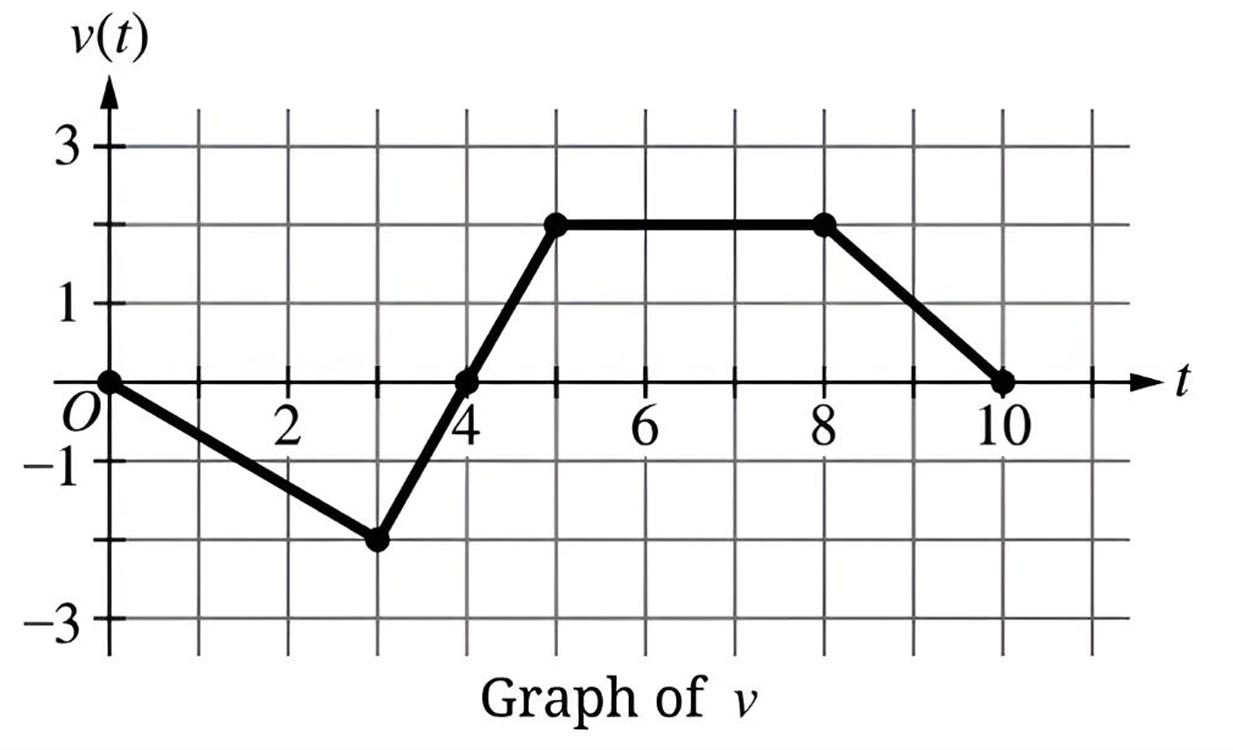
The velocity \( v(t) \) is decreasing when the acceleration \( a(t) \) is negative. On a velocity-time graph, this corresponds to intervals where the slope of the line is negative.
\(\bullet\) For \( \mathbf{0 \le t \le 3} \): The graph slopes downward from \( v=0 \) to \( v=-2 \). The slope is negative (\( m = -2/3 \)), so velocity is decreasing.
\(\bullet\) For \( 3 \le t \le 5 \): The graph slopes upward. The slope is positive, so velocity is increasing.
\(\bullet\) For \( 5 \le t \le 8 \): The graph is horizontal. The slope is zero, so velocity is constant.
\(\bullet\) For \( \mathbf{8 \le t \le 10} \): The graph slopes downward from \( v=2 \) to \( v=0 \). The slope is negative (\( m = -1 \)), so velocity is decreasing.
Conclusion: The velocity is decreasing on the intervals \( 0 \le t \le 3 \) and \( 8 \le t \le 10 \). Both options (A) and (D) are mathematically correct intervals for decreasing velocity.
Question 47
▶️ Answer/Explanation
First, fully factor the polynomial: \( p(x) = x(x+3)(x-3)(x+3) = x(x-3)(x+3)^2 \).
Identify the zeros (critical points) of the function: \( x = 0 \), \( x = 3 \), and \( x = -3 \).
Analyze the factor \( (x+3)^2 \): it is always positive for all real \( x \neq -3 \), so it does not change the sign of \( p(x) \).
The sign of \( p(x) \) therefore depends on the remaining term \( x(x-3) \).
We solve \( x(x-3) < 0 \), which occurs between the roots, so \( 0 < x < 3 \).
Checking the interval \( (0, 3) \), the condition holds true, and it does not include \( x = -3 \).
Therefore, the interval where \( p(x) < 0 \) is \( (0, 3) \).
Correct Option: (D)
Question 48
▶️ Answer/Explanation
The goal is to find an expression equivalent to \(h(x) = 9 \cdot 3^x\) using properties of exponents.
First, we express the constant \(9\) as a power with base \(3\), such that \(9 = 3^2\).
Next, we substitute this into the function equation: \(h(x) = 3^2 \cdot 3^x\).
Using the product rule for exponents, \(a^m \cdot a^n = a^{m+n}\), we combine the terms.
This simplification results in \(h(x) = 3^{(2+x)}\) or \(h(x) = 3^{(x+2)}\).
Comparing this result to the given options, it matches option (B).
Correct Option: (B)
Question 49
▶️ Answer/Explanation
The correct option is (B).
To find the slant asymptote, we divide the numerator by the denominator:
1. We represent the function as \(h(x) = \frac{x^2 – 6x + 7}{x – 2}\).
2. Perform polynomial long division: Divide \(x^2\) by \(x\) to get \(x\). Multiply \(x(x – 2) = x^2 – 2x\).
3. Subtract \((x^2 – 6x) – (x^2 – 2x)\) to result in \(-4x\). Bring down the \(+7\).
4. Divide \(-4x\) by \(x\) to get \(-4\). Multiply \(-4(x – 2) = -4x + 8\).
5. Subtract \((-4x + 7) – (-4x + 8)\) to get a remainder of \(-1\).
6. The function can be written as \(h(x) = (x – 4) – \frac{1}{x – 2}\).
7. As \(x \rightarrow \infty\), the remainder fraction approaches 0, leaving the slant asymptote \(y = x – 4\).
Question 50

▶️ Answer/Explanation
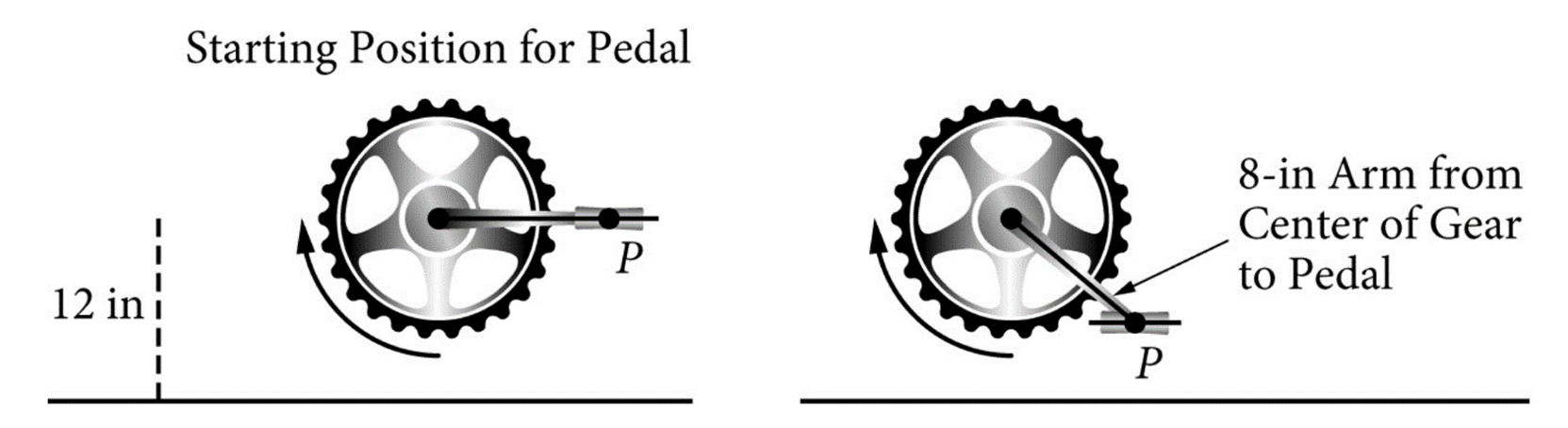
The center of the gear is 12 inches above the ground, so the vertical midline of the function is 12.
The length of the pedal arm is 8 inches, which determines the amplitude of the motion, so amplitude = 8.
The pedal completes 1 revolution per second, meaning the period \(T = 1\).
The coefficient of \(t\) inside the function is determined by \(\frac{2\pi}{T} = \frac{2\pi}{1} = 2\pi\).
At \(t=0\), the pedal starts at the midline (12 in) and moves clockwise (downwards first).
A sine function starts at the midline; since it moves down first, it must be a negative sine function.
Combining these components gives the expression: \(h(t) = 12 – 8 \sin(2\pi t)\).
Correct Option: (D)
Question 51
▶️ Answer/Explanation
The end behavior of the polynomial \(p(x)\) is determined by its leading term, \(ax^n\).
Since \(\lim_{x \to \infty} p(x) = -\infty\), the leading term must be negative as \(x\) gets large, which implies \(a < 0\).
This condition eliminates options (C) and (D) because \(a\) must be negative.
Since \(\lim_{x \to -\infty} p(x) = \infty\), the function rises to the left. With \(a < 0\), \(x^n\) must be negative.
For \(x^n\) to be negative when \(x\) is negative, the degree \(n\) must be an odd integer.
Looking at the remaining options, only (A) has an odd value for \(n\) (\(n=5\)).
Therefore, the correct choice is \(a = -3\) and \(n = 5\).
Question 52

(B)

(C)

(D)

▶️ Answer/Explanation
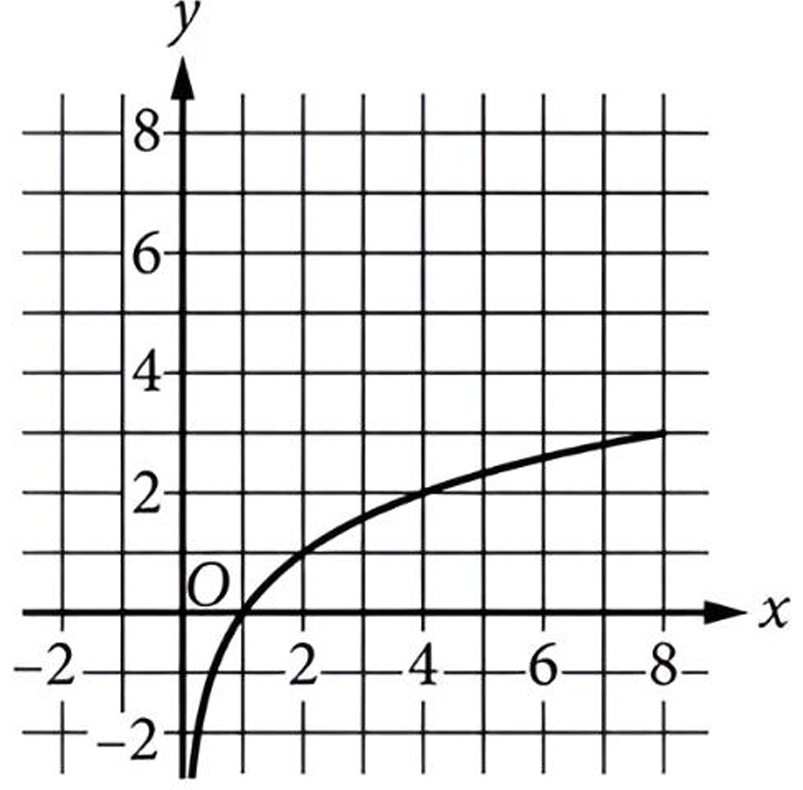
The problem describes a function property: when input \( x \) doubles (\( x \rightarrow 2x \)), the output increases by 1 (\( g(x) \rightarrow g(x) + 1 \)).
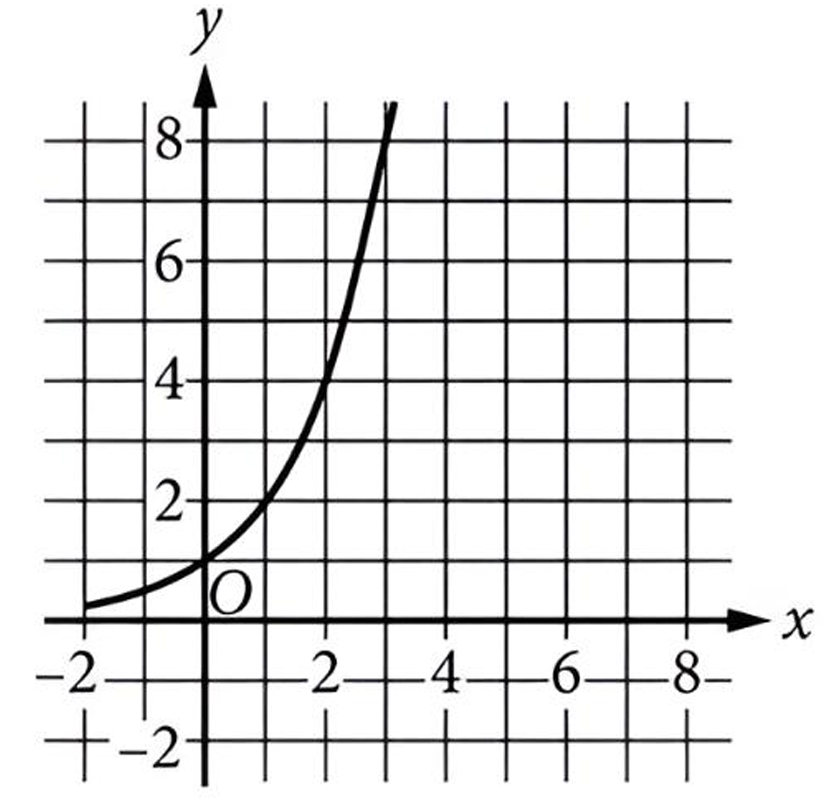
This relationship is written as \( g(2x) = g(x) + 1 \), which is characteristic of a logarithmic function \( g(x) = \log_2(x) \).
Let’s test the points on Graph (B) to verify this:
• At \( x = 1 \), \( y = 0 \).
• At \( x = 2 \) (doubled), \( y = 1 \). The increase is \( 1 – 0 = 1 \).
• At \( x = 4 \) (doubled), \( y = 2 \). The increase is \( 2 – 1 = 1 \).
• At \( x = 8 \) (doubled), \( y = 3 \). The increase is \( 3 – 2 = 1 \).
Graphs (C) and (D) represent linear functions passing through the origin, where doubling input doubles the output.
Graph (A) represents an exponential function, which grows much faster than the required condition.
Therefore, Graph (B) is the correct answer.
Question 53
▶️ Answer/Explanation
The given equation is \(\log(y – A) = Bx – \log C\).
Rearrange the terms to group the logarithms: \(\log(y – A) + \log C = Bx\).
Apply the product rule \(\log m + \log n = \log(mn)\): \(\log[C(y – A)] = Bx\).
Convert from logarithmic to exponential form (base 10): \(C(y – A) = 10^{Bx}\).
Divide both sides by \(C\): \(y – A = \frac{10^{Bx}}{C}\).
Add \(A\) to both sides to solve for \(y\): \(y = \frac{10^{Bx}}{C} + A\).
Therefore, the correct option is (A).
Question 54
▶️ Answer/Explanation
The correct answer is (C).
The distance from the origin to a polar point \((r, \theta)\) is given by \(|r| = |f(\theta)|\).
On the interval \(\pi \leq \theta \leq \frac{3\pi}{2}\), we are given that \(f(\theta) < 0\), so the distance is \(d(\theta) = -f(\theta)\).
We are also given that \(f(\theta)\) is decreasing, which implies its derivative is negative: \(f'(\theta) < 0\).
To find how the distance changes, we differentiate \(d(\theta)\) with respect to \(\theta\): \(d'(\theta) = -f'(\theta)\).
Since \(f'(\theta)\) is negative, \(-f'(\theta)\) must be positive, meaning \(d'(\theta) > 0\).
A positive derivative indicates an increasing function, so the distance is increasing on this interval.
Question 55
(B) \( 7 \)
(C) \( 4 \)
(D) \( \frac{5}{3} \)
▶️ Answer/Explanation
To find the horizontal asymptote, compare the degrees of the numerator and denominator; since both are 2, the asymptote is \( y = \frac{1}{1} = 1 \), so \( b = 1 \).
Set the function equal to the asymptote to find the intersection: \( \frac{x^2 – 4}{x^2 – 2x + 2} = 1 \).
Multiply across and simplify: \( x^2 – 4 = x^2 – 2x + 2 \).
Subtract \( x^2 \) from both sides to get \( -4 = -2x + 2 \).
Solve for \( x \): \( 2x = 6 \Rightarrow x = 3 \), so \( a = 3 \).
Finally, calculate the sum: \( a + b = 3 + 1 = 4 \).
Therefore, the correct option is (C).
Question 56
▶️ Answer/Explanation
To find the value of \( g^{-1}(3) \), we need to find the value of \( x \) such that \( g(x) = 3 \).
First, substitute \( f(x) \) into the given equation for \( g(x) \):
\( g(x) = \frac{1}{2}\log_5(x+3) + 2 \)
Set the equation equal to 3 and solve for \( x \):
\( \frac{1}{2}\log_5(x+3) + 2 = 3 \)
Subtract 2 from both sides: \( \frac{1}{2}\log_5(x+3) = 1 \)
Multiply both sides by 2: \( \log_5(x+3) = 2 \)
Convert the logarithmic equation to exponential form: \( x + 3 = 5^2 \)
Solve for \( x \): \( x = 25 – 3 = 22 \).
Therefore, the correct option is (D).
Question 57
▶️ Answer/Explanation
We are given the model (h(d) = A_0(0.5)^{d/8}) where (d) is in days. We need to convert the variable to hours (t), given that (t = 24d). First, solve for (d) in terms of (t): (d = \frac{t}{24}). Substitute this expression for (d) into the original function: (k(t) = A_0(0.5)^{\frac{t/24}{8}}). Simplify the exponent by multiplying the denominators: (\frac{t}{24 \cdot 8} = \frac{t}{192}). Therefore, the function is (k(t) = A_0(0.5)^{t/192}). Comparing this to the options, Option (D) is the correct choice as it utilizes the factor (192) derived from (24 \times 8).
Question 58
▶️ Answer/Explanation
To determine the behavior, we examine the first derivative (slope) and second derivative (concavity) at \( t = 150 \).
1. Determine if increasing or decreasing:
Calculate \( D'(t) = -160\left(\frac{2\pi}{365}\right)\sin\left(\frac{2\pi}{365}(t – 172)\right) \). At \( t = 150 \), the term \( (t-172) \) is negative. Since sine is an odd function, the sine term is negative. Multiplying by the negative coefficient makes \( D'(150) \) positive. Thus, daylight is increasing.
2. Determine the rate of change:
Calculate \( D”(t) = -160\left(\frac{2\pi}{365}\right)^2\cos\left(\frac{2\pi}{365}(t – 172)\right) \). At \( t = 150 \), the cosine of a small angle is positive. The leading negative sign makes \( D”(150) \) negative. This means the graph is concave down, or the rate is decreasing.
Conclusion: The function is increasing at a decreasing rate. (Option A)
Question 59

▶️ Answer/Explanation
Correct Option: (D)
The midline is (y = -1) because the maximum is (2) and the minimum is (-4), averaging to (\frac{2 + (-4)}{2} = -1).
The amplitude is (3), calculated as the distance from the midline (-1) to the maximum (2).
The period is (\pi), as the distance between peaks (e.g., from (\approx 0.375\pi) to (\approx 1.375\pi)) corresponds to (\pi). This implies the coefficient (B = \frac{2\pi}{\pi} = 2).
The graph crosses the midline (y=-1) going upwards at (x = \frac{\pi}{8}). Since a standard sine function starts this way at (x=0), this indicates a phase shift of (\frac{\pi}{8}) to the right.
Combining these, the function is (f(x) = 3 \sin\left(2\left(x – \frac{\pi}{8}\right)\right) – 1).

Question 60
II. \( k(-3) = -7 \)
III. \( \lim_{x \to -\infty} k(x) = \infty \)
(B) II only
(C) I and II only
(D) I and III only
▶️ Answer/Explanation
The correct answer is (A).
Step 1 (Statement I): The definition of an odd function is \( k(-x) = -k(x) \). For \( x = 2 \), we have \( k(-2) = -k(2) \). Since it is given that \( k(2) = 0 \), it follows that \( k(-2) = -0 = 0 \). Thus, Statement I is true.
Step 2 (Statement II): Using the odd function property for \( x = 3 \), we have \( k(-3) = -k(3) \). Since \( k(3) = -7 \), substitution gives \( k(-3) = -(-7) = 7 \). The statement claims \( k(-3) = -7 \), which is incorrect. Thus, Statement II is false.
Step 3 (Statement III): We are given \( k(x) \leq 0 \) for \( x \geq 2 \). Due to symmetry, for \( x \leq -2 \), \( k(x) \) must be \( \geq 0 \). However, a function being non-negative does not imply it approaches infinity; it could approach a constant limit. Thus, Statement III is not necessarily true.
Question 61
▶️ Answer/Explanation
The correct option is (A).
The limit \( \lim_{x\to-3^+} f(x) = -\infty \) implies a vertical asymptote at \( x = -3 \).
For the logarithm to be undefined at this asymptote, the argument must be zero: \( x + h = 0 \).
Substituting \( x = -3 \), we get \( -3 + h = 0 \), so \( h = 3 \).
The function passes through \( (-2, 4) \), so substitute \( x = -2 \), \( f(x) = 4 \), and \( h = 3 \).
\( 4 = 2 \log(-2 + 3) + k \Rightarrow 4 = 2 \log(1) + k \).
Since \( \log(1) = 0 \), the equation becomes \( 4 = 0 + k \), which gives \( k = 4 \).
Question 62

▶️ Answer/Explanation
(A) (i)
First, evaluate the inner function \(f(5)\) using the table: \(f(5) = 34\).
Next, substitute this value into \(g(x)\) to find \(h(5) = g(34)\).
\(g(34) = \frac{34^3 – 14(34) – 27}{34 + 2}\)
\(g(34) = \frac{39304 – 476 – 27}{36} = \frac{38801}{36}\)
\(h(5) \approx 1077.806\)
(A) (ii)
To find \(f^{-1}(4)\), we look for the input value \(x\) in the table that produces an output of \(4\).
The table shows that \(f(3) = 4\).
Therefore, \(f^{-1}(4) = 3\).
(B) (i)
Set \(g(x) = 3\) and solve for \(x\):
\(\frac{x^3 – 14x – 27}{x + 2} = 3\)
Multiply both sides by \((x+2)\): \(x^3 – 14x – 27 = 3(x + 2)\)
Simplify: \(x^3 – 14x – 27 = 3x + 6\)
Rearrange into polynomial form: \(x^3 – 17x – 33 = 0\)
Using a graphing calculator to find the zero of this polynomial:
\(x \approx 4.879\)
(B) (ii)
We evaluate the limit as \(x \to -\infty\) for \(g(x)\).
\(\lim_{x \to -\infty} \frac{x^3 – 14x – 27}{x + 2}\)
By examining the leading terms, the function behaves like \(\frac{x^3}{x} = x^2\) for large absolute values of \(x\).
As \(x \to -\infty\), \(x^2 \to \infty\).
\(\lim_{x \to -\infty} g(x) = \infty\)
(C) (i)
Calculate the first differences of \(f(x)\): \((-5) – (-10) = 5\), \(4 – (-5) = 9\), \(17 – 4 = 13\), \(34 – 17 = 17\).
Calculate the second differences: \(9 – 5 = 4\), \(13 – 9 = 4\), \(17 – 13 = 4\).
Since the second differences are constant, \(f\) is best modeled by a quadratic function.
(C) (ii)
The model is quadratic because for equal intervals of the input values \(x\) (step size of \(1\)), the rate of change of the output values increases by a constant amount (constant second difference of \(4\)).
Question 63
▶️ Answer/Explanation
(A)(i) Equations
Substituting the points \((1, 3)\) and \((5, 89)\) into \(H(t) = ab^t\):
1. \(3 = ab^1\) (or \(3 = ab\))
2. \(89 = ab^5\)
(A)(ii) Values for a and b
Dividing equation 2 by equation 1: \(\frac{ab^5}{ab} = \frac{89}{3} \implies b^4 = 29.67\).
Solving for \(b\): \(b = (29.67)^{0.25} \approx 2.33\).
Solving for \(a\): \(a = \frac{3}{2.33} \approx 1.29\).
(B)(i) Average Rate of Change
\(\text{Rate} = \frac{H(5) – H(1)}{5 – 1} = \frac{89 – 3}{4} = \frac{86}{4} = 21.5\)
Answer: 21.5 feet per week.
(B)(ii) Interpretation
The answer indicates that between the first and fifth weeks, the bamboo tree grew at an average speed of 21.5 feet per week.
(B)(iii) Comparison
Greater. The function represents exponential growth (\(b > 1\)), which is concave up. This means the rate of growth increases over time, so the rate after week 5 will be steeper than the rate before week 5.
(C) Confidence
\(t = 4\) weeks.
The biologists should be more confident in \(t=4\) because it is an interpolation (within the observed data range). \(t=11\) is an extrapolation; biological growth cannot remain exponential indefinitely, so the model is likely inaccurate that far out.
Question 64

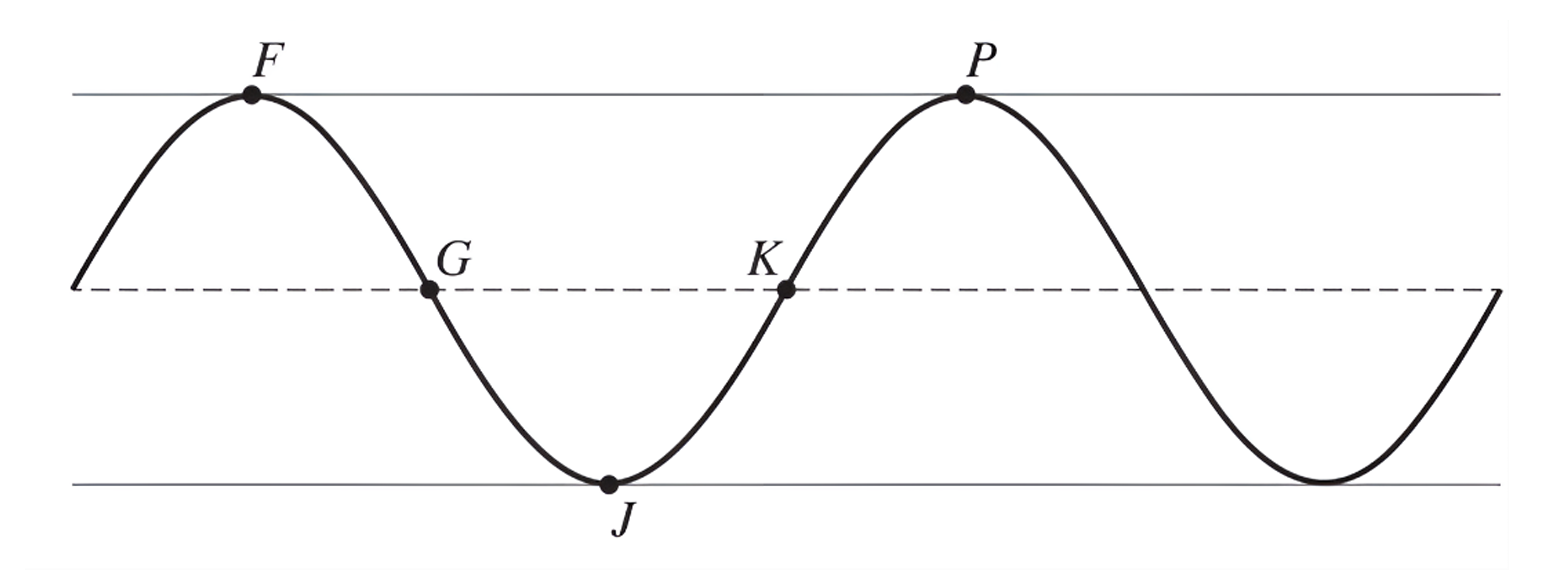
Determine the possible coordinates $(t, h(t))$ for the $5$ points: $F, G, J, K,$ and $P$.

(A) $h$ is positive and increasing
(B) $h$ is positive and decreasing
(C) $h$ is negative and increasing
(D) $h$ is negative and decreasing
▶️ Answer/Explanation
(A)
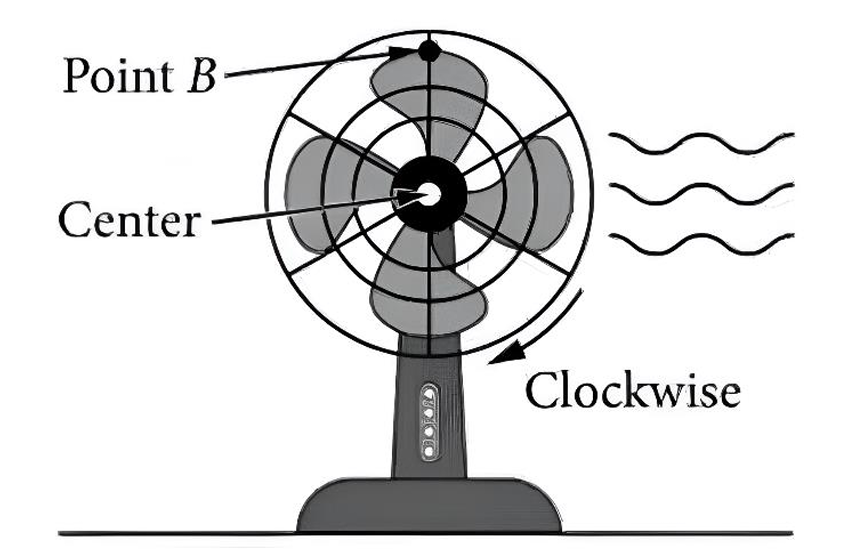
The center of the fan is $d = 20$ inches above the table. The radius of the fan blade is $r = 6$ inches, which is the amplitude $a$. The maximum height is $20 + 6 = 26$ inches and the minimum height is $20 – 6 = 14$ inches. The fan completes $5$ rotations per second, so the period is $T = \frac{1}{5} = 0.2$ seconds. Point $B$ starts at the maximum height at $t = 0$, so point $F$ is $(0, 26)$. Point $G$ is at the midline after $\frac{1}{4}$ of a period: $(\frac{0.2}{4}, 20) = (0.05, 20)$. Point $J$ is at the minimum after $\frac{1}{2}$ of a period: $(\frac{0.2}{2}, 14) = (0.1, 14)$. Point $K$ is at the midline after $\frac{3}{4}$ of a period: $(\frac{3 \times 0.2}{4}, 20) = (0.15, 20)$. Point $P$ is at the maximum after $1$ full period: $(0.2, 26)$. The coordinates are: $F(0, 26)$, $G(0.05, 20)$, $J(0.1, 14)$, $K(0.15, 20)$, and $P(0.2, 26)$.
(B)
The amplitude is $a = 6$. The vertical shift (midline) is $d = 20$. The period is $T = 0.2$, so the frequency constant is $b = \frac{2\pi}{0.2} = 10\pi$. Since the function starts at a maximum at $t=0$, it follows $h(t) = 6 \cos(10\pi t) + 20$. To write this as a sine function $h(t) = 6 \sin(10\pi(t + c)) + 20$, we use the identity $\cos(\theta) = \sin(\theta + \frac{\pi}{2})$. Setting $10\pi(t + c) = 10\pi t + \frac{\pi}{2}$, we find $10\pi c = \frac{\pi}{2}$, which gives $c = \frac{1}{20} = 0.05$. Thus, $a = 6$, $b = 10\pi$, $c = 0.05$, and $d = 20$.
(C)
(i) On the interval $(t_1, t_2)$, which is $(0.15, 0.2)$, the graph moves from the midline (point $K$) up to the maximum (point $P$). Throughout this interval, $h(t)$ is between $20$ and $26$, so it is positive. The function is moving upwards, so it is increasing. The correct option is (A) $h$ is positive and increasing.
(ii) On the interval $(t_1, t_2)$, the graph is concave down as it levels off toward the maximum. The slope (rate of change) is positive because the function is increasing. However, the slope is becoming less steep as it approaches the horizontal tangent at point $P$. Therefore, the rate of change of $h$ is decreasing on the interval $(t_1, t_2)$.
Question 65

(A) The function \(g\) and \(h\) are given by
\(g(x) = 3 \ln x – \frac{1}{2} \ln x\)
\(h(x) = \frac{\sin^2 x – 1}{\cos x}\)
(i) Rewrite \(g(x)\) as a single natural logarithm without negative exponents in any part of the expression. Your result should be of the form \(\ln(\text{expression})\).
(ii) Rewrite \(h(x)\) as an expression in which \(\cos x\) appears once and no other trigonometric functions are involved.
(B) The functions \(j\) and \(k\) are given by
\(j(x) = 2(\sin x)(\cos x)\)
\(k(x) = 8e^{(3x)} – e\)
(i) Solve \(j(x) = 0\) for values of \(x\) in the interval \(\left[0, \frac{\pi}{2}\right]\).
(ii) Solve \(k(x) = 3e\) for values of \(x\) in the domain of \(k\).
(C) The function \(m\) is given by
\(m(x) = \cos(2x) + 4\)
Find all input values in the domain of \(m\) that yield an output of \(\frac{9}{2}\).
▶️ Answer/Explanation
(A)(i) Rewrite \(g(x)\)
The function is given by \(g(x) = 3 \ln x – \frac{1}{2} \ln x\).
Combine the like terms:
\(g(x) = \left(3 – \frac{1}{2}\right) \ln x\)
\(g(x) = \frac{5}{2} \ln x\)
Apply the power property of logarithms, \(a \ln b = \ln(b^a)\):
\(g(x) = \ln\left(x^{5/2}\right)\)
(A)(ii) Rewrite \(h(x)\)
The function is given by \(h(x) = \frac{\sin^2 x – 1}{\cos x}\).
Recall the Pythagorean identity: \(\sin^2 x + \cos^2 x = 1\).
Rearrange the identity to isolate the numerator expression: \(\sin^2 x – 1 = -\cos^2 x\).
Substitute this into the function:
\(h(x) = \frac{-\cos^2 x}{\cos x}\)
Simplify the expression by canceling one \(\cos x\) term:
\(h(x) = -\cos x\)
(B)(i) Solve \(j(x) = 0\)
Set the function equal to zero: \(2(\sin x)(\cos x) = 0\).
Divide both sides by 2:
\(\sin x \cos x = 0\)
By the zero product property, either \(\sin x = 0\) or \(\cos x = 0\).
Case 1: \(\sin x = 0\). In the interval \(\left[0, \frac{\pi}{2}\right]\), \(x = 0\).
Case 2: \(\cos x = 0\). In the interval \(\left[0, \frac{\pi}{2}\right]\), \(x = \frac{\pi}{2}\).
The solutions are \(x = 0\) and \(x = \frac{\pi}{2}\).
(B)(ii) Solve \(k(x) = 3e\)
Set the function equal to \(3e\):
\(8e^{(3x)} – e = 3e\)
Add \(e\) to both sides:
\(8e^{(3x)} = 4e\)
Divide both sides by 8:
\(e^{(3x)} = \frac{4e}{8}\)
\(e^{(3x)} = \frac{e}{2}\)
Take the natural logarithm (\(\ln\)) of both sides:
\(\ln\left(e^{3x}\right) = \ln\left(\frac{e}{2}\right)\)
Use logarithm properties to simplify (\(\ln(e^a) = a\) and \(\ln(a/b) = \ln a – \ln b\)):
\(3x = \ln e – \ln 2\)
Since \(\ln e = 1\):
\(3x = 1 – \ln 2\)
Divide by 3:
\(x = \frac{1 – \ln 2}{3}\)
(C) Find input values for \(m(x) = \frac{9}{2}\)
Set the function equal to \(\frac{9}{2}\):
\(\cos(2x) + 4 = \frac{9}{2}\)
Subtract 4 from both sides (note that \(4 = \frac{8}{2}\)):
\(\cos(2x) = \frac{9}{2} – \frac{8}{2}\)
\(\cos(2x) = \frac{1}{2}\)
The reference angle for cosine equal to \(\frac{1}{2}\) is \(\frac{\pi}{3}\).
The general solution for \(2x\) is:
\(2x = \frac{\pi}{3} + 2\pi n\) or \(2x = -\frac{\pi}{3} + 2\pi n\) (where \(n\) is an integer).
Solve for \(x\) by dividing by 2:
\(x = \frac{\pi}{6} + \pi n\) or \(x = -\frac{\pi}{6} + \pi n\)
Combining these, the input values are \(x = \pm \frac{\pi}{6} + \pi n\) for any integer \(n\).