
AS & A Level Chemistry 2.1 Relative masses of atoms and molecules Exam Style Practice Questions Paper 1- New Syllabus
Question
Which statement is correct?
(B) The relative molecular mass of \(\mathrm{O_2}\) is \(16.0\).
(C) The relative formula mass of \(\mathrm{CaCO_3}\) is \(100.1\).
(D) The relative isotopic mass of a \(\mathrm{^{24}Mg}\) atom is \(24.3\).
▶️ Answer/Explanation
Correct Answer: \( \boxed{\mathrm{C}} \)
Relative formula mass of calcium carbonate:
\(\mathrm{CaCO_3}=40.1+12.0+3(16.0)=100.1\)
Option (A) is incorrect because \(35.5\) is the average relative atomic mass of chlorine, not the isotopic mass of \(\mathrm{^{35}Cl}\).
Option (B) is incorrect because the relative molecular mass of \(\mathrm{O_2}\) is \(32.0\).
Option (D) is incorrect because the relative isotopic mass of \(\mathrm{^{24}Mg}\) is approximately \(24.0\), not \(24.3\).
Therefore, the correct answer is (C).
Question
When \(0.15\,\mathrm{g}\) of an organic compound is vaporised, it occupies a volume of \(65.0\,\mathrm{cm^3}\) at \(405\,\mathrm{K}\) and \(1.00\times10^5\,\mathrm{Pa}\).
Using the expression \( \mathrm{pV=nRT} \), which expression should be used to calculate the relative molecular mass, \(M_{\mathrm{r}}\), of the compound?
(A) \( \displaystyle \frac{0.15\times65\times10^{-6}\times1\times10^{5}}{8.31\times405} \)
(B) \( \displaystyle \frac{0.15\times8.31\times405}{1\times10^{5}\times65\times10^{-3}} \)
(C) \( \displaystyle \frac{0.15\times65\times10^{-3}\times1\times10^{5}}{8.31\times405} \)
(D) \( \displaystyle \frac{0.15\times8.31\times405}{1\times10^{5}\times65\times10^{-6}} \)
▶️ Answer/Explanation
Correct Answer: \( \boxed{\mathrm{D}} \)
Using the ideal gas equation:
\( \mathrm{pV=nRT} \)
Since
\( \mathrm{n=\dfrac{m}{M_r}} \)
Substituting gives:
\( \mathrm{M_r=\dfrac{mRT}{pV}} \)
The volume must be converted to SI units:
\(65.0\,\mathrm{cm^3}=65.0\times10^{-6}\,\mathrm{m^3}\)
Hence the required expression is:
\( \displaystyle \frac{0.15\times8.31\times405}{1\times10^{5}\times65\times10^{-6}} \)
Therefore, the correct answer is (D).
Question
The skeletal formulae of arginine and lysine are shown.
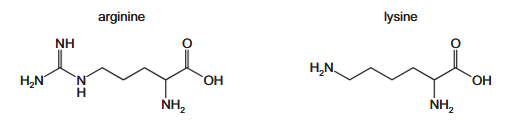
Which row is correct?
| substance | empirical formula | \( \mathrm{M_r} \) | |
|---|---|---|---|
| A | arginine | \( \mathrm{C_3H_7N_2O} \) | 174 |
| B | arginine | \( \mathrm{C_3H_8N_2O} \) | 176 |
| C | lysine | \( \mathrm{C_3H_7NO} \) | 144 |
| D | lysine | \( \mathrm{C_3H_8NO} \) | 146 |
▶️ Answer/Explanation
Correct Answer: \( \boxed{\mathrm{A}} \)
From the skeletal formula, arginine has the molecular formula:
\( \mathrm{C_6H_{14}N_4O_2} \)
Its empirical formula is obtained by dividing all subscripts by 2:
\( \mathrm{C_3H_7N_2O} \)
Its relative molecular mass is:
\( \mathrm{(6\times12)+(14\times1)+(4\times14)+(2\times16)=174} \)
For lysine, the molecular formula is \( \mathrm{C_6H_{14}N_2O_2} \), giving an empirical formula of \( \mathrm{C_3H_7NO} \) and \( M_r=146 \). Therefore, options C and D are incorrect.
Hence, the correct answer is (A).