
AS & A Level Chemistry 21.1 Organic synthesis Exam Style Practice Questions Paper 1- New Syllabus
Question
The structure of a naturally occurring compound, Q, is shown.
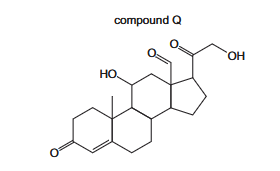
Compound Q is heated under reflux with an excess of acidified \(\mathrm{KMnO_4}\).
Organic product R is formed.
Which row is correct?
| Results of tests with compound Q | Results of tests with organic product R | |
|---|---|---|
| A | orange precipitate with 2,4-DNPH and no reaction with alkaline \(\mathrm{I_2(aq)}\) | yellow precipitate with alkaline \(\mathrm{I_2(aq)}\) and no reaction with Fehling’s reagent |
| B | red precipitate with Fehling’s reagent and no reaction with alkaline \(\mathrm{I_2(aq)}\) | orange precipitate with 2,4-DNPH and no reaction with alkaline \(\mathrm{I_2(aq)}\) |
| C | yellow precipitate with alkaline \(\mathrm{I_2(aq)}\) and orange precipitate with 2,4-DNPH | no reaction with alkaline \(\mathrm{I_2(aq)}\) and no reaction with Fehling’s reagent |
| D | yellow precipitate with alkaline \(\mathrm{I_2(aq)}\) and red precipitate with Fehling’s reagent | yellow precipitate with alkaline \(\mathrm{I_2(aq)}\) and orange precipitate with 2,4-DNPH |
▶️ Answer/Explanation
Correct Answer: \( \boxed{\mathrm{B}} \)
Compound Q contains an aldehyde group, so it gives a positive Fehling’s test, producing a red precipitate.
Q does not contain the \(\mathrm{CH_3CO-}\) or \(\mathrm{CH_3CH(OH)-}\) group required for the iodoform reaction, so it gives no reaction with alkaline iodine.
On heating under reflux with excess acidified \(\mathrm{KMnO_4}\), the aldehyde is oxidised to a carboxylic acid, while the ketone group remains unchanged.
Product R therefore still contains a carbonyl group, giving an orange precipitate with 2,4-DNPH, but it does not react with alkaline iodine.
Therefore, the correct answer is (B).
Question
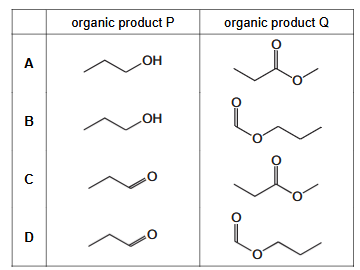
Propanoic acid reacts with \( \mathrm{LiAlH_4} \) to give organic product P.
Methanoic acid reacts with organic product P, in the presence of a few drops of concentrated sulfuric acid, to give organic product Q.
What are the skeletal formulae of the two organic products?
▶️ Answer/Explanation
Correct Answer: \( \boxed{\mathrm{B}} \)
\( \mathrm{LiAlH_4} \) reduces carboxylic acids to primary alcohols.
Therefore, propanoic acid is reduced to propan-1-ol (product P):
\( \mathrm{CH_3CH_2COOH \xrightarrow{LiAlH_4} CH_3CH_2CH_2OH} \)
Propan-1-ol then reacts with methanoic acid in the presence of concentrated sulfuric acid to form the ester propyl methanoate:
\( \mathrm{HCOOH + CH_3CH_2CH_2OH \rightleftharpoons HCOOCH_2CH_2CH_3 + H_2O} \)
Only option B shows propan-1-ol as product P and propyl methanoate as product Q. Therefore, the correct answer is (B).
Question
Which formula represents the organic compound formed by the reaction of propanoic acid with methanol in the presence of concentrated sulfuric acid as a catalyst?
(B) \( \mathrm{CH_3CH_2CO_2CH_3} \)
(C) \( \mathrm{CH_3CO_2CH_2CH_3} \)
(D) \( \mathrm{CH_3CH_2CH_2CO_2CH_3} \)
▶️ Answer/Explanation
Correct Answer: \( \boxed{\mathrm{B}} \)
Propanoic acid reacts with methanol in an acid-catalysed esterification reaction to form an ester and water.
\( \mathrm{CH_3CH_2COOH + CH_3OH \rightleftharpoons CH_3CH_2COOCH_3 + H_2O} \)
The ester formed is methyl propanoate, with the formula \( \mathrm{CH_3CH_2CO_2CH_3} \).
Option (A) is a ketone, option (C) is ethyl ethanoate, and option (D) is methyl butanoate.
Therefore, the correct answer is (B).