
AS & A Level Chemistry 3.1 Electronegativity and bonding Exam Style Practice Questions Paper 1- New Syllabus
Question
J is either \( \mathrm{MgCl_2} \) or \( \mathrm{AlCl_3} \).
K is either \( \mathrm{SiO_2} \) or \( \mathrm{SiCl_4} \).
For J:
\( \mathrm{J(aq)\xrightarrow{\;add\ drops\ of\ aqueous\ NaOH\;}white\ precipitate\xrightarrow{\;add\ excess\ aqueous\ NaOH\;}precipitate\ dissolves} \)
For K:
\( \mathrm{K\xrightarrow{\;add\ water\;}misty\ white\ fumes\ and\ a\ white\ precipitate\ in\ a\ solution\ with\ pH<7} \)
Which row is correct?
| Identity of J | Identity of K | |
|---|---|---|
| (A) | \( \mathrm{AlCl_3} \) | \( \mathrm{SiCl_4} \) |
| (B) | \( \mathrm{AlCl_3} \) | \( \mathrm{SiO_2} \) |
| (C) | \( \mathrm{MgCl_2} \) | \( \mathrm{SiCl_4} \) |
| (D) | \( \mathrm{MgCl_2} \) | \( \mathrm{SiO_2} \) |
▶️ Answer/Explanation
Correct Answer: \( \boxed{\mathrm{A}} \)
When aqueous sodium hydroxide is added to \( \mathrm{Al^{3+}} \), a white precipitate of \( \mathrm{Al(OH)_3} \) forms, which dissolves in excess sodium hydroxide because it is amphoteric.
In contrast, \( \mathrm{Mg(OH)_2} \) does not dissolve in excess sodium hydroxide. Therefore, J is \( \mathrm{AlCl_3} \).
\( \mathrm{SiCl_4} \) reacts vigorously with water to produce hydrochloric acid (giving a solution with \( \mathrm{pH<7} \)) and a white precipitate of hydrated silicon dioxide, together with misty white fumes of \( \mathrm{HCl} \).
\( \mathrm{SiO_2} \) does not react with water under these conditions.
Therefore, \(J=\mathrm{AlCl_3}\) and \(K=\mathrm{SiCl_4}\). Hence, the correct answer is (A).
An ion contains 1 nitrogen atom and 2 hydrogen atoms. It has an H–N–H bond angle of approximately 105°. Which row is correct?
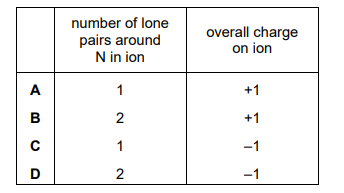
▶️ Answer/Explanation
Ans: D
The ion described is \(\text{NH}_2^-\), which has a bent shape due to the lone pair on nitrogen. The bond angle of 105° is consistent with a bent molecular geometry, where the lone pair repels the bonding pairs, reducing the angle from the ideal tetrahedral angle of 109.5°. The correct row in the table is D, as it matches the ion’s formula, shape, and bond angle.
This question is about the first ionisation energies of magnesium and neon. Which row is correct?

▶️ Answer/Explanation
Ans: D
Neon has a higher first ionisation energy than magnesium because it is a noble gas with a full valence shell, making it more stable. Magnesium’s first ionisation energy is lower as it readily loses one electron to achieve stability. The equation for first ionisation energy is: \( X(g) \rightarrow X^+(g) + e^- \). Thus, the correct row is D, where neon’s ionisation energy is greater than magnesium’s.