
Question
Four resistors of resistance \(R\), \(2R\), \(3R\) and \(4R\) are connected to form a network.
A battery of negligible internal resistance and a voltmeter are connected to the resistor network as shown.
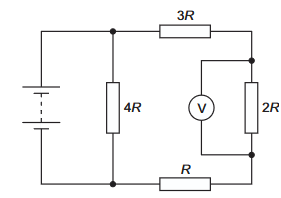
The voltmeter reading is \(2\,\mathrm{V}\).
What is the electromotive force (e.m.f.) of the battery?
(B) \(4\,\mathrm{V}\)
(C) \(6\,\mathrm{V}\)
(D) \(10\,\mathrm{V}\)
▶️ Answer/Explanation
Correct Answer: \( \boxed{\mathrm{C}} \)
The voltmeter measures the potential difference across the \(2R\) resistor.
Hence,
\(V_{2R}=I(2R)=2\,\mathrm{V}\)
\(\Rightarrow IR=1\,\mathrm{V}\)
Therefore, the potential differences across the other series resistors are
\(V_{3R}=I(3R)=3IR=3\,\mathrm{V}\)
\(V_{R}=I(R)=IR=1\,\mathrm{V}\)
The total potential difference across the series branch is
\(V_{\text{branch}}=V_{3R}+V_{2R}+V_R=3+2+1=6\,\mathrm{V}\)
Since this branch is connected directly across the battery,
\(E=V_{\text{branch}}=6\,\mathrm{V}\)
Therefore, the correct answer is (C).
Question
The circuit diagram shows a battery with internal resistance \(r\), two resistors, a switch and a voltmeter. The switch is open.
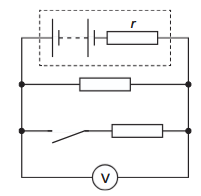
The switch is now closed.
What happens to the current in the battery, and what happens to the reading on the voltmeter, when the switch is closed?
| current in battery | reading on voltmeter | |
|---|---|---|
| A | increases | decreases |
| B | increases | remains the same |
| C | remains the same | decreases |
| D | remains the same | remains the same |
▶️ Answer/Explanation
Correct Answer: \( \boxed{\mathrm{A}} \)
Closing the switch places another resistor in parallel, reducing the external resistance.
The current supplied by the battery therefore increases.
The larger current produces a greater voltage drop across the internal resistance \(r\), so the terminal potential difference measured by the voltmeter decreases.
Therefore, the correct answer is (A).
Question
The diagram shows a circuit containing a battery and cells with negligible internal resistance.
Some values of current, electromotive force (e.m.f.) and resistance are shown.
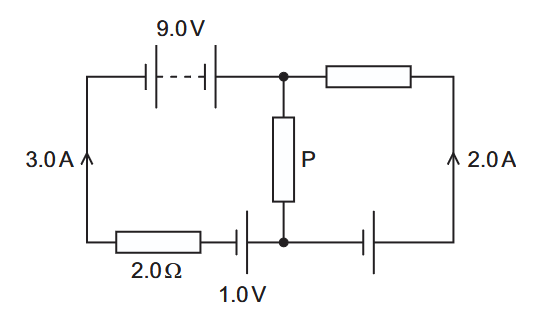
One resistor is labelled \( P \).
What is the resistance of resistor \( P \)?
(B) \( 0.80\,\Omega \)
(C) \( 2.0\,\Omega \)
(D) \( 2.8\,\Omega \)
▶️ Answer/Explanation
Correct Answer: \( \boxed{\mathrm{A}} \)
At the top junction, \( 3.0\,\mathrm{A} \) enters and \( 2.0\,\mathrm{A} \) leaves through the right-hand branch.
Hence, the current through resistor \( P \) is
\( I_P=3.0+2.0=5.0\,\mathrm{A} \).
The \( 2.0\,\Omega \) resistor has a potential difference of
\( V=IR=3.0\times2.0=6.0\,\mathrm{V} \).
Applying Kirchhoff’s loop rule to the left-hand loop,
\( 9.0=6.0+1.0+V_P \), so \( V_P=2.0\,\mathrm{V} \).
Therefore,
\( R_P=\dfrac{V_P}{I_P}=\dfrac{2.0}{5.0}=0.40\,\Omega \).
Therefore, the correct answer is (A).