
Question
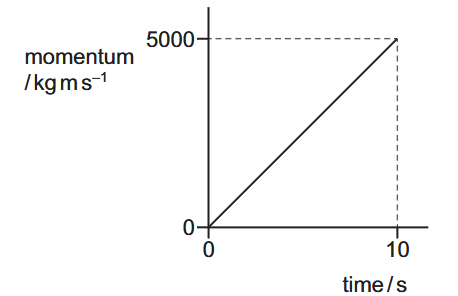
The graph shows how the momentum of a motorcycle changes with time.
What is the resultant force on the motorcycle?
(B) \( 5000\,\mathrm{N} \)
(C) \( 25\,000\,\mathrm{N} \)
(D) \( 50\,000\,\mathrm{N} \)
▶️ Answer/Explanation
Correct Answer: \( \boxed{\mathrm{A}} \)
The resultant force is the rate of change of momentum:
\( F=\dfrac{\Delta p}{\Delta t} \).
From the graph, the momentum increases from \( 0 \) to \( 5000\,\mathrm{kg\,m\,s^{-1}} \) in \( 10\,\mathrm{s} \).
Hence,
\( F=\dfrac{5000}{10}=500\,\mathrm{N} \).
Therefore, the correct answer is (A).
Question
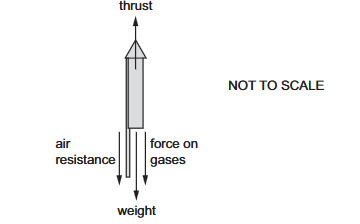
A firework travels vertically upwards in air. Gases are pushed vertically downwards from the firework.
Several forces that act on the firework and gases are shown.
Which forces are a Newton’s third law pair?
(B) air resistance and thrust
(C) force on gases and thrust
(D) thrust and weight
▶️ Answer/Explanation
Correct Answer: \( \boxed{\mathrm{C}} \)
According to Newton’s third law, forces occur in equal and opposite pairs acting on different objects.
The firework exerts a downward force on the gases, labelled force on gases. In response, the gases exert an equal upward force on the firework, labelled thrust.
These two forces act on different bodies and are equal in magnitude but opposite in direction, making them a Newton’s third law pair.
Air resistance and weight do not form third-law pairs with thrust because they arise from different interactions.
Therefore, the correct answer is (C).
Question
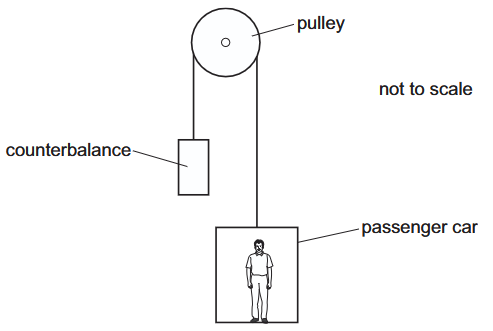
A lift (elevator) consists of a passenger car supported by a cable that runs over a light, frictionless pulley to a counterbalance. The counterbalance falls as the passenger car rises.
Some masses are shown in the table.
Passenger car \(=520\,\mathrm{kg}\)
Counterbalance \(=640\,\mathrm{kg}\)
Passenger \(=80\,\mathrm{kg}\)
What is the magnitude of the acceleration of the car when carrying just one passenger and when the pulley is free to rotate?
(B) \(0.32\,\mathrm{m\,s^{-2}}\)
(C) \(0.61\,\mathrm{m\,s^{-2}}\)
(D) \(0.65\,\mathrm{m\,s^{-2}}\)
▶️ Answer/Explanation
Correct Answer: \( \boxed{\mathrm{B}} \)
The total mass of the passenger car is \(520+80=600\,\mathrm{kg}\).
The driving force is \((640-600)g=40g\).
The total moving mass is \(640+600=1240\,\mathrm{kg}\).
Using \(F=ma\),
\(a=\dfrac{40g}{1240}\approx0.32\,\mathrm{m\,s^{-2}}\).
Therefore, the correct answer is (B).