
Question
A projectile is fired at an angle of \(45^\circ\) upwards from horizontal ground. Air resistance is negligible.
Which row describes the horizontal motion and the vertical motion of the projectile after it is fired until immediately before it reaches the ground again?
| horizontal motion | vertical motion | |
|---|---|---|
| A | constant velocity | constant acceleration |
| B | constant velocity | varying acceleration |
| C | varying velocity | constant acceleration |
| D | varying velocity | varying acceleration |
▶️ Answer/Explanation
Correct Answer: \( \boxed{\mathrm{A}} \)
With negligible air resistance, there is no horizontal force, so the horizontal velocity remains constant.
The vertical motion is affected only by gravity, giving a constant downward acceleration of \(g\).
Therefore, the correct answer is (A).
Question
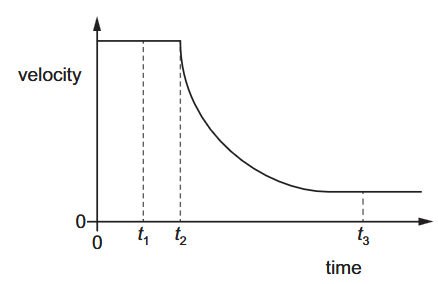
A skydiver is falling at constant velocity. She then opens her parachute. The graph shows the variation with time of her velocity.
Which statements about the motion of the skydiver are correct?
1 The magnitude of the acceleration is maximum at time \(t_2\).
2 The magnitude of the drag force at time \(t_1\) equals the magnitude of the drag force at time \(t_3\).
3 The magnitude of the drag force is maximum at time \(t_1\).
(B) 1 and 3
(C) 2 only
(D) 3 only
▶️ Answer/Explanation
Correct Answer: \( \boxed{\mathrm{A}} \)
The acceleration is the gradient of the velocity–time graph, and its magnitude is greatest immediately after the parachute opens at \(t_2\).
At both \(t_1\) and \(t_3\), the skydiver is moving at terminal velocity, so the drag force equals the weight in each case.
The drag force is not maximum at \(t_1\); it is greatest just after the parachute opens when the speed is still high and the parachute greatly increases air resistance.
Therefore, the correct answer is (A).
Question
A sphere falls from rest through the air. The graph shows the variation with time of the sphere’s velocity.
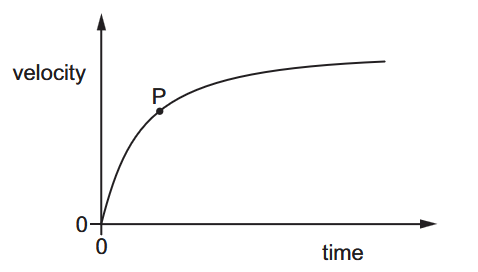
Which diagram shows the forces acting on the sphere when it is at the velocity corresponding to point \( P \) on the graph?
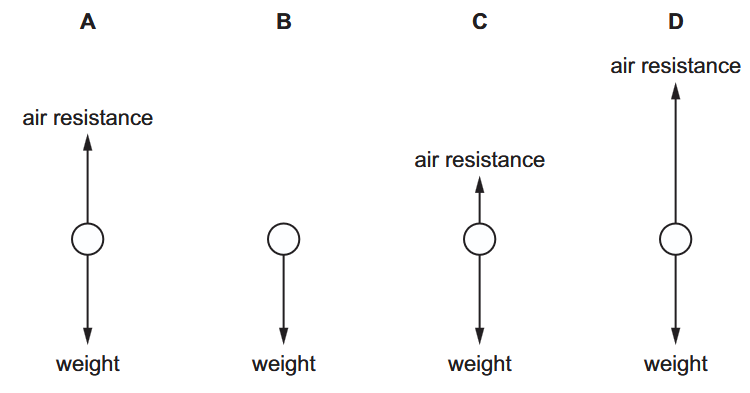
(B) Only the weight acts on the sphere.
(C) Weight is greater than air resistance.
(D) Air resistance is greater than the weight.
▶️ Answer/Explanation
Correct Answer: \( \boxed{\mathrm{C}} \)
At point \( P \), the sphere is still accelerating downward because the velocity-time graph has a positive gradient.
This means the resultant force is downward, so the weight must be greater than the air resistance.
As the sphere continues to fall, the air resistance increases until it becomes equal to the weight at terminal velocity.
Therefore, the correct answer is (C).