A couple is applied to a tap, as shown.
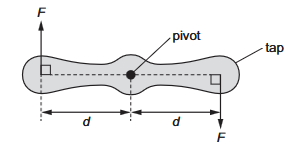
What is the torque of the couple?
Correct Answer: \( \boxed{\mathrm{C}} \)
The torque of a couple equals one of the forces multiplied by the perpendicular distance between their lines of action.
The two forces are separated by a distance \(d+d=2d\).
Hence, the torque is \(F(2d)=2Fd\).
Therefore, the correct answer is (C).
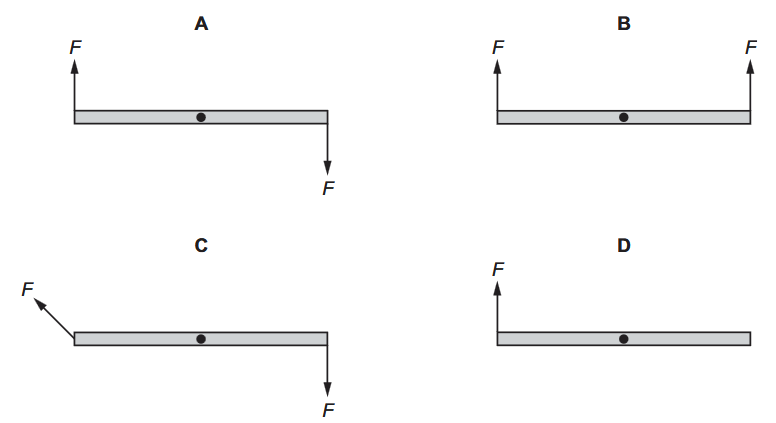
Which diagram shows a couple?
Correct Answer: \( \boxed{\mathrm{A}} \)
A couple consists of two equal and opposite parallel forces acting along different lines of action.
A couple produces a turning effect (moment) but no resultant force.
Only diagram (A) shows two equal, opposite and parallel forces separated by a perpendicular distance.
Therefore, the correct answer is (A).
The diagram shows a uniform bar of mass \(M\) and length \(L\) resting on a pivot at a distance \(x\) from end X.
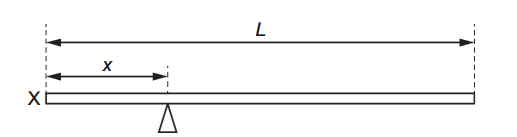
An object of mass \(m\) is placed on the bar at distance \(y\) from the pivot so that the bar is in equilibrium.
What is an expression for \(y\)?
Correct Answer: \( \boxed{\mathrm{C}} \)
For equilibrium, clockwise moment equals anticlockwise moment.
The weight of the bar acts at its centre, a distance \(\dfrac{L}{2}-x\) from the pivot.
Hence, \(mgy=Mg\left(\dfrac{L}{2}-x\right)\).
Therefore, \(y=\dfrac{M}{2m}(L-2x)\), so the correct answer is (C).
