
Question
A sound wave travels from the left to the right.
The graph shows the variation of the displacement to the right of particles in the sound wave with distance, at one instant.
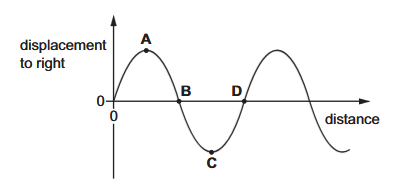
Which letter represents the centre of a compression?
(B) B
(C) C
(D) D
▶️ Answer/Explanation
Correct Answer: \( \boxed{\mathrm{B}} \)
In a longitudinal wave, a compression occurs where particles are closest together.
Particle separation is related to the gradient of the displacement-distance graph.
A compression occurs where the gradient is most negative, because neighbouring particles are displaced towards each other.
Point B is the zero-displacement point with the maximum negative gradient.
Therefore, the centre of a compression is at B.
Therefore, the correct answer is (B).
Question
Which statement compares the behaviour of transverse and longitudinal waves?
(B) Only longitudinal waves can travel in free space.
(C) Only transverse waves can be coherent.
(D) Only transverse waves can be polarised.
▶️ Answer/Explanation
Correct Answer: \( \boxed{\mathrm{D}} \)
Polarisation is the restriction of oscillations to one plane.
Only transverse waves have oscillations perpendicular to the direction of propagation and can therefore be polarised.
Longitudinal waves oscillate parallel to the direction of propagation, so they cannot be polarised.
Therefore, the correct answer is (D).
Question
Radio waves can be polarised, but sound waves cannot be polarised.
Which statement gives the reason for this?
(B) Radio waves are transverse waves, but sound waves are longitudinal waves.
(C) Radio waves can travel through a vacuum, but sound waves cannot travel through a vacuum.
(D) Radio waves travel at a much higher speed than sound waves.
▶️ Answer/Explanation
Correct Answer: \( \boxed{\mathrm{B}} \)
Only transverse waves can be polarised because their oscillations are perpendicular to the direction of propagation.
Radio waves are transverse electromagnetic waves, whereas sound waves are longitudinal mechanical waves.
Therefore, the correct answer is (B).