
Magnetic Fields as Fields of Force
A magnetic field is a region of space where a magnetic force is experienced by magnetic materials, moving charges, or current-carrying conductors.
Definition:
A magnetic field is an example of a field of force produced either by moving electric charges or by permanent magnets.
Sources of Magnetic Fields:
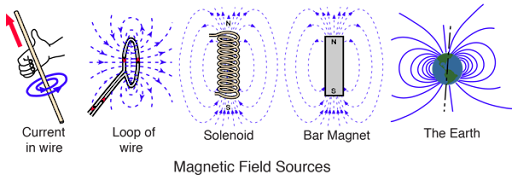
- Moving charges
- A moving charge (or electric current) produces a magnetic field around it.
- Examples: current in a wire, electrons moving in a beam, current loops.
- Permanent magnets
- Magnetic materials such as iron, cobalt, and neodymium produce their own magnetic fields due to alignment of atomic magnetic moments.
Field of Force:
- A magnetic field exerts a force on:
- Moving charges (e.g., electrons in a wire)
- Current-carrying conductors
- Magnetic materials (iron, nickel, etc.)
- The force arises without physical contact → meaning the magnetic field acts as a non-contact force field.
Representing Magnetic Fields:

- Field lines are drawn from north to south outside a magnet.
- Density of lines shows field strength (closer = stronger).
- Direction of field line = direction of force on a north pole.
Example
Why does a current-carrying wire experience a force when placed in a magnetic field?
▶️ Answer / Explanation
A current in the wire consists of moving charges (electrons). Moving charges produce their own magnetic field, which interacts with the external magnetic field. This interaction produces a force on the wire.
Example
Explain why a permanent magnet can exert a force on a piece of iron even when they are not touching.
▶️ Answer / Explanation
The permanent magnet creates a magnetic field around it. When the iron enters this field, its atoms become magnetically aligned, causing attraction. Because the field extends through space, the force occurs without physical contact.
Example
An electron beam moves through a vacuum tube. Explain why a magnetic field appears around the beam and identify the source of this field.
▶️ Answer / Explanation
Electrons in the beam are moving charges. A moving charge produces a magnetic field that wraps around the path of motion (circular field lines). Thus, the electron beam itself is the source of the magnetic field.
Representing a Magnetic Field Using Field Lines
A magnetic field can be visualised and represented using magnetic field lines (also called lines of force). These lines show both the direction and strength of the magnetic field in a region.
Key Rules for Magnetic Field Lines:

- Direction:
- Magnetic field lines always run from the north pole of a magnet to the south pole outside the magnet.
- Density of lines = field strength:
- Closer spacing → stronger magnetic field
- Wider spacing → weaker magnetic field
- Field lines never cross
- Crossing would imply two possible directions of force at a point, which is impossible.
- Continuous loops
- Inside the magnet, field lines run from south to north, forming closed loops.
- Uniform field
- Represented by parallel, equally spaced, straight lines
- Example: between two opposite parallel pole faces
Typical Magnetic Field Patterns:
- Bar magnet: curved lines from north to south, dense near poles
- Between two opposite poles: uniform, straight, parallel lines
- Around a long straight wire carrying current: concentric circles around the wire
- Inside a solenoid: nearly uniform, parallel lines
Example
What does a dense cluster of magnetic field lines near the pole of a bar magnet indicate?
▶️ Answer / Explanation
Dense field lines indicate a strong magnetic field. Field strength is greatest near the poles where the lines are most concentrated.
Example
A student draws magnetic field lines between two parallel magnet poles and shows straight, evenly spaced lines. Explain what this representation means.
▶️ Answer / Explanation
Straight, parallel, and evenly spaced field lines represent a uniform magnetic field. This means the magnetic field strength and direction are the same at every point in the region.
Example
Explain why magnetic field lines around a current-carrying straight wire form concentric circles, and describe how the direction of these lines is determined.
▶️ Answer / Explanation
A moving charge (current) produces a circular magnetic field around the wire due to electromagnetic induction. The field lines must form closed loops, so they circle the wire.
The direction is determined by the right-hand grip rule: Thumb → direction of current Fingers → curl in direction of magnetic field lines
Thus the field forms concentric circular lines around the wire.