
Substitution & Elimination
A system of linear equations consists of two equations with two variables (usually \( x \) and \( y \)). A solution is the ordered pair \( (x, y) \) that satisfies both equations at the same time.
Geometrically, each equation represents a line. The solution is the point where the two lines intersect.
Possible Outcomes
- One solution → lines intersect once
- No solution → parallel lines
- Infinitely many solutions → same line
Method 1: Substitution
Use substitution when one equation already has a variable isolated or is easy to isolate.
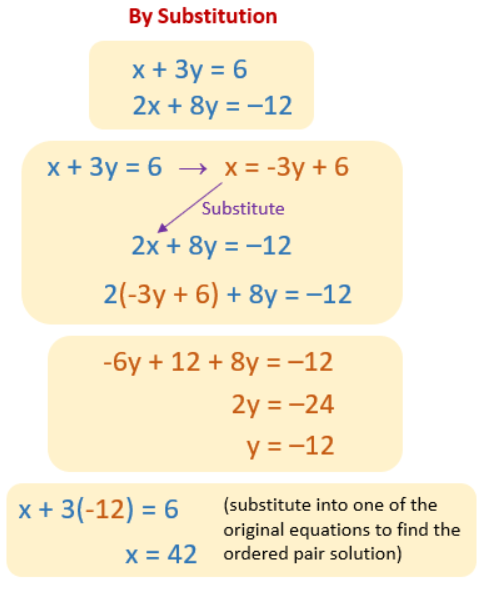
Steps
- Solve one equation for a variable
- Substitute into the other equation
- Solve for the remaining variable
- Substitute back to find the second variable
Method 2: Elimination
Use elimination when coefficients can easily be made opposites.
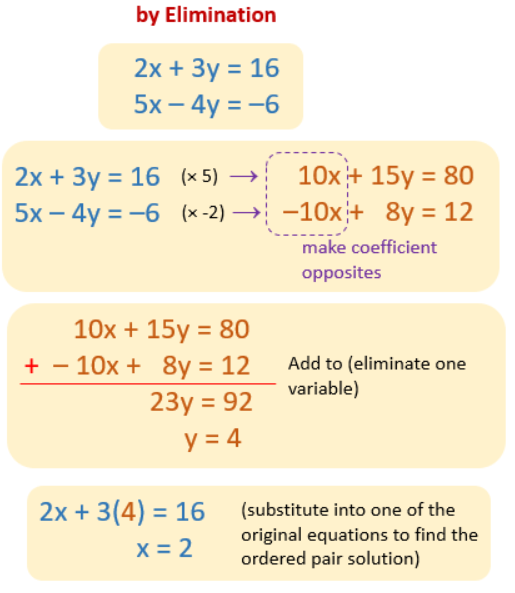
Steps
- Multiply equations if necessary
- Add or subtract equations to eliminate one variable
- Solve
- Back-substitute
DIGITAL SAT Insight
The SAT rarely says “solve the system.” Instead it asks for the value of one variable, the value of \( x + y \), or an interpreted quantity (cost, number of tickets, mixture, etc.).
Example 1 (Substitution Method):
At a school event, adult tickets cost \$8 and student tickets cost \$5. A total of 22 tickets were sold for \$146. How many student tickets were sold?
▶️ Answer/Explanation
Let
\( a = \) number of adult tickets
\( s = \) number of student tickets
Total tickets:
\( a + s = 22 \)
Total revenue:
\( 8a + 5s = 146 \)
From the first equation:
\( a = 22 – s \)
Substitute into second:
\( 8(22 – s) + 5s = 146 \)
\( 176 – 8s + 5s = 146 \)
\( 176 – 3s = 146 \)
\( -3s = -30 \)
\( s = 10 \)
Conclusion: 10 student tickets were sold.
Example 2 (Elimination Method):
Two numbers have a sum of 31 and a difference of 5. What is the larger number?
▶️ Answer/Explanation
Let the numbers be \( x \) and \( y \).
\( x + y = 31 \)
\( x – y = 5 \)
Add equations:
\( 2x = 36 \)
\( x = 18 \)
Conclusion: The larger number is 18.
Example 3 (Interpreting Solution):
A gym charges a monthly membership fee plus a one-time joining fee. The total cost for 3 months is \$120, and the total cost for 5 months is \$180. What is the monthly fee?
▶️ Answer/Explanation
Let
\( m = \) monthly fee
\( j = \) joining fee
Equations:
\( 3m + j = 120 \)
\( 5m + j = 180 \)
Subtract first from second:
\( 2m = 60 \)
\( m = 30 \)
Conclusion: The monthly fee is \$30.
Word Problems
In DIGITAL SAT questions, systems of equations are most commonly tested through real-life situations. You must translate the situation into two equations and then solve.
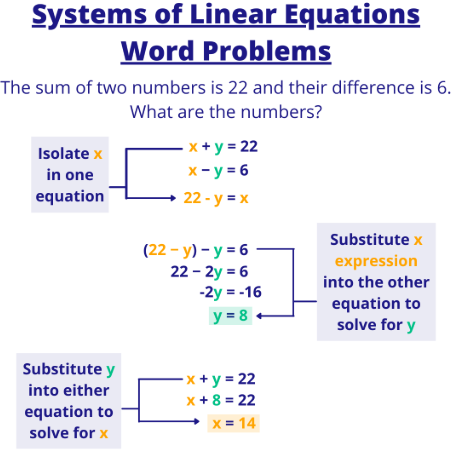
These problems usually involve two unknown quantities such as:
- two types of tickets
- two different speeds
- mixtures
- fixed fee and per-unit rate
How to Form the Equations
- Define two variables clearly
- Use totals (total cost, total distance, total quantity) to create equations
- Write two independent equations
- Solve using substitution or elimination
- Interpret the answer in context
Important SAT Observation
Many SAT mistakes happen because students define variables poorly. Always write what each variable represents before writing equations.
Example 1 (Tickets):
At a movie theater, adult tickets cost \$12 and child tickets cost \$8. A group bought 18 tickets for a total of \$176. How many child tickets were purchased?
▶️ Answer/Explanation
Let
\( a = \) adult tickets
\( c = \) child tickets
Total tickets:
\( a + c = 18 \)
Total cost:
\( 12a + 8c = 176 \)
From the first equation:
\( a = 18 – c \)
Substitute:
\( 12(18 – c) + 8c = 176 \)
\( 216 – 12c + 8c = 176 \)
\( 216 – 4c = 176 \)
\( -4c = -40 \)
\( c = 10 \)
Conclusion: 10 child tickets were purchased.
Example 2 (Speed/Distance):
Two runners start at the same time from the same point but run in opposite directions. One runs at 6 miles per hour and the other at 8 miles per hour. After how many hours will they be 42 miles apart?
▶️ Answer/Explanation
Let \( t \) be the time in hours.
Distance runner 1:
\( 6t \)
Distance runner 2:
\( 8t \)
They run opposite directions, so distances add:
\( 6t + 8t = 42 \)
\( 14t = 42 \)
\( t = 3 \)
Conclusion: They will be 42 miles apart after 3 hours.
Example 3 (Mixture Problem):
A chemist mixes a 20% solution with a 50% solution to obtain 30 liters of a 30% solution. How many liters of the 20% solution were used?
▶️ Answer/Explanation
Let
\( x = \) liters of 20% solution
\( y = \) liters of 50% solution
Total volume:
\( x + y = 30 \)
Amount of pure substance:
\( 0.20x + 0.50y = 0.30(30) \)
\( 0.20x + 0.50y = 9 \)
From first equation:
\( y = 30 – x \)
Substitute:
\( 0.20x + 0.50(30 – x) = 9 \)
\( 0.20x + 15 – 0.50x = 9 \)
\( -0.30x + 15 = 9 \)
\( -0.30x = -6 \)
\( x = 20 \)
Conclusion: 20 liters of the 20% solution were used.