
Slope (Rate of Change)
The slope of a line measures how steep the line is. On the DIGITAL SAT, slope is usually interpreted as a rate of change, meaning how much one quantity changes when another quantity increases by 1 unit.
If \( y \) depends on \( x \), then slope tells us:
“how much \( y \) changes for every 1 unit increase in \( x \)”
Slope Formula
Given two points \( (x_1, y_1) \) and \( (x_2, y_2) \), the slope \( m \) is
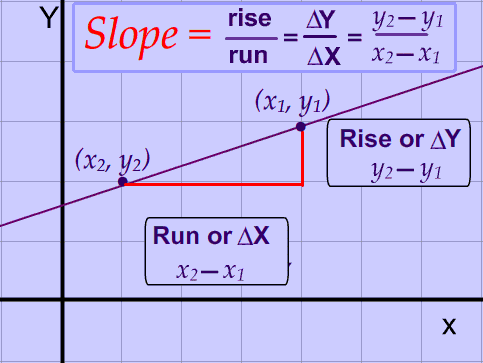
\( m = \dfrac{y_2 – y_1}{x_2 – x_1} \)
This is often remembered as
rise / run
Types of Slopes
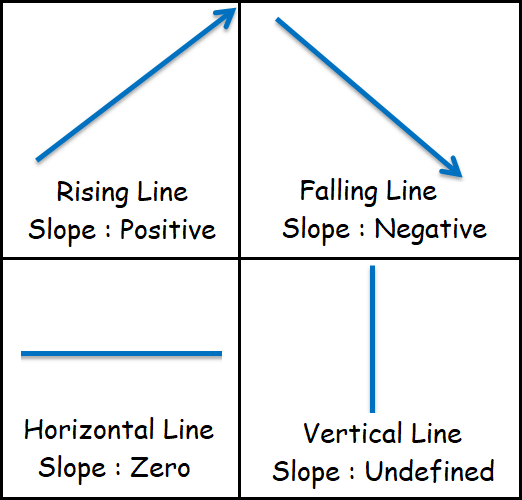
- Positive slope: line rises left to right
- Negative slope: line falls left to right
- Zero slope: horizontal line
- Undefined slope: vertical line
Important DIGITAL SAT Meaning
The SAT rarely asks “find the slope.” Instead it asks what the slope represents.
Examples of real meanings:
- dollars per month
- miles per hour
- students per classroom
- cost per item
Finding Slope from an Equation
If a line is written as
\( y = mx + b \)
then \( m \) is the slope.
Key SAT Insight
Always include units when interpreting slope. The SAT frequently tests whether you can say something like:
“The cost increases by \$5 per month.”
Example 1 (Slope from Two Points):
A delivery company tracks distance traveled. A truck is at 40 miles after 2 hours and 100 miles after 5 hours. What is the truck’s speed?
▶️ Answer/Explanation
Points: \( (2,40) \) and \( (5,100) \)
\( m = \dfrac{100 – 40}{5 – 2} = \dfrac{60}{3} = 20 \)
Conclusion: The truck travels 20 miles per hour. The slope represents speed.
Example 2 (Slope from Equation):
A gym’s membership cost is modeled by
\( C = 25m + 40 \)
where \( C \) is total cost (dollars) and \( m \) is number of months.
What does 25 represent?
▶️ Answer/Explanation
The equation is in slope-intercept form \( y = mx + b \).
So slope \( m = 25 \).
Conclusion: The cost increases by \$25 per month. It is the monthly fee.
Example 3 (Interpreting Negative Slope):
The value of a laptop is modeled by
\( V = 900 – 120t \)
where \( V \) is value (dollars) and \( t \) is years.
What does the slope represent?
▶️ Answer/Explanation
Slope \( m = -120 \).
Negative slope means decrease.
Conclusion: The laptop loses \$120 in value each year.
Equation Forms (Slope-Intercept & Point-Slope)
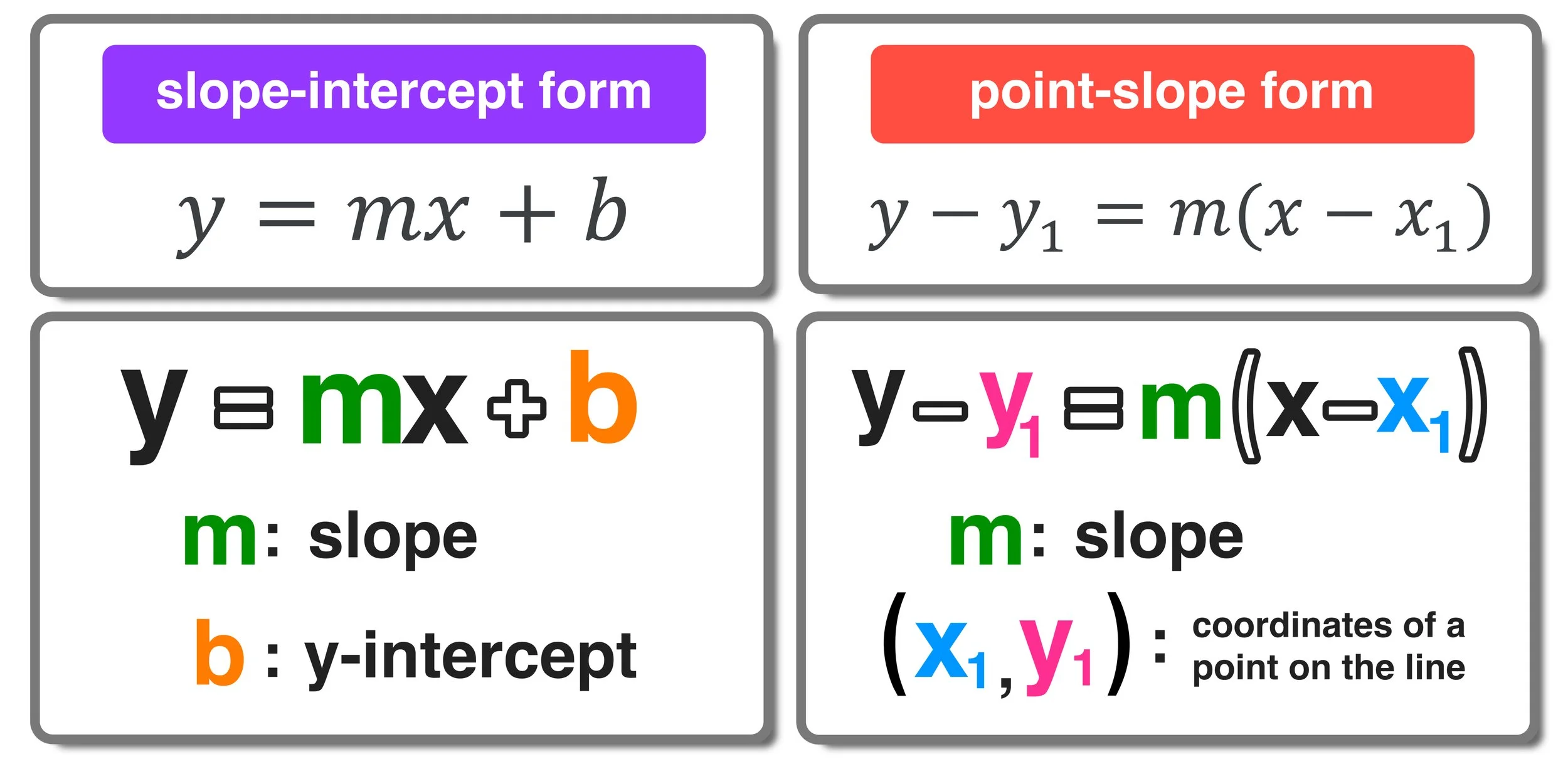
On the DIGITAL SAT, you are often given information about a line and asked to write its equation. The two most important forms are slope-intercept form and point-slope form
 .
.
Slope-Intercept Form
\( y = mx + c \)
- \( m \) = slope (rate of change)
- \( c \) = y-intercept (value of \( y \) when \( x = 0 \))
This is the most useful form for interpreting real-world situations because:
- Slope → rate per unit
- y-intercept → starting value
Point-Slope Form
\( y – y_1 = m(x – x_1) \)
This form is used when you know:
- the slope \( m \)
- one point on the line \( (x_1, y_1) \)
Converting to Slope-Intercept
After using point-slope form, expand and isolate \( y \) to get \( y = mx + b \). The SAT frequently asks for the equation in this form.
Key DIGITAL SAT Insight
In real-world models:
- \( b \) often represents an initial fee or starting amount
- \( m \) represents cost per item, speed, or growth rate
Example 1 (Identify Slope and Intercept):
A ride-share company models total cost by
\( C = 3.5x + 2 \)
where \( x \) is miles and \( C \) is cost in dollars.
Interpret the slope and y-intercept.
▶️ Answer/Explanation
Slope \( m = 3.5 \)
This means the cost increases \$3.50 per mile.
Intercept \( b = 2 \)
This is the starting fee charged before driving.
Conclusion: \$2 base fee and \$3.50 per mile.
Example 2 (Using Point-Slope Form):
A line has slope 4 and passes through the point \( (2, 11) \). Write the equation in slope-intercept form.
▶️ Answer/Explanation
Start with point-slope form:
\( y – 11 = 4(x – 2) \)
Expand:
\( y – 11 = 4x – 8 \)
Add 11:
\( y = 4x + 3 \)
Conclusion: The equation is \( y = 4x + 3 \).
Example 3 (Forming an Equation from Context):
A savings account has \$150 initially and increases by \$20 each month. Write a linear equation for the balance \( B \) after \( m \) months.
▶️ Answer/Explanation
Initial amount → y-intercept \( b = 150 \)
Monthly increase → slope \( m = 20 \)
\( B = 20m + 150 \)
Conclusion: The balance model is \( B = 20m + 150 \).
Graphing Lines, x- and y-Intercepts
On the DIGITAL SAT, you are often given a graph or an equation and asked to identify key features of a line. The most important features are the y-intercept, the x-intercept, and how to quickly sketch or understand the graph.
y-Intercept
The y-intercept is the value of \( y \) when \( x = 0 \). It is where the line crosses the vertical axis.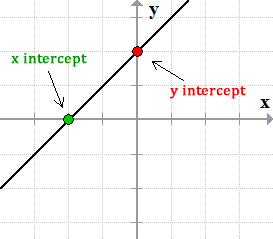
In slope-intercept form
\( y = mx + c \)
the y-intercept is \( c \), and the point is
\( (0, c) \)
x-Intercept
The x-intercept is the value of \( x \) when \( y = 0 \). It is where the line crosses the horizontal axis.
To find it, set \( y = 0 \) and solve the equation.
Graphing a Line Quickly
If you know slope and y-intercept:
- Plot the y-intercept
- Use the slope \( \dfrac{\text{rise}}{\text{run}} \)
- Draw the straight line through the points
Important DIGITAL SAT Meaning
- y-intercept → starting value
- x-intercept → when the quantity becomes zero
The test often asks what the intercept represents in context rather than just calculating it.
Example 1 (Finding Intercepts from Equation):
Given the equation
\( y = -2x + 8 \)
find both intercepts.
▶️ Answer/Explanation
y-intercept:
\( b = 8 \)
Point: \( (0, 8) \)
x-intercept (set \( y=0 \)):
\( 0 = -2x + 8 \)
\( 2x = 8 \)
\( x = 4 \)
Point: \( (4, 0) \)
Conclusion: Intercepts are \( (0,8) \) and \( (4,0) \).
Example 2 (Interpreting Intercepts):
A water tank drains according to
\( V = 120 – 6t \)
where \( V \) is liters and \( t \) is minutes.
What does the y-intercept represent?
▶️ Answer/Explanation
y-intercept occurs when \( t = 0 \).
\( V = 120 \)
Conclusion: The tank initially contains 120 liters of water.
Example 3 (x-Intercept Meaning):
Using the same model
\( V = 120 – 6t \)
When will the tank be empty?
▶️ Answer/Explanation
Tank empty means \( V = 0 \).
\( 0 = 120 – 6t \)
\( 6t = 120 \)
\( t = 20 \)
Conclusion: The tank is empty after 20 minutes. The x-intercept represents when the quantity becomes zero.
Parallel & Perpendicular Lines
On the DIGITAL SAT, you are frequently asked to compare two linear equations. The relationship between the lines is determined entirely by their slopes.
Parallel Lines
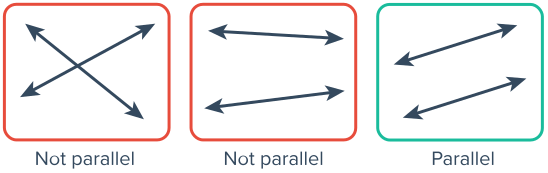
Two lines are parallel if they have the same slope but different y-intercepts.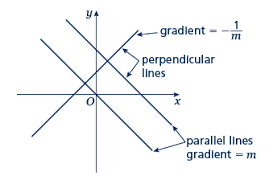
\( y = m x + b_1 \)
\( y = m x + b_2 \)
Because their slopes are equal, the lines never meet.
Perpendicular Lines
Two lines are perpendicular if their slopes are negative reciprocals.
\( m_1 \cdot m_2 = -1 \)
To find the negative reciprocal:
- flip the fraction
- change the sign
Examples:
- \( 2 \rightarrow -\dfrac{1}{2} \)
- \( -3 \rightarrow \dfrac{1}{3} \)
- \( \dfrac{4}{5} \rightarrow -\dfrac{5}{4} \)
Important DIGITAL SAT Insight
The SAT often gives a line and a point and asks you to write the equation of a line that is parallel or perpendicular to it.
Strategy
- Parallel → keep the same slope
- Perpendicular → use negative reciprocal slope
- Then use point-slope form
Example 1 (Parallel Line):
Find the equation of a line parallel to
\( y = -3x + 7 \)
that passes through \( (2,1) \).
▶️ Answer/Explanation
Parallel lines have the same slope.
\( m = -3 \)
Use point-slope form:
\( y – 1 = -3(x – 2) \)
Expand:
\( y – 1 = -3x + 6 \)
\( y = -3x + 7 \)
Conclusion: The required equation is \( y = -3x + 7 \).
Example 2 (Perpendicular Line):
Find the equation of a line perpendicular to
\( y = \dfrac{1}{2}x + 4 \)
that passes through \( (4,3) \).
▶️ Answer/Explanation
Slope of given line:
\( m = \dfrac{1}{2} \)
Perpendicular slope (negative reciprocal):
\( m = -2 \)
Use point-slope form:
\( y – 3 = -2(x – 4) \)
Expand:
\( y – 3 = -2x + 8 \)
\( y = -2x + 11 \)
Conclusion: The equation is \( y = -2x + 11 \).
Example 3 (Recognizing Relationship):
Determine the relationship between the lines
\( y = 4x – 1 \)
\( 4x – y = 6 \)
▶️ Answer/Explanation
Rewrite second equation:
\( 4x – y = 6 \)
\( y = 4x – 6 \)
Both slopes are 4.
Conclusion: The lines are parallel.
Interpreting Graphs in Context
On the DIGITAL SAT, you are often shown a graph and asked what it means in a real situation. You are not just reading coordinates. You are interpreting a model.
A linear graph usually represents a relationship between two quantities such as:
- time and distance
- cost and number of items
- temperature and time
- revenue and quantity sold
How to Read a Graph
Always check three things:
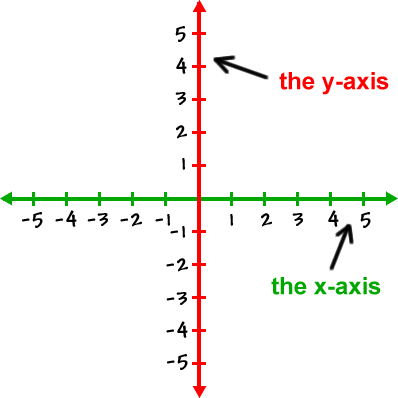
- What each axis represents
- The slope (rate of change)
- The intercepts (starting value or zero point)
Meaning of Important Features
- Slope: rate (per hour, per item, per month)
- y-intercept: initial amount
- x-intercept: when the quantity becomes zero
- Intersection of two lines: when two situations are equal
Important DIGITAL SAT Tip
Units matter. The correct answer usually includes a sentence interpretation, not just a number.
Example 1 (Slope Interpretation):
A graph shows distance (miles) versus time (hours). The line passes through \( (1, 50) \) and \( (3, 150) \). What does the slope represent?
▶️ Answer/Explanation
Slope:
\( m = \dfrac{150 – 50}{3 – 1} = \dfrac{100}{2} = 50 \)
Conclusion: The object travels 50 miles per hour. The slope represents speed.
Example 2 (y-Intercept Meaning):
A graph models the amount of money in a bank account over time. The line crosses the y-axis at 200. What does this mean?
▶️ Answer/Explanation
The y-intercept occurs when time = 0.
Conclusion: The account started with \$200.
Example 3 (Intersection Meaning):
Two lines on a graph represent the total cost of two different internet plans over time. The lines intersect at \( (6, 90) \). What does this point represent?
▶️ Answer/Explanation
The intersection means both plans have the same cost.
At 6 months, the total cost is \$90 for each plan.
Conclusion: After 6 months, both plans cost the same amount (\$90).