
Graphical, Substitution, and Elimination Methods
A system of linear equations consists of two equations involving the same variables. The solution is the ordered pair \( (x, y) \) that satisfies both equations simultaneously.
On the DIGITAL SAT, systems are very often written in standard form.
Standard Form
\( a_1x + b_1y = c_1 \)
\( a_2x + b_2y = c_2 \)
Each equation represents a straight line. The solution is the point where the two lines intersect.
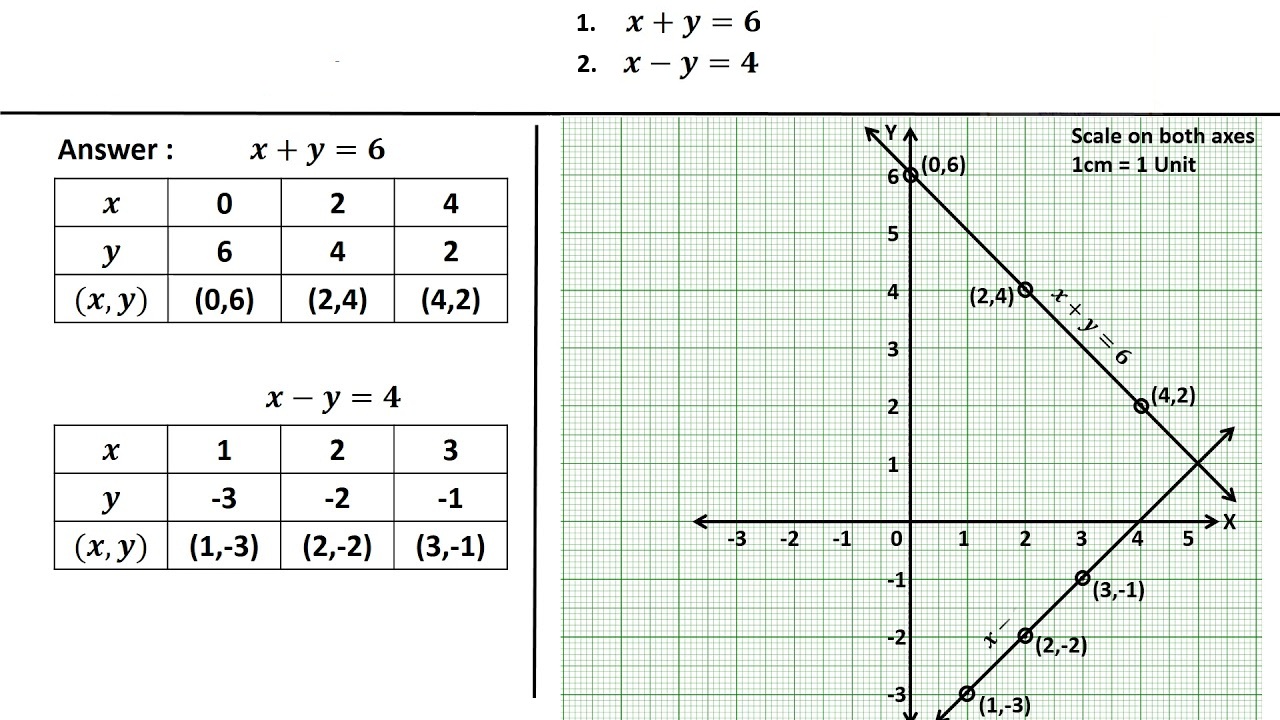
Method 1: Graphical Method
Each equation represents a straight line. The solution is the point where the lines cross.
Steps:
- Graph both equations
- Find the intersection point
- That point is the solution
On the DIGITAL SAT, you are usually given the graph rather than asked to draw it.
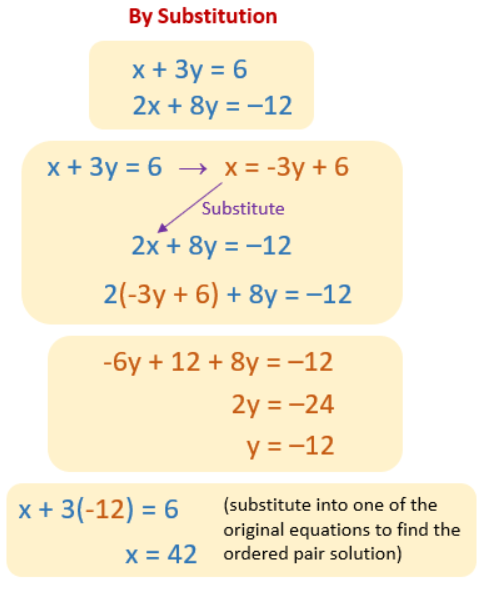
Method 2: Substitution Method
Use substitution when one equation already isolates a variable.
Steps:
- Solve one equation for a variable
- Substitute into the other equation
- Solve for one variable
- Substitute back
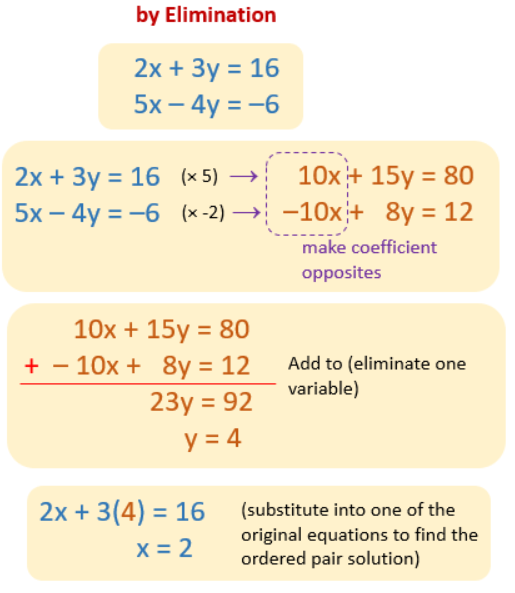
Method 3: Elimination Method
Use elimination when coefficients can cancel.
Steps:
- Multiply equations if needed
- Add or subtract equations
- Solve
- Back-substitute
DIGITAL SAT Insight
The SAT often asks for only one value, such as \( x \), \( y \), or \( x + y \), instead of the ordered pair.
Example 1 (Graphical Method):
Solve the system graphically:
\( y = x + 1 \)
\( y = -x + 5 \)
▶️ Answer/Explanation
Step 1: Create a table for \( y = x + 1 \)
| \( x \) | \( y = x + 1 \) |
|---|---|
| 0 | 1 |
| 2 | 3 |
| 4 | 5 |
Step 2: Create a table for \( y = -x + 5 \)
| \( x \) | \( y = -x + 5 \) |
|---|---|
| 0 | 5 |
| 2 | 3 |
| 4 | 1 |
Plot the points from both tables and draw straight lines through them.
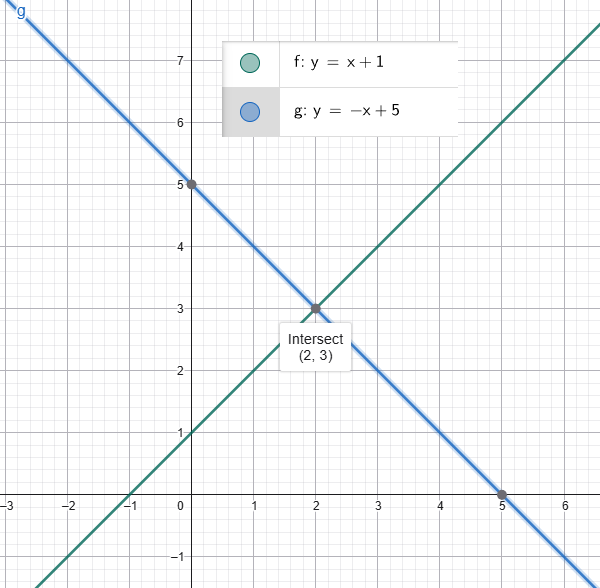
Both lines intersect at \( (2, 3) \).
Conclusion: The solution to the system is \( (2, 3) \).
Example 2 (Substitution Method):
Solve the system:
\( y = 3x + 2 \)
\( 2x + y = 14 \)
▶️ Answer/Explanation
Substitute \( y = 3x + 2 \):
\( 2x + (3x + 2) = 14 \)
\( 5x + 2 = 14 \)
\( 5x = 12 \)
\( x = \dfrac{12}{5} \)
Find \( y \):
\( y = 3\left(\dfrac{12}{5}\right) + 2 = \dfrac{36}{5} + \dfrac{10}{5} = \dfrac{46}{5} \)
Conclusion: The solution is \( \left(\dfrac{12}{5}, \dfrac{46}{5}\right) \).
Example 3 (Elimination Method):
Solve the system:
\( 3x + 2y = 16 \)
\( 3x – 2y = 4 \)
▶️ Answer/Explanation
Add equations:
\( 6x = 20 \)
\( x = \dfrac{10}{3} \)
Substitute into first equation:
\( 3\left(\dfrac{10}{3}\right) + 2y = 16 \)
\( 10 + 2y = 16 \)
\( 2y = 6 \)
\( y = 3 \)
Conclusion: The solution is \( \left(\dfrac{10}{3}, 3\right) \).
One, No, or Infinitely Many Solutions (Using Standard Form)
On the DIGITAL SAT, systems are often written in standard form:
\( a_1x + b_1y = c_1 \)
\( a_2x + b_2y = c_2 \)
You are frequently asked how many solutions the system has without fully solving it. This depends on the relationship between the coefficients.
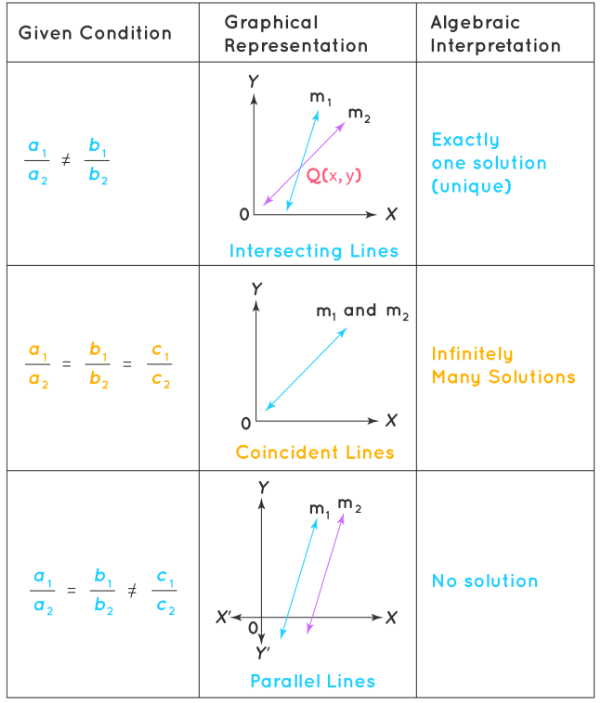
Key Coefficient Rule
- If \( \dfrac{a_1}{a_2} \ne \dfrac{b_1}{b_2} \) → one solution
- If \( \dfrac{a_1}{a_2} = \dfrac{b_1}{b_2} \ne \dfrac{c_1}{c_2} \) → no solution
- If \( \dfrac{a_1}{a_2} = \dfrac{b_1}{b_2} = \dfrac{c_1}{c_2} \) → infinitely many solutions
Why this works:
- Different ratios → different slopes → lines intersect
- Same ratios but different constants → parallel lines
- All ratios equal → same line
What Happens Algebraically
- One solution → you get a number for \( x \) and \( y \)
- No solution → false statement (example \( 4 = 9 \))
- Infinite solutions → true statement (example \( 7 = 7 \))
Example 1 (One Solution):
\( 2x + 3y = 11 \)
\( 4x – y = 5 \)
Determine the number of solutions.
▶️ Answer/Explanation
Compare ratios:
\( \dfrac{2}{4} = \dfrac{1}{2} \)
\( \dfrac{3}{-1} = -3 \)
Ratios are different.
Conclusion: The system has exactly one solution.
Example 2 (No Solution):
\( 3x + 6y = 9 \)
\( x + 2y = 1 \)
Determine the number of solutions.
▶️ Answer/Explanation
Ratios:
\( \dfrac{3}{1} = 3 \)
\( \dfrac{6}{2} = 3 \)
\( \dfrac{9}{1} = 9 \)
First two ratios equal but constant ratio different.
Conclusion: No solution (parallel lines).
Example 3 (Infinite Solutions):
\( 2x + 4y = 8 \)
\( x + 2y = 4 \)
Determine the number of solutions.
▶️ Answer/Explanation
Ratios:
\( \dfrac{2}{1} = 2 \)
\( \dfrac{4}{2} = 2 \)
\( \dfrac{8}{4} = 2 \)
All ratios equal.
Conclusion: Infinitely many solutions.