
Reading Piecewise Definitions
A piecewise function is a function defined by different formulas over different intervals of \( x \).
In other words, the rule changes depending on the input value.
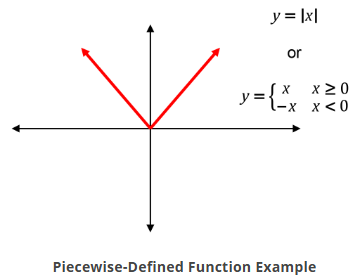
It is written in the form:
\( f(x)= \begin{cases} \text{rule 1}, & \text{condition 1}\\ \text{rule 2}, & \text{condition 2}\\ \text{rule 3}, & \text{condition 3} \end{cases} \)
How to Read It
You do not use all formulas. You choose the formula whose interval contains the given \( x \)-value.
Important SAT Idea
The most common mistake is using the wrong interval. Always check the inequality sign carefully.
- \( x < 2 \) → values less than 2 only
- \( x \le 2 \) → includes 2
- \( x > 2 \) → values greater than 2
- \( x \ge 2 \) → includes 2
Endpoint Rule
If two intervals meet at a number (for example 3), only the interval with \( \le \) or \( \ge \) contains that value.
Example 1:
\( f(x)= \begin{cases} 2x+1, & x<0\\ x^2, & x\ge0 \end{cases} \)
Which rule is used when \( x=-3 \)?
▶️ Answer/Explanation
Since \( -3<0 \), use the first rule.
Answer: \( 2x+1 \).
Example 2 (Endpoint):
\( g(x)= \begin{cases} x+4, & x\le3\\ 5x, & x>3 \end{cases} \)
Which rule applies when \( x=3 \)?
▶️ Answer/Explanation
The first interval includes 3 because of \( \le \).
Answer: \( x+4 \).
Example 3 (SAT Context):
A parking garage charges
\( C(t)= \begin{cases} 5, & 0<t\le2\\ 5+3(t-2), & t>2 \end{cases} \)
Which rule applies for 1.5 hours?
▶️ Answer/Explanation
Since \( 1.5 \le 2 \), use the first rule.
Answer: Cost = 5 dollars rule.