
Expanding (Distributive Law)
Two expressions are equivalent if they have the same value for every value of the variable.
One of the most important algebra skills on the DIGITAL SAT is expanding expressions using the distributive law.
Distributive Law
\( a(b+c)=ab+ac \)
You multiply the outside term by every term inside the bracket.
Important Rules
- Multiply to every term inside parentheses
- Watch negative signs carefully
- Combine like terms at the end
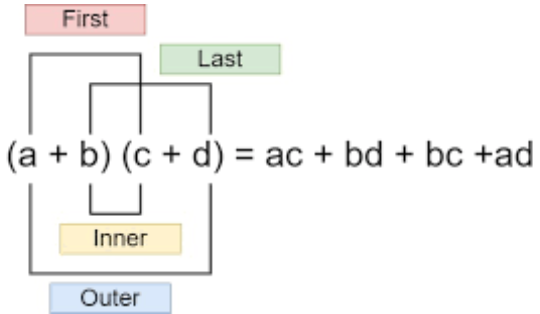
Double Brackets (FOIL Method)
For two binomials:
\( (a+b)(c+d)=ac+ad+bc+bd \)
(sometimes remembered as FOIL: First, Outer, Inner, Last)
DIGITAL SAT Tip
Many SAT questions do not ask you to “expand.” Instead they ask which expression is equivalent. That is still a distributive law question.
Example 1:
Expand \( 3(2x+5) \).
▶️ Answer/Explanation
\( 3\cdot2x + 3\cdot5 \)
\( =6x+15 \)
Answer: \( 6x+15 \)
Example 2:
Expand \( -2(x-4) \).
▶️ Answer/Explanation
\( -2\cdot x + (-2)(-4) \)
\( =-2x+8 \)
Answer: \( -2x+8 \)
Example 3:
Which expression is equivalent to \( (x+3)(x+2) \)?
▶️ Answer/Explanation
\( x(x+2)+3(x+2) \)
\( =x^2+2x+3x+6 \)
\( =x^2+5x+6 \)
Answer: \( x^2+5x+6 \)
Factorization (Common Factor & Grouping)
Factorization is the reverse of expanding. Instead of multiplying brackets, we rewrite an expression as a product.
This is extremely important on the DIGITAL SAT because questions often ask you to:
- simplify expressions
- solve equations
- identify a hidden meaning (like zeros or intercepts)
1. Common Factor
Take out the greatest common factor (GCF) from all terms.
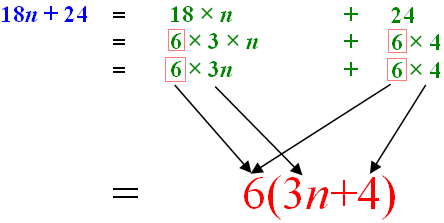
\( ab + ac = a(b+c) \)
Steps
- Find the common number or variable
- Factor it outside brackets
- Divide each term by it
2. Factorization by Grouping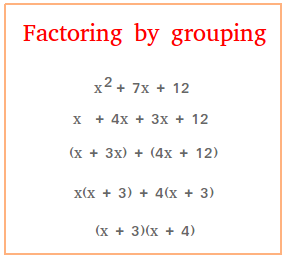
Used when there are four terms.
\( ax+ay+bx+by \)
Group them in pairs:
\( a(x+y)+b(x+y) \)
\( (a+b)(x+y) \)
DIGITAL SAT Tip
Many SAT problems hide a common factor. If every term has an \( x \), factor it first.
Example 1 (Common Factor):
Factor \( 6x + 12 \).
▶️ Answer/Explanation
GCF = 6
\( 6(x+2) \)
Answer: \( 6(x+2) \)
Example 2 (Variable Common Factor):
Factor \( 8x^2 – 4x \).
▶️ Answer/Explanation
Common factor = \( 4x \)
\( 4x(2x-1) \)
Answer: \( 4x(2x-1) \)
Example 3 (Grouping):
Factor \( 3x + 3y + 2x + 2y \).
▶️ Answer/Explanation
Group terms:
\( (3x+3y)+(2x+2y) \)
Factor each group:
\( 3(x+y)+2(x+y) \)
\( (3+2)(x+y) \)
\( 5(x+y) \)
Answer: \( 5(x+y) \)