Home / Digital SAT / Digital SAT Maths Study Notes

Digital SAT Maths -Unit 2 - 2.2 Exponents and Radicals- Study Notes- New Syllabus

Digital SAT Maths -Unit 2 – 2.2 Exponents and Radicals- Study Notes- New syllabus

Digital SAT Maths -Unit 2 – 2.2 Exponents and Radicals- Study Notes – per latest Syllabus.

Key Concepts:

Laws of exponents
Negative & fractional exponents
Simplifying radicals

Digital SAT Maths -Concise Summary Notes- All Topics

 Laws of Exponents

Exponents represent repeated multiplication.

\( a^3 = a \cdot a \cdot a \)

The DIGITAL SAT frequently tests whether you know how to rewrite and simplify expressions using exponent rules.
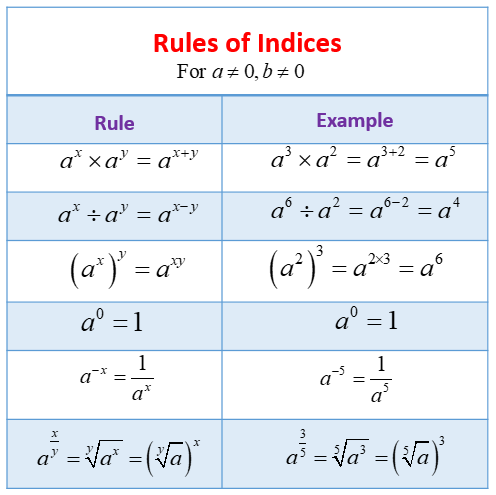
1. Product Rule

\( a^m \cdot a^n = a^{m+n} \)

(Add the exponents when bases are the same)

2. Quotient Rule

\( \dfrac{a^m}{a^n} = a^{m-n} \)

3. Power of a Power

\( (a^m)^n = a^{mn} \)

4. Power of a Product

\( (ab)^n = a^n b^n \)

5. Zero Exponent Rule

\( a^0 = 1 \) (for \( a \ne 0 \))

Important Warning

These rules only work when the bases are the same.

\( 2^3 \cdot 3^3 \ne 6^6 \)

DIGITAL SAT Tip

Many SAT questions do not look like exponent questions. They ask you to identify an equivalent expression.

Example 1:

Simplify \( x^4 \cdot x^3 \).

▶️ Answer/Explanation

Add exponents:

\( x^{4+3}=x^7 \)

Answer: \( x^7 \)

Example 2:

Simplify \( \dfrac{y^8}{y^5} \).

▶️ Answer/Explanation

Subtract exponents:

\( y^{8-5}=y^3 \)

Answer: \( y^3 \)

Example 3:

Simplify \( (2x^2)^3 \).

▶️ Answer/Explanation

\( (2^3)(x^{2\cdot3}) \)

\( 8x^6 \)

Answer: \( 8x^6 \)

Negative & Fractional Exponents

The DIGITAL SAT often rewrites radicals as exponents and exponents as radicals. You must be comfortable moving between the two forms.

Negative Exponents

A negative exponent means reciprocal.

\( a^{-n} = \dfrac{1}{a^n} \)

Examples:

\( x^{-2} = \dfrac{1}{x^2} \)

\( \dfrac{1}{x^{-3}} = x^3 \)

Fractional Exponents

Fractional exponents represent roots.

\( a^{1/2} = \sqrt{a} \)

\( a^{1/3} = \sqrt[3]{a} \)

General rule:

\( a^{m/n} = \sqrt[n]{a^m} = (\sqrt[n]{a})^m \)

Combined Form

\( a^{-m/n} = \dfrac{1}{\sqrt[n]{a^m}} \)

DIGITAL SAT Tip

If the answer choices contain radicals, rewrite exponents as roots. If the answers contain exponents, rewrite radicals as powers.

Example 1:

Rewrite \( x^{-3} \) without negative exponents.

▶️ Answer/Explanation

\( x^{-3}=\dfrac{1}{x^3} \)

Answer: \( \dfrac{1}{x^3} \)

Example 2:

Rewrite \( \sqrt{x^5} \) using exponents.

▶️ Answer/Explanation

\( \sqrt{x^5}=x^{5/2} \)

Answer: \( x^{5/2} \)

Example 3:

Simplify \( 16^{3/4} \).

▶️ Answer/Explanation

\( 16^{3/4}=(\sqrt[4]{16})^3 \)

\( \sqrt[4]{16}=2 \)

\( 2^3=8 \)

Answer: 8

Simplifying Radicals

A radical is a root expression such as a square root or cube root.

\( \sqrt{a} \), \( \sqrt[3]{a} \)

To simplify a radical, we remove perfect powers from inside the root.

Key Idea

If a number contains a perfect square factor:

\( \sqrt{ab}=\sqrt{a}\sqrt{b} \)

We take the square root of the perfect square.

Perfect Squares to Remember

\( 1, 4, 9, 16, 25, 36, 49, 64, 81, 100 \)

Radicals with Variables

\( \sqrt{x^2}=x \)

\( \sqrt{x^6}=x^3 \)

Rationalizing the Denominator

We do not leave a radical in the denominator.

\( \dfrac{1}{\sqrt{a}}=\dfrac{\sqrt{a}}{a} \)

DIGITAL SAT Tip

Answer choices often differ only by simplified radical form, so full simplification matters.

Example 1:

Simplify \( \sqrt{72} \).

▶️ Answer/Explanation

\( 72=36\cdot2 \)

\( \sqrt{72}=\sqrt{36}\sqrt{2} \)

\( =6\sqrt{2} \)

Answer: \( 6\sqrt{2} \)

Example 2:

Simplify \( \sqrt{50x^2} \).

▶️ Answer/Explanation

\( 50=25\cdot2 \)

\( \sqrt{50x^2}=\sqrt{25}\sqrt{2}\sqrt{x^2} \)

\( =5x\sqrt{2} \)

Answer: \( 5x\sqrt{2} \)

Example 3 (Rationalize Denominator):

Simplify \( \dfrac{4}{\sqrt{5}} \).

▶️ Answer/Explanation

Multiply by \( \dfrac{\sqrt{5}}{\sqrt{5}} \)

\( \dfrac{4\sqrt{5}}{5} \)

Answer: \( \dfrac{4\sqrt{5}}{5} \)

Scroll to Top