Home / Digital SAT / Digital SAT Maths Study Notes

Digital SAT Maths -Unit 2 - 2.3 Rational Expressions- Study Notes- New Syllabus

Digital SAT Maths -Unit 2 – 2.3 Rational Expressions- Study Notes- New syllabus

Digital SAT Maths -Unit 2 – 2.3 Rational Expressions- Study Notes – per latest Syllabus.

Key Concepts:

Simplifying algebraic fractions
Restrictions (denominator ≠ 0)

Digital SAT Maths -Concise Summary Notes- All Topics

 Simplifying Algebraic Fractions

A rational expression is a fraction that contains a variable in the numerator, denominator, or both.

\( \dfrac{x+2}{x-3} \), \( \dfrac{3x^2}{x+5} \)

To simplify a rational expression, we cancel common factors. This is exactly the same idea as simplifying numerical fractions.

Key Rule

You may only cancel factors, not terms.

Correct: \( \dfrac{2x}{2}=x \)

Incorrect: \( \dfrac{x+2}{x} = 2 \) (cannot cancel across addition)

Steps to Simplify

  1. Factor numerator
  2. Factor denominator
  3. Cancel common factors

DIGITAL SAT Tip

Many SAT problems are testing factoring, not fractions. If a rational expression looks complicated, factor first.

Example 1:

Simplify \( \dfrac{6x}{3} \).

▶️ Answer/Explanation

\( \dfrac{6x}{3}=2x \)

Answer: \( 2x \)

Example 2:

Simplify \( \dfrac{x^2-9}{x-3} \).

▶️ Answer/Explanation

Factor numerator:

\( x^2-9=(x-3)(x+3) \)

\( \dfrac{(x-3)(x+3)}{x-3} \)

\( =x+3 \)

Answer: \( x+3 \)

Example 3:

Simplify \( \dfrac{2x^2+4x}{2x} \) for \( x\ne0 \).

▶️ Answer/Explanation

Factor numerator:

\( 2x(x+2) \)

\( \dfrac{2x(x+2)}{2x} \)

\( =x+2 \)

Answer: \( x+2 \)

 Restrictions (Denominator ≠ 0)

A rational expression is undefined when the denominator equals 0.
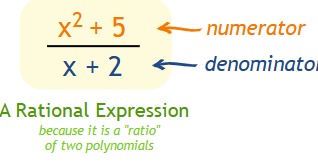
Therefore, certain values of the variable are not allowed. These are called restrictions on the domain.

Main Rule

Denominator \( \ne 0 \)

To find restrictions:

  1. Set the denominator equal to 0
  2. Solve for the variable
  3. Exclude those values

Important SAT Idea

Even if a factor cancels when simplifying, the restriction still remains.

This is one of the most common DIGITAL SAT trap questions.

Example 1:

Find the restriction for \( \dfrac{1}{x-5} \).

▶️ Answer/Explanation

\( x-5=0 \)

\( x=5 \)

Restriction: \( x\ne5 \)

Example 2:

Find the restrictions for \( \dfrac{2}{x^2-9} \).

▶️ Answer/Explanation

Factor denominator:

\( x^2-9=(x-3)(x+3) \)

\( x=3 \) or \( x=-3 \)

Restrictions: \( x\ne3,\; x\ne-3 \)

Example 3:

Find the restriction for \( \dfrac{x-2}{x-2} \).

▶️ Answer/Explanation

Even though the expression simplifies to 1, the denominator still cannot be 0.

\( x-2=0 \Rightarrow x=2 \)

Restriction: \( x\ne2 \)

Scroll to Top