
Standard Form & Vertex Form
A quadratic function is a function whose highest power of \( x \) is 2.
\( f(x)=ax^2+bx+c \)
Its graph is a parabola.
1. Standard Form
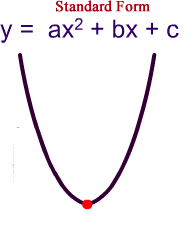
\( f(x)=ax^2+bx+c \)
- \( c \) = y-intercept
- If \( a>0 \) parabola opens upward
- If \( a<0 \) parabola opens downward
Vertex (Maximum/Minimum)
The x-coordinate of the vertex is:
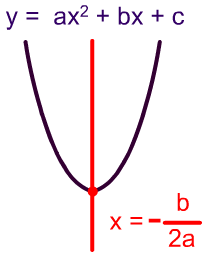
\( x=-\dfrac{b}{2a} \)
2. Vertex Form
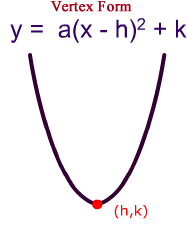
\( f(x)=a(x-h)^2+k \)
- Vertex = \( (h,k) \)
- Easy to identify maximum or minimum value
Why SAT Loves Vertex Form
Because it immediately shows the highest or lowest value of a function.
DIGITAL SAT Tip
If a question asks for maximum value, minimum value, or turning point → use vertex form.
Example 1 (Identify Vertex):
Find the vertex of \( f(x)=2(x-3)^2+5 \).
▶️ Answer/Explanation
Compare with \( a(x-h)^2+k \).
\( h=3,\; k=5 \)
Vertex: \( (3,5) \)
Example 2 (Find Vertex from Standard Form):
Find the vertex of \( f(x)=x^2-6x+1 \).
▶️ Answer/Explanation
\( x=-\dfrac{-6}{2(1)}=3 \)
Now substitute into function:
\( f(3)=9-18+1=-8 \)
Vertex: \( (3,-8) \)
Example 3 (Interpretation):
The height of a ball is \( h(t)=-t^2+6t+2 \). Find the maximum height.
▶️ Answer/Explanation
\( t=-\dfrac{6}{2(-1)}=3 \)
\( h(3)=-9+18+2=11 \)
Maximum height: 11 units
Completing the Square
Completing the square is a method used to rewrite a quadratic from standard form into vertex form.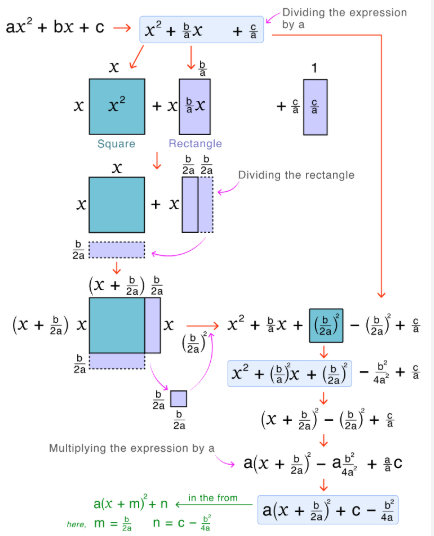
We convert:
\( ax^2+bx+c \)
into
\( a(x-h)^2+k \)
This lets us easily find the vertex (maximum or minimum).
Core Idea
We create a perfect square trinomial.
\( x^2+bx \rightarrow (x+\frac{b}{2})^2-\left(\frac{b}{2}\right)^2 \)
Steps
- Factor coefficient of \( x^2 \) (if not 1)
- Take half of \( b \)
- Square it
- Add and subtract the same number
- Rewrite as a square
DIGITAL SAT Tip
If the problem asks for minimum value, maximum value, or turning point and the equation is in standard form, you should complete the square.
Example 1:
Rewrite \( x^2+6x+5 \) in vertex form.
▶️ Answer/Explanation
Half of 6 is 3.
\( x^2+6x+9-9+5 \)
\( (x+3)^2-4 \)
Answer: \( (x+3)^2-4 \)
Example 2:
Rewrite \( x^2-8x+2 \) in vertex form.
▶️ Answer/Explanation
Half of −8 is −4.
\( x^2-8x+16-16+2 \)
\( (x-4)^2-14 \)
Answer: \( (x-4)^2-14 \)
Example 3:
Find the minimum value of \( f(x)=x^2-4x+7 \).
▶️ Answer/Explanation
\( x^2-4x+4-4+7 \)
\( (x-2)^2+3 \)
Smallest value occurs when square = 0.
Minimum value: 3
Discriminant
The discriminant tells us how many real solutions a quadratic equation has.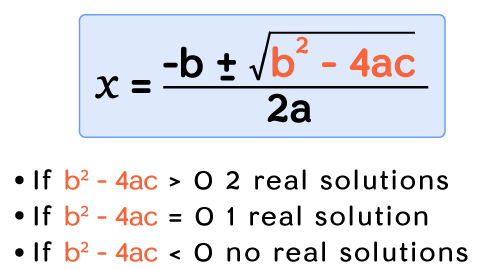
For the quadratic:
\( ax^2+bx+c=0 \)
the discriminant is:
\( D=b^2-4ac \)
It comes from the quadratic formula:
\( x=\dfrac{-b\pm\sqrt{b^2-4ac}}{2a} \)
What the Discriminant Means
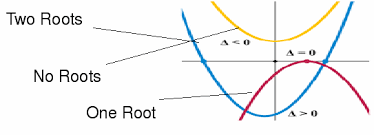
- \( D>0 \) → two real solutions
- \( D=0 \) → one real solution (repeated root)
- \( D<0 \) → no real solutions
Graph Interpretation
- 2 solutions → parabola crosses x-axis twice
- 1 solution → parabola touches x-axis
- 0 solutions → parabola never touches x-axis
DIGITAL SAT Tip
SAT often asks the number of solutions without solving the equation. Use the discriminant instead of factoring.
Example 1:
How many real solutions does \( x^2-5x+6=0 \) have?
▶️ Answer/Explanation
\( a=1,\; b=-5,\; c=6 \)
\( D=(-5)^2-4(1)(6) \)
\( D=25-24=1>0 \)
Answer: 2 real solutions
Example 2:
How many real solutions does \( x^2-4x+4=0 \) have?
▶️ Answer/Explanation
\( a=1,\; b=-4,\; c=4 \)
\( D=(-4)^2-4(1)(4)=16-16=0 \)
Answer: 1 real solution
Example 3:
How many real solutions does \( 2x^2+3x+5=0 \) have?
▶️ Answer/Explanation
\( a=2,\; b=3,\; c=5 \)
\( D=3^2-4(2)(5)=9-40=-31<0 \)
Answer: no real solutions