
Degree & Leading Coefficient
A polynomial function is a function made of powers of \( x \) added or subtracted together.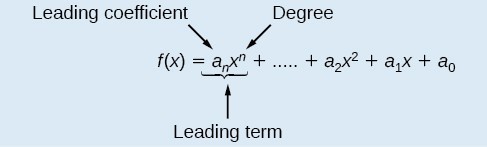
\( f(x)=3x^4-2x^2+5x-7 \)
Degree of a Polynomial
The degree is the highest exponent of \( x \).
Examples:
- \( 4x^3+2x-1 \) → degree 3
- \( 5x^2+7 \) → degree 2
- \( -8x+3 \) → degree 1
Leading Coefficient
The leading coefficient is the coefficient of the highest-degree term.
For \( f(x)=3x^4-2x^2+5x-7 \)
degree = 4, leading coefficient = 3
Why This Matters (SAT)
The degree and leading coefficient determine how the graph behaves for very large positive or negative \( x \).
Quick Graph Behavior Idea
- Even degree → both ends go same direction
- Odd degree → ends go opposite directions
- Positive leading coefficient → right end goes up
- Negative leading coefficient → right end goes down
DIGITAL SAT Tip
You often do NOT need the whole graph. The SAT only cares about the highest power term.
Example 1:
Find the degree and leading coefficient of \( f(x)=5x^3-2x^2+9 \).
▶️ Answer/Explanation
Highest exponent is 3.
Degree: 3
Leading coefficient: 5
Example 2:
Determine the degree and leading coefficient of \( g(x)=-2x^4+3x-1 \).
▶️ Answer/Explanation
Highest exponent is 4.
Degree: 4
Leading coefficient: −2
Example 3:
A function has even degree and a negative leading coefficient. What happens to the graph as \( x\to\infty \)?
▶️ Answer/Explanation
Even degree → both ends same direction.
Negative coefficient → graph goes downward.
Answer: the graph goes down to negative infinity.
Zeros & Factors
A zero (or root) of a polynomial is a value of \( x \) that makes the function equal to 0.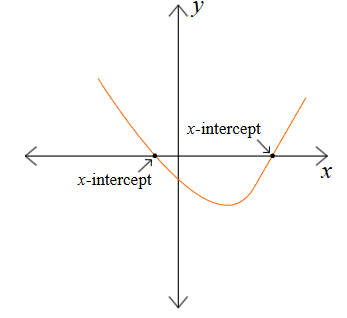
\( f(x)=0 \)
Graphically, zeros are the x-intercepts of the graph.
Factor Theorem
If \( x=a \) is a zero of a polynomial, then \( (x-a) \) is a factor.
Zero \( \rightarrow \) Factor
Example:
If \( x=3 \) is a zero → factor is \( (x-3) \)
How to Find Zeros
- Factor the polynomial
- Set each factor equal to 0
Important Idea
If a factor repeats, the graph touches the x-axis and turns around.
DIGITAL SAT Tip
SAT frequently gives the graph or a table and asks you to identify a factor.
Example 1:
Find the zeros of \( f(x)=x^2-5x+6 \).
▶️ Answer/Explanation
\( x^2-5x+6=(x-2)(x-3) \)
\( x-2=0 \Rightarrow x=2 \)
\( x-3=0 \Rightarrow x=3 \)
Zeros: 2 and 3
Example 2:
A polynomial has zeros \( x=1 \) and \( x=-4 \). Write a possible polynomial.
▶️ Answer/Explanation
Zeros → factors:
\( (x-1)(x+4) \)
\( x^2+3x-4 \)
One possible polynomial: \( x^2+3x-4 \)
Example 3:
If a graph crosses the x-axis at \( x=5 \), which factor must the polynomial contain?
▶️ Answer/Explanation
Zero at 5 → factor \( (x-5) \).
Answer: \( (x-5) \)
End Behavior
The end behavior of a polynomial describes what happens to the graph as \( x \to \infty \) (very large positive) and \( x \to -\infty \) (very large negative).
Only two things determine end behavior:
- the degree
- the leading coefficient
Even Degree Polynomials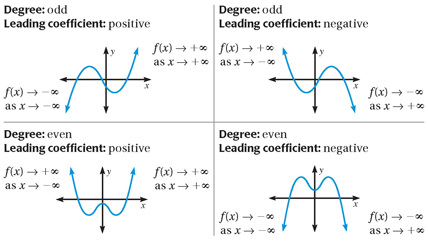
- Positive leading coefficient → both ends go up
- Negative leading coefficient → both ends go down
Odd Degree Polynomials
- Positive leading coefficient → left down, right up
- Negative leading coefficient → left up, right down
Quick Memory Trick
The graph behaves like the highest-power term:
\( x^4 \) → both up
\( -x^4 \) → both down
\( x^3 \) → left down, right up
\( -x^3 \) → left up, right down
DIGITAL SAT Tip
Ignore all lower-degree terms. Only the leading term matters.
Example 1:
Describe the end behavior of \( f(x)=x^4-3x^2+2 \).
▶️ Answer/Explanation
Leading term \( x^4 \) → even degree, positive coefficient.
Answer: both ends go up.
Example 2:
Describe the end behavior of \( g(x)=-2x^3+5x \).
▶️ Answer/Explanation
Leading term \( -2x^3 \) → odd degree, negative coefficient.
Answer: left end up, right end down.
Example 3:
A polynomial has odd degree and positive leading coefficient. What happens as \( x\to\infty \)?
▶️ Answer/Explanation
Odd degree positive → right end goes up.
Answer: \( f(x)\to\infty \)