
Non-linear Functions (Graphs) : Parabolas
A parabola is the graph of a quadratic function.
\( f(x)=ax^2+bx+c \)
It is a U-shaped curve and is one of the most tested graphs on the DIGITAL SAT.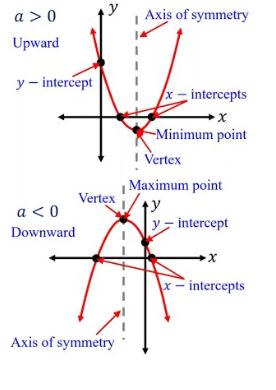
Direction of Opening
- If \( a>0 \) → opens upward (minimum point)
- If \( a<0 \) → opens downward (maximum point)
Intercepts
y-intercept
Occurs at \( x=0 \Rightarrow y=c \)
x-intercepts (roots)
Solve:
\( ax^2+bx+c=0 \)
Shape (Width)
- Large |a| → narrow parabola
- Small |a| → wide parabola
DIGITAL SAT Tip
You often do NOT need to graph fully. Just identify opening direction and intercepts.
Example 1:
For \( f(x)=2x^2-8x+3 \), does the parabola open up or down?
▶️ Answer/Explanation
\( a=2>0 \)
Answer: opens upward.
Example 2:
Find the y-intercept of \( f(x)=x^2+5x-4 \).
▶️ Answer/Explanation
\( f(0)=-4 \)
Answer: \( (0,-4) \)
Example 3:
How many x-intercepts does \( f(x)=x^2+4x+4 \) have?
▶️ Answer/Explanation
\( x^2+4x+4=(x+2)^2 \)
Repeated root.
Answer: 1 x-intercept
Vertex & Axis of Symmetry
Every parabola has a turning point called the vertex.
It is the highest point (maximum) or lowest point (minimum) of the graph.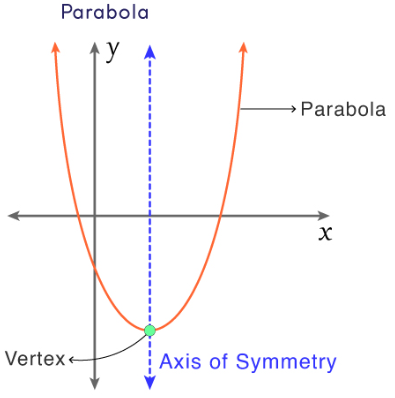
Vertex Formula (from Standard Form)
For \( f(x)=ax^2+bx+c \):
\( x_{vertex}=-\dfrac{b}{2a} \)
Then substitute this x-value into the function to get the y-coordinate.
Axis of Symmetry
A parabola is perfectly symmetric.
The vertical line passing through the vertex is called the axis of symmetry.
\( x=-\dfrac{b}{2a} \)
Vertex Form (Fastest Method)
If written as:
\( f(x)=a(x-h)^2+k \)
- Vertex = \( (h,k) \)
- Axis of symmetry = \( x=h \)
DIGITAL SAT Tip
If the question asks for maximum/minimum value, it is asking for the vertex.
Example 1:
Find the vertex of \( f(x)=x^2-6x+5 \).
▶️ Answer/Explanation
\( x=-\dfrac{-6}{2(1)}=3 \)
\( f(3)=9-18+5=-4 \)
Vertex: \( (3,-4) \)
Example 2:
Find the axis of symmetry of \( f(x)=2x^2+8x+1 \).
▶️ Answer/Explanation
\( x=-\dfrac{8}{2(2)}=-2 \)
Answer: \( x=-2 \)
Example 3:
Find the vertex and axis of symmetry of \( f(x)=3(x-4)^2+2 \).
▶️ Answer/Explanation
Compare with \( a(x-h)^2+k \).
\( h=4,\; k=2 \)
Vertex: \( (4,2) \)
Axis of symmetry: \( x=4 \)