
Horizontal & Vertical Shifts
A transformation changes the position of a graph without changing its basic shape.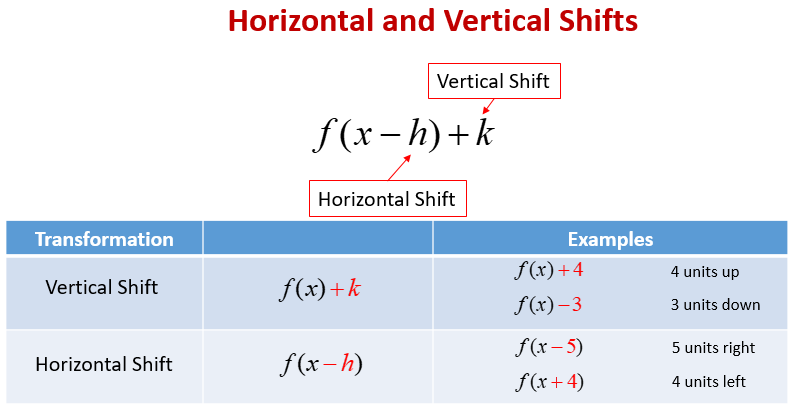
We start with a base function:
\( y=f(x) \)
Then modify it.
1. Horizontal Shifts → \( f(x \pm a) \)
These move the graph left or right.
- \( f(x-a) \) → shift RIGHT by \( a \)
- \( f(x+a) \) → shift LEFT by \( a \)
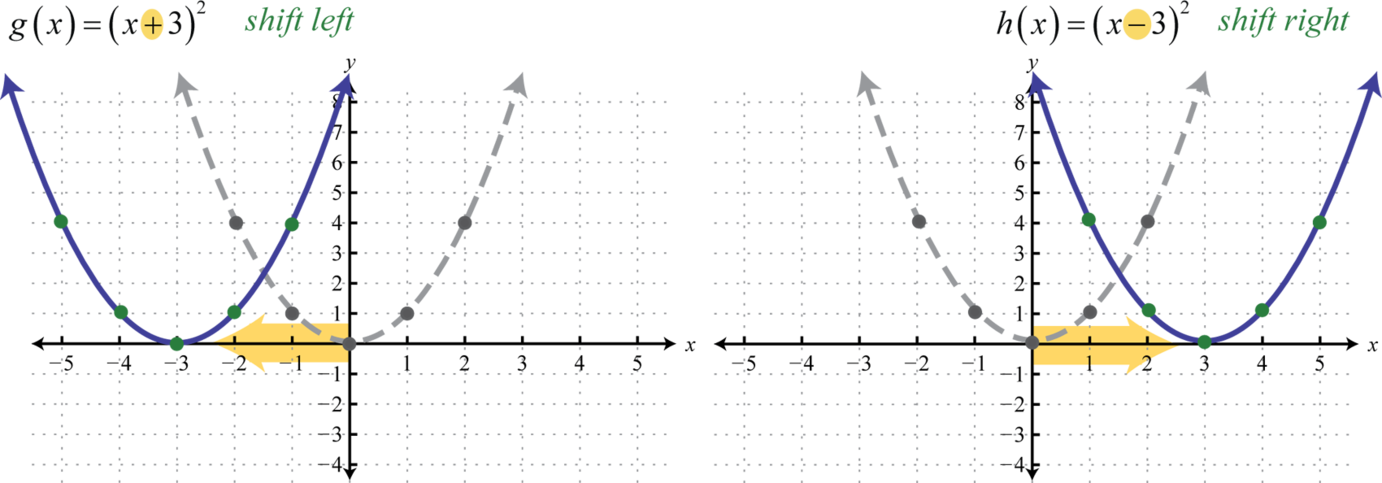
(This is the most common SAT trick because the direction feels reversed.)
2. Vertical Shifts → \( f(x) \pm k \)
These move the graph up or down.
- \( f(x)+k \) → shift UP \( k \)
- \( f(x)-k \) → shift DOWN \( k \)
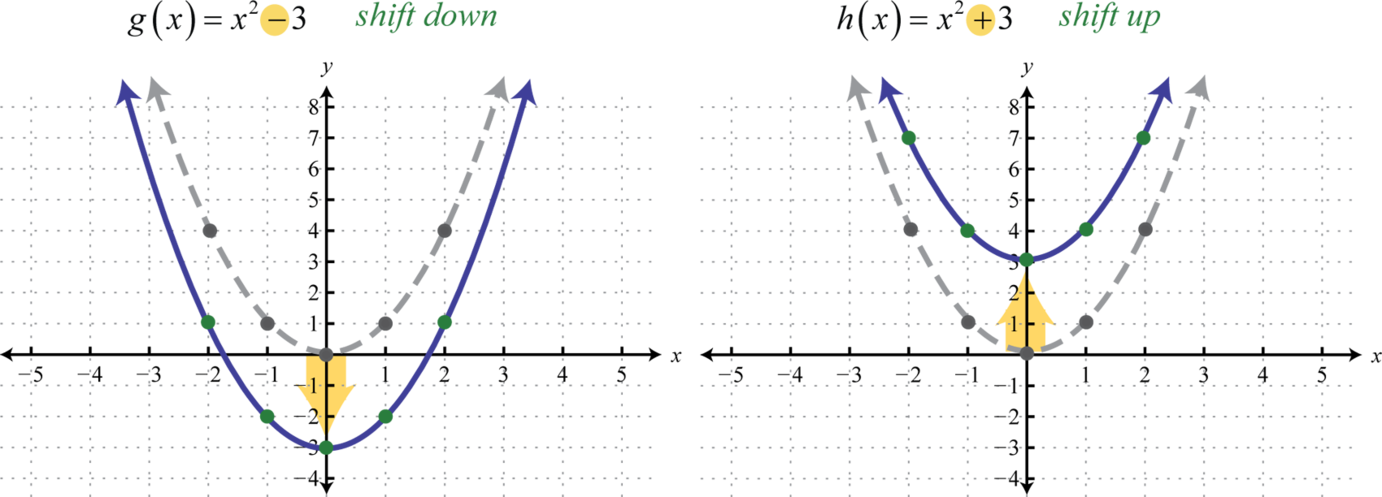
Important Observation
- Changes inside the brackets affect x-values (horizontal)
- Changes outside affect y-values (vertical)
DIGITAL SAT Tip
If a question asks how the vertex moves, it is a transformation question.
Example 1:
The graph of \( y=f(x) \) is shifted to \( y=f(x-4) \). Describe the movement.
▶️ Answer/Explanation
\( x-4 \) means shift right 4 units.
Answer: 4 units right
Example 2:
The graph \( y=f(x) \) becomes \( y=f(x)+3 \). What happens?
▶️ Answer/Explanation
+3 outside the function shifts the graph upward.
Answer: up 3 units
Example 3:
The vertex of \( y=x^2 \) is \( (0,0) \). Find the new vertex of \( y=(x-2)^2+5 \).
▶️ Answer/Explanation
Right 2, up 5.
Answer: \( (2,5) \)
Stretch & Compression
Besides shifting a graph, we can also change how wide or steep it looks.
These are called stretches and compressions.
Start with the base function:
\( y=f(x) \)
1. Vertical Stretch/Compression → \( y=af(x) \)
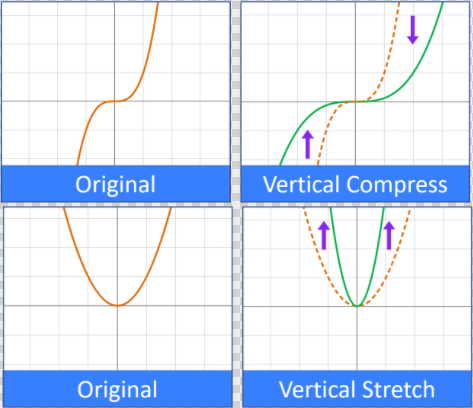
- \( a>1 \) → vertical stretch (graph becomes steeper/narrower)
- \( 0<a<1 \) → vertical compression (graph becomes flatter/wider)
All y-values are multiplied by \( a \).
2. Horizontal Stretch/Compression → \( y=f(bx) \)
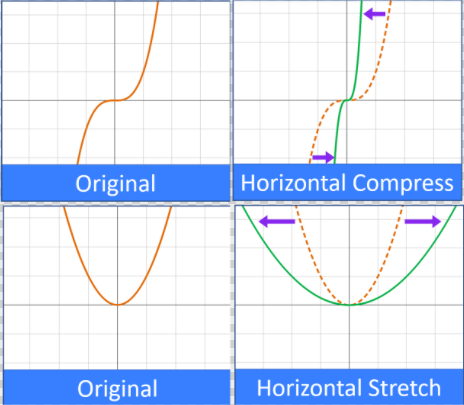
- \( b>1 \) → horizontal compression
- \( 0<b<1 \) → horizontal stretch
This changes x-values (note: horizontal changes feel reversed).
Important Memory Trick
- Outside function → affects height
- Inside function → affects width
DIGITAL SAT Tip
For quadratics \( y=ax^2 \): larger \( |a| \) = narrower parabola.
Example 1:
Compare \( y=x^2 \) and \( y=3x^2 \).
▶️ Answer/Explanation
3 multiplies all y-values.
Answer: vertical stretch (narrower parabola)
Example 2:
Compare \( y=x^2 \) and \( y=\frac{1}{2}x^2 \).
▶️ Answer/Explanation
Factor less than 1 compresses vertically.
Answer: vertical compression (wider parabola)
Example 3:
What happens to \( y=x^2 \) when changed to \( y=f(2x)= (2x)^2 \)?
▶️ Answer/Explanation
2 inside causes horizontal compression.
Answer: graph becomes narrower.
Reflection
A reflection flips a graph across an axis.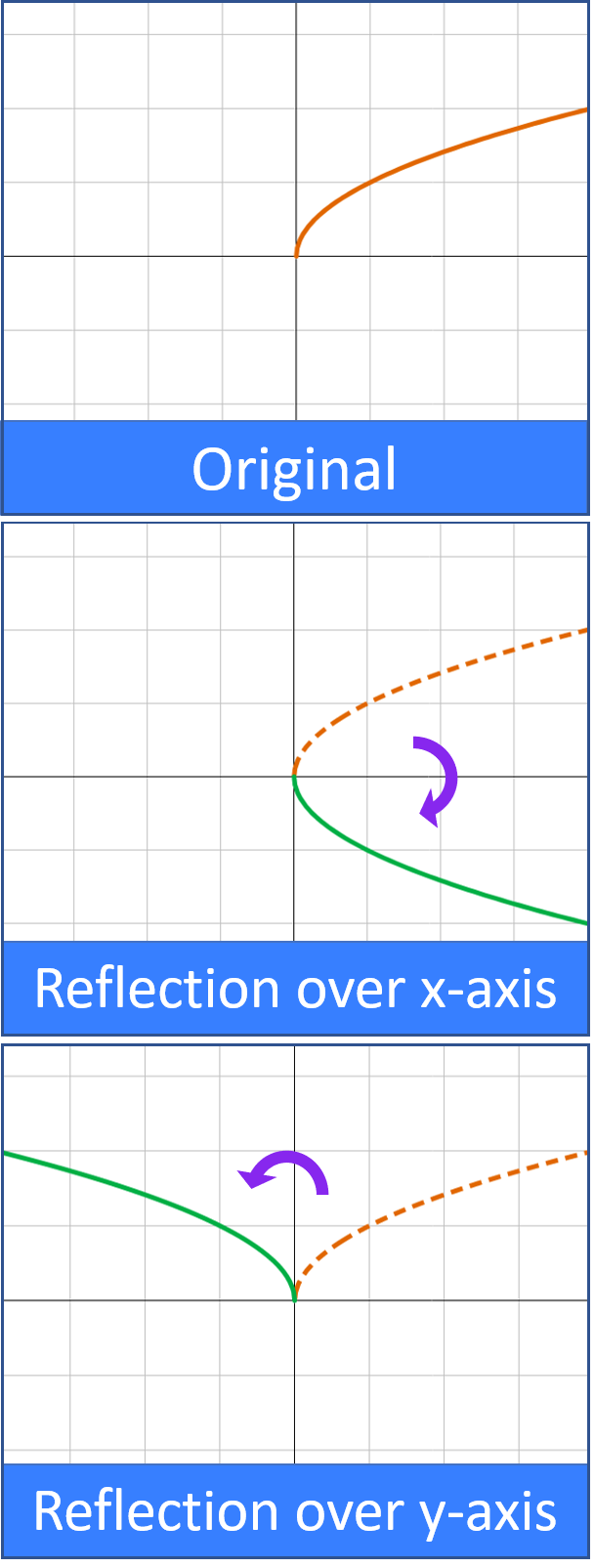
Start with the base function:
\( y=f(x) \)
1. Reflection Across the x-axis
\( y=-f(x) \)
All y-values change sign.
- Positive y → negative y
- Graph flips upside down
2. Reflection Across the y-axis
\( y=f(-x) \)
All x-values change sign.
- Left becomes right
- Right becomes left
Quick Comparison
- Negative outside → flip over x-axis
- Negative inside → flip over y-axis
DIGITAL SAT Tip
Parabola \( y=x^2 \) reflected across the x-axis becomes \( y=-x^2 \). Many SAT questions hide this inside a larger function.
Example 1:
Describe the transformation from \( y=x^2 \) to \( y=-x^2 \).
▶️ Answer/Explanation
Negative outside the function.
Answer: reflection across x-axis
Example 2:
Describe the transformation from \( y=x^3 \) to \( y=(-x)^3 \).
▶️ Answer/Explanation
Negative inside the function.
Answer: reflection across y-axis
Example 3 :
The graph \( y=f(x) \) becomes \( y=-f(-x) \). Describe the change.
▶️ Answer/Explanation
Negative inside → y-axis reflection. Negative outside → x-axis reflection.
Answer: reflection across both axes (180° rotation about origin)