
Direct & Inverse Variation
Direct Variation
Two quantities are in direct variation when one increases and the other increases proportionally.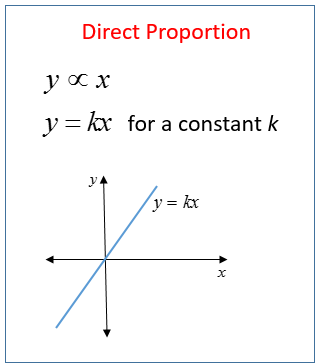
\( y \propto x \)
This means:
\( y=kx \)
where \( k \) is the constant of variation.
Graph: straight line passing through the origin.
Examples
- total cost and number of items (fixed price)
- distance and time at constant speed
Inverse Variation
Two quantities are in inverse variation when one increases while the other decreases proportionally.
\( y \propto \dfrac{1}{x} \)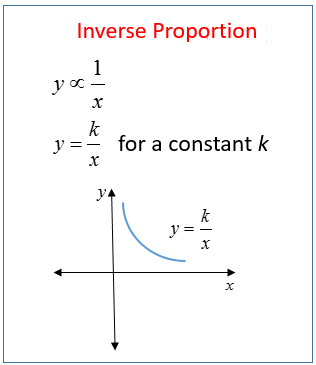
This means:
\( y=\dfrac{k}{x} \)
Graph: decreasing curve (hyperbola).
Examples
- speed and travel time (fixed distance)
- workers and time to complete a job
Finding the Constant
- Direct: \( k=\dfrac{y}{x} \)
- Inverse: \( k=xy \)
DIGITAL SAT Tip
If doubling one quantity doubles the other → direct variation. If doubling one quantity halves the other → inverse variation.
Example 1 (Direct Variation):
\( y \) varies directly with \( x \). If \( y=12 \) when \( x=3 \), find \( y \) when \( x=5 \).
▶️ Answer/Explanation
\( k=\dfrac{12}{3}=4 \)
\( y=4(5)=20 \)
Answer: 20
Example 2 (Inverse Variation):
\( y \) varies inversely with \( x \). If \( y=8 \) when \( x=2 \), find \( y \) when \( x=4 \).
▶️ Answer/Explanation
\( k=xy=16 \)
\( y=\dfrac{16}{4}=4 \)
Answer: 4
Example 3 (Identify Type):
A car travels 120 km in 2 hours and 180 km in 3 hours at the same speed. Is this direct or inverse variation?
▶️ Answer/Explanation
Distance increases with time proportionally.
Answer: direct variation
Unit Rates
A rate compares two quantities with different units.
kilometers per hour, dollars per item, liters per minute
A unit rate is a rate where the second quantity equals 1.
- price per 1 item
- distance per 1 hour
How to Find a Unit Rate
Divide the first quantity by the second quantity.
\( \text{unit rate}=\dfrac{\text{quantity}}{\text{units}} \)
Why SAT Tests This
Many DIGITAL SAT questions are disguised comparison problems. You must compare unit prices or speeds.
DIGITAL SAT Tip
Whenever a question asks “which is the better deal?” → compute unit rate.
Example 1 (Speed):
A car travels 180 km in 3 hours. Find its speed.
▶️ Answer/Explanation
\( \dfrac{180}{3}=60 \)
Answer: 60 km/h
Example 2 (Best Buy):
Pack A: 6 notebooks for $9 Pack B: 10 notebooks for $14 Which is cheaper per notebook?
▶️ Answer/Explanation
Pack A:
\( \dfrac{9}{6}=1.5 \) dollars
Pack B:
\( \dfrac{14}{10}=1.4 \) dollars
Answer: Pack B is cheaper
Example 3 (Constant Rate):
A faucet fills 12 liters in 4 minutes. How many liters per minute?
▶️ Answer/Explanation
\( \dfrac{12}{4}=3 \)
Answer: 3 L/min
Scaling
Scaling means increasing or decreasing quantities while keeping the same proportion.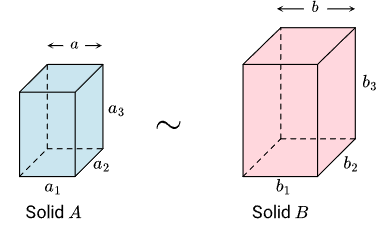
This appears on the DIGITAL SAT in maps, models, recipes, and similar figures.
Scale Factor
The number that multiplies all measurements.
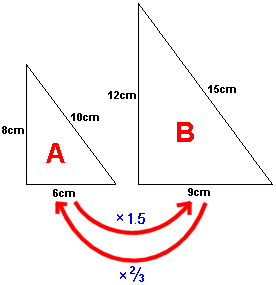
\( \text{scale factor}=\dfrac{\text{new size}}{\text{original size}} \)
Effect on Measurements
- Lengths multiply by scale factor
- Perimeter multiplies by scale factor
- Area multiplies by (scale factor)\(^2\)
Common SAT Trap
Students often multiply area by the scale factor instead of squaring it.
DIGITAL SAT Tip
If dimensions double → area becomes 4 times larger.
Example 1 (Length):
A model car is built at a scale of 1:5. If the real car length is 20 m, what is the model length?
▶️ Answer/Explanation
\( \dfrac{20}{5}=4 \)
Answer: 4 m
Example 2 (Area):
A square has side 3 cm. A similar square has scale factor 2. Find its area.
▶️ Answer/Explanation
New side:
\( 3\times2=6 \)
Area:
\( 6^2=36 \)
Answer: 36 cm²
Example 3 (Recipe Scaling):
A recipe uses 2 cups of flour for 4 servings. How much flour is needed for 10 servings?
▶️ Answer/Explanation
Scale factor:
\( \dfrac{10}{4}=2.5 \)
Flour:
\( 2\times2.5=5 \)
Answer: 5 cups