
Observational vs Experimental Studies
In statistics, researchers collect data in two main ways: observational studies and experiments. The DIGITAL SAT often asks you to identify which type of study is being described.
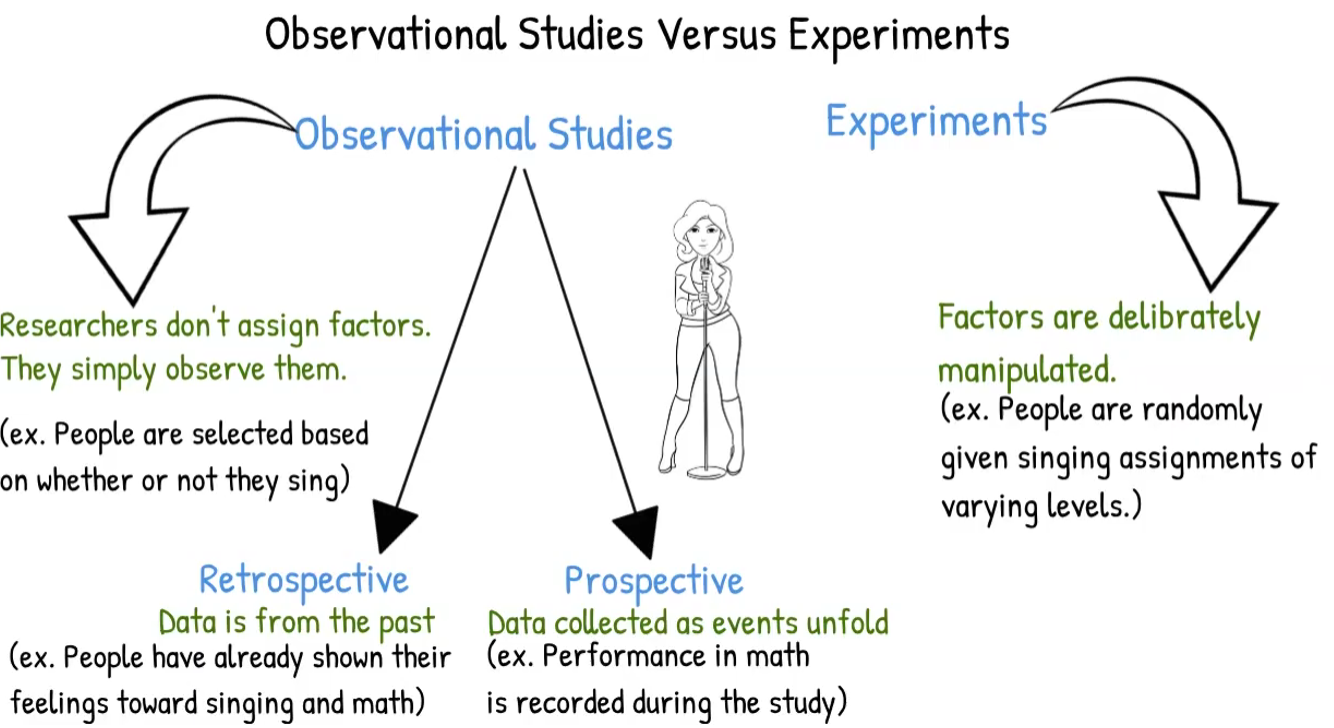
Observational Study
In an observational study, researchers only observe and record information. They do not change anything or assign treatments.
Researchers simply measure what already happens naturally.
Example situations:
- surveying students about sleep habits
- recording how many hours people exercise
- studying diet patterns
Experiment
In an experiment, researchers actively assign a treatment to participants and then measure the outcome.
The key idea is intervention. The researcher changes something.
Example situations:
- giving one group a new teaching method
- testing a medicine vs a placebo
- changing study time and measuring scores
Key Recognition Rule
- Researcher assigns a treatment → Experiment
- Researcher only records → Observational study
Why This Matters
Only experiments can establish cause-and-effect relationships. Observational studies cannot prove causation.
Example 1:
Researchers record how many hours students sleep and compare it with their grades, without changing students’ schedules. What type of study is this?
▶️ Answer/Explanation
Researchers did not assign sleep schedules. They only observed.
Conclusion: Observational study.
Example 2:
Students are randomly assigned to two groups. One group uses a new math learning app and the other uses a textbook. After 6 weeks, their test scores are compared. What type of study is this?
▶️ Answer/Explanation
The researcher assigned a treatment (learning app).
Conclusion: Experiment.
Example 3:
A survey asks adults how many cups of coffee they drink and records their reported stress levels. What type of study is this?
▶️ Answer/Explanation
Participants were not assigned coffee intake.
Conclusion: Observational study.
Cause vs Correlation
The DIGITAL SAT very frequently tests whether you understand the difference between correlation and causation. Many questions try to trick you into assuming that because two variables are related, one must cause the other.
Correlation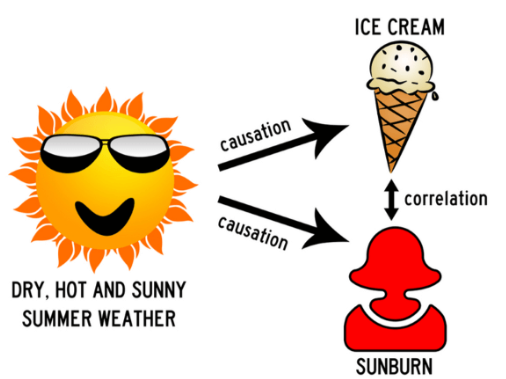
Correlation means two variables are associated or move together in a pattern.
- Positive correlation → both increase together
- Negative correlation → one increases while the other decreases
Correlation only describes a relationship. It does not explain why the relationship exists.
Causation
Causation means one variable directly produces a change in another variable.
To claim causation, a controlled experiment is usually required.
Confounding Variable
A confounding variable is a third factor that influences both variables and explains the relationship.
This is one of the most important ideas tested on the SAT.
Key Rule
Correlation does not imply causation.
DIGITAL SAT Tip
If the study is observational, you usually cannot conclude cause and effect.
Example 1:
A study finds students who sleep more hours tend to have higher grades. Does this prove more sleep causes better grades?
▶️ Answer/Explanation
The study shows association only.
Other factors (study habits, time management) may influence both.
Conclusion: This is correlation, not causation.
Example 2:
Ice cream sales and drowning incidents both increase during summer months. Does ice cream consumption cause drowning?
▶️ Answer/Explanation
The hidden factor is hot weather, which increases swimming and ice cream purchases.
Conclusion: A confounding variable exists. The relationship is correlation only.
Example 3:
In an experiment, students are randomly assigned either 8 hours or 5 hours of sleep for one week. The 8-hour group scores significantly higher on a test. What conclusion is justified?
▶️ Answer/Explanation
A treatment was assigned and variables were controlled.
Conclusion: A causal relationship can be supported.