
Percentage Increase & Decrease
Percent means per 100.
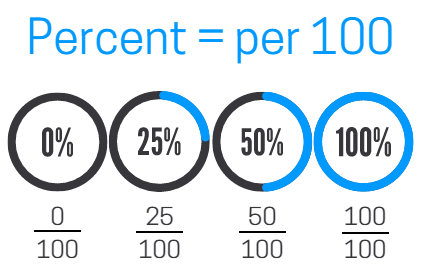
\( 25\%=\dfrac{25}{100}=0.25 \)
Percentage Increase
When a quantity grows:
\( \%\text{ increase}=\dfrac{\text{increase}}{\text{original}}\times100 \)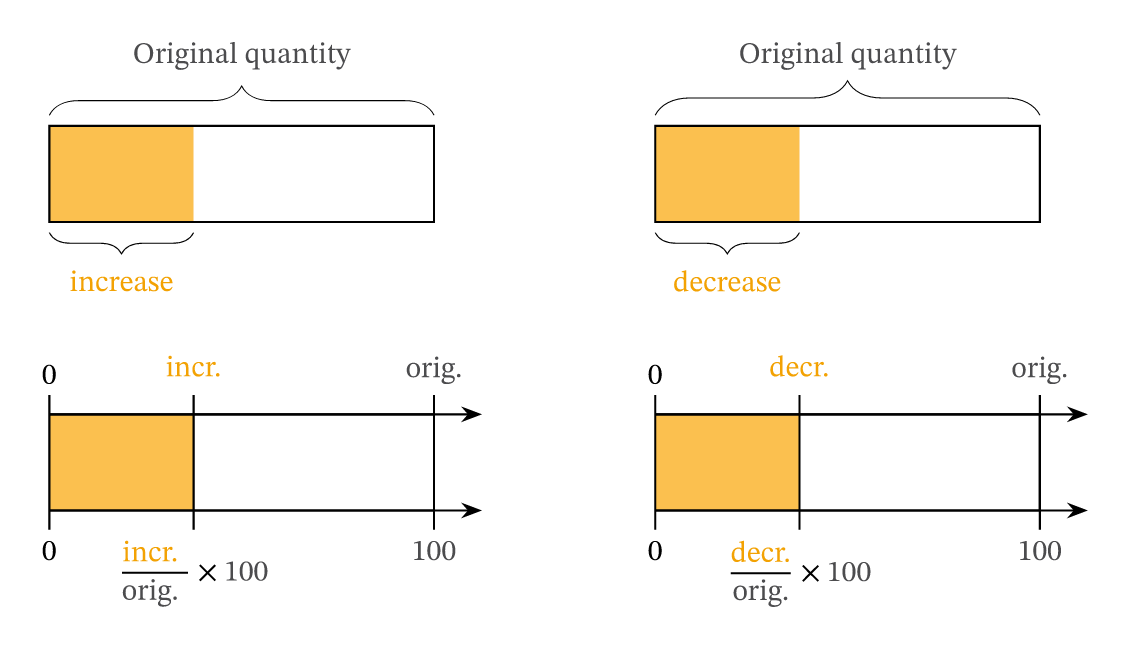
New value:
\( \text{new}=\text{original}(1+\text{rate}) \)
Percentage Decrease
When a quantity becomes smaller:
\( \%\text{ decrease}=\dfrac{\text{decrease}}{\text{original}}\times100 \)
New value:
\( \text{new}=\text{original}(1-\text{rate}) \)
DIGITAL SAT Tip
Always use the original value in the denominator. Students often mistakenly use the new value.
Example 1 (Increase):
A phone price rises from $400 to $460. Find the percent increase.
▶️ Answer/Explanation
Increase:
\( 460-400=60 \)
\( \dfrac{60}{400}\times100=15\% \)
Answer: 15%
Example 2 (Decrease):
A jacket costs $80 and is discounted to $60. Find the percent decrease.
▶️ Answer/Explanation
Decrease:
\( 80-60=20 \)
\( \dfrac{20}{80}\times100=25\% \)
Answer: 25%
Example 3 (Find New Value):
A salary of $2000 increases by 8%. What is the new salary?
▶️ Answer/Explanation
\( 2000(1.08)=2160 \)
Answer: $2160
Profit, Loss & Discount
Cost Price (CP) = price you paid to buy an item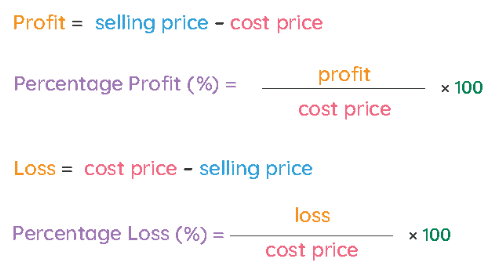
Selling Price (SP) = price you sold the item for
Profit
If \( SP>CP \), you gain money.
\( \text{Profit}=SP-CP \)
\( \%\text{ Profit}=\dfrac{\text{Profit}}{CP}\times100 \)
Loss
If \( SP<CP \), you lose money.
\( \text{Loss}=CP-SP \)
\( \%\text{ Loss}=\dfrac{\text{Loss}}{CP}\times100 \)
Discount
Stores often mark a higher marked price (MP) and then reduce it.
\( \text{Discount}=MP-SP \)
\( SP=MP(1-\text{discount rate}) \)
DIGITAL SAT Tip
Profit percent and discount percent are based on different originals:
- profit → based on cost price
- discount → based on marked price
Example 1 (Profit):
An item costs $50 and sells for $65. Find the profit percent.
▶️ Answer/Explanation
Profit \( =65-50=15 \)
\( \dfrac{15}{50}\times100=30\% \)
Answer: 30%
Example 2 (Loss):
A bicycle bought for $200 is sold for $170. Find the loss percent.
▶️ Answer/Explanation
Loss \( =200-170=30 \)
\( \dfrac{30}{200}\times100=15\% \)
Answer: 15%
Example 3 (Discount):
A jacket marked $120 is sold at 25% discount. Find the selling price.
▶️ Answer/Explanation
\( SP=120(1-0.25)=120(0.75)=90 \)
Answer: $90
Successive Percentage Change
A successive percentage change happens when a value changes more than once.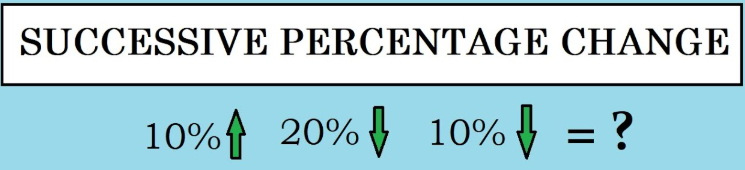
Example: a price increases, then decreases.
Important Idea
Each percentage change is applied to the new value, not the original value.
Multiplier Method (Most Important SAT Method)
- Increase by \( r\% \) → multiply by \( (1+r) \)
- Decrease by \( r\% \) → multiply by \( (1-r) \)
Final value:
\( \text{Final}=\text{Original} \times \text{(multiplier 1)} \times \text{(multiplier 2)} \)
Very Important Fact
An increase and the same percent decrease do NOT cancel.
DIGITAL SAT Tip
Never add or subtract percentages. Always multiply the multipliers.
Example 1:
A price of $100 increases by 20% and then increases by 10%. Find the final price.
▶️ Answer/Explanation
\( 100(1.20)(1.10)=132 \)
Answer: $132
Example 2:
A $200 item increases by 25% and then decreases by 25%. What is the final price?
▶️ Answer/Explanation
\( 200(1.25)(0.75)=187.5 \)
Answer: $187.50
Example 3 (Find Overall % Change):
A value becomes \( 1.32 \) times the original. What is the percent increase?
▶️ Answer/Explanation
Multiplier 1.32 means 32% increase.
Answer: 32%
Reverse Percentage
In a reverse percent problem, you are given the final value and must find the original value.
Instead of multiplying, you work backwards.
Key Idea (Multiplier Method)
- Increase \( r\% \) → multiply by \( (1+r) \)
- Decrease \( r\% \) → multiply by \( (1-r) \)
To reverse the change, divide instead of multiply.
\( \text{Original}=\dfrac{\text{Final}}{\text{multiplier}} \)
Common SAT Situations
- price after discount
- salary after raise
- population after growth
DIGITAL SAT Tip
Students often subtract the percent. Never do that. Always divide by the multiplier.
Example 1 (After Increase):
After a 20% increase, a salary becomes $2400. Find the original salary.
▶️ Answer/Explanation
Multiplier \( =1.20 \)
\( \dfrac{2400}{1.20}=2000 \)
Answer: $2000
Example 2 (After Discount):
A jacket is sold for $75 after a 25% discount. Find the marked price.
▶️ Answer/Explanation
Multiplier \( =0.75 \)
\( \dfrac{75}{0.75}=100 \)
Answer: $100
Example 3 (Population):
A town’s population becomes 13,200 after a 10% increase. Find the original population.
▶️ Answer/Explanation
Multiplier \( =1.10 \)
\( \dfrac{13200}{1.10}=12000 \)
Answer: 12,000