Digital SAT Maths -Unit 3 - 3.3 Units and Dimensional Analysis- Study Notes- New Syllabus
Digital SAT Maths -Unit 3 – 3.3 Units and Dimensional Analysis- Study Notes- New syllabus
Digital SAT Maths -Unit 3 – 3.3 Units and Dimensional Analysis- Study Notes – per latest Syllabus.
Key Concepts:
Unit conversions
Multi-step unit problems
Unit Conversions
A unit conversion changes a measurement from one unit to another without changing its value.
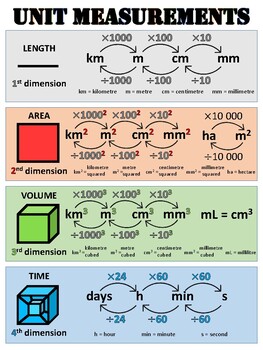
We use conversion factors.
A conversion factor is a fraction equal to 1.
Example: \( \dfrac{100\text{ cm}}{1\text{ m}}=1 \)
Dimensional Analysis Method
Multiply by a conversion factor so unwanted units cancel.
Key Rule
Put the unit you want to remove on the opposite side of the fraction.
Common SAT Conversions
- \( 1\text{ m}=100\text{ cm} \)
- \( 1\text{ km}=1000\text{ m} \)
- \( 1\text{ kg}=1000\text{ g} \)
- \( 1\text{ hr}=60\text{ min} \)
- \( 1\text{ min}=60\text{ s} \)
DIGITAL SAT Tip
Always write the units during calculation. If units cancel correctly, your setup is correct.
Example 1:
Convert 3.5 m to centimeters.
▶️ Answer/Explanation
\( 3.5\text{ m}\times\dfrac{100\text{ cm}}{1\text{ m}}=350\text{ cm} \)
Answer: 350 cm
Example 2:
Convert 2 hours to seconds.
▶️ Answer/Explanation
\( 2\text{ hr}\times\dfrac{60\text{ min}}{1\text{ hr}}\times\dfrac{60\text{ s}}{1\text{ min}}=7200\text{ s} \)
Answer: 7200 s
Example 3:
Convert 5 kg to grams.
▶️ Answer/Explanation
\( 5\text{ kg}\times\dfrac{1000\text{ g}}{1\text{ kg}}=5000\text{ g} \)
Answer: 5000 g
Multi-step Unit Problems
Some DIGITAL SAT questions require multiple conversions in one calculation.
You solve them using a chain of conversion factors.
This is called dimensional analysis.
Key Strategy
- Start with the given quantity
- Multiply by conversion factors
- Cancel units step-by-step
- End with the required unit
Important Rule
If units do not cancel, the setup is wrong.
DIGITAL SAT Tip
Write units at every step. Units guide the math more than numbers.
Example 1 (Speed Conversion):
Convert 72 km/h to m/s.
▶️ Answer/Explanation
\( 72\dfrac{\text{km}}{\text{h}} \times\dfrac{1000\text{ m}}{1\text{ km}} \times\dfrac{1\text{ h}}{3600\text{ s}} =20\dfrac{\text{m}}{\text{s}} \)
Answer: 20 m/s
Example 2 (Rate Problem):
A machine produces 30 bottles per minute. How many bottles in 2 hours?
▶️ Answer/Explanation
\( 30\dfrac{\text{bottles}}{\text{min}} \times120\text{ min} =3600\text{ bottles} \)
Answer: 3600 bottles
Example 3 (Density Type):
Water flows at 5 liters per minute. How many milliliters flow in 30 seconds?
▶️ Answer/Explanation
\( 5\dfrac{\text{L}}{\text{min}} \times\dfrac{1\text{ min}}{60\text{ s}} \times30\text{ s} =2.5\text{ L} \)
\( 2.5\text{ L}\times1000=2500\text{ mL} \)
Answer: 2500 mL
