
Probability :Basic Definition
Probability measures how likely an event is to occur. On the DIGITAL SAT, probability questions usually involve selecting objects, interpreting tables, or simple real-life scenarios.
The probability of an event is always a number between 0 and 1.
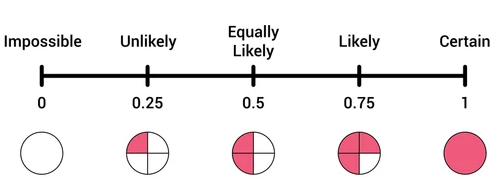
- \( 0 \) → impossible event
- \( 1 \) → certain event
- Between 0 and 1 → possible event
Probability Formula
If all outcomes are equally likely,
\( \mathrm{P}(\mathrm{event}) = \dfrac{\mathrm{number\ of\ favorable\ outcomes}}{\mathrm{total\ number\ of\ outcomes}} \)
Sample Space
The sample space is the list of all possible outcomes.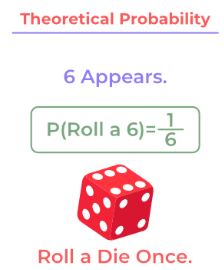
Example: Rolling a six-sided die
Sample space: \( \{1,2,3,4,5,6\} \)
Each outcome has probability
\( \dfrac{1}{6} \)
Complement Rule
Sometimes it is easier to find the probability an event does not happen.
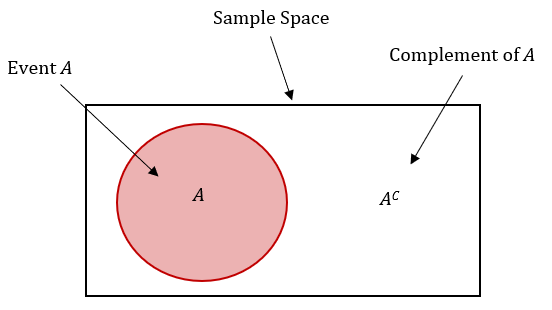
\( \mathrm{P}(\mathrm{not\ A}) = 1 – \mathrm{P}(\mathrm{A}) \)
This is heavily used on the SAT.
Example 1 (Basic Probability):
A bag contains 5 red marbles and 3 blue marbles. One marble is selected at random. What is the probability the marble is red?
▶️ Answer/Explanation
Total marbles:
\( 5 + 3 = 8 \)
Favorable outcomes (red):
\( 5 \)
\( \mathrm{P}(\mathrm{red}) = \dfrac{5}{8} \)
Conclusion: The probability is \( \dfrac{5}{8} \).
Example 2 (Complement Rule):
A multiple-choice question has 4 answer options and only one correct answer. A student guesses randomly. What is the probability the student answers incorrectly?
▶️ Answer/Explanation
Probability of correct answer:
\( \dfrac{1}{4} \)
Use complement:
\( \mathrm{P}(\mathrm{incorrect}) = 1 – \dfrac{1}{4} = \dfrac{3}{4} \)
Conclusion: The probability of an incorrect answer is \( \dfrac{3}{4} \).
Example 3 (Interpreting Probability):
A weather forecast states there is a 0.2 probability of rain tomorrow. What is the probability it will not rain?
▶️ Answer/Explanation
\( \mathrm{P}(\mathrm{no\ rain}) = 1 – 0.2 = 0.8 \)
Conclusion: The probability it will not rain is \( 0.8 \) (80%).
Independent vs Dependent Events
When two events occur together, the DIGITAL SAT often asks whether the events are independent or dependent. This determines how we calculate probability.
Independent Events
Two events are independent if one event does not affect the probability of the other event.

Example: flipping a coin twice. The first flip does not change the second flip.
For independent events:
\( \mathrm{P}(\mathrm{A\ and\ B}) = \mathrm{P}(\mathrm{A}) \times \mathrm{P}(\mathrm{B}) \)
Dependent Events
Two events are dependent if the first event changes the probability of the second event.
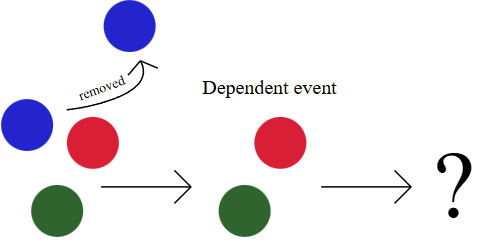
This usually happens when objects are chosen without replacement.
For dependent events:
\( \mathrm{P}(\mathrm{A\ and\ B}) = \mathrm{P}(\mathrm{A}) \times \mathrm{P}(\mathrm{B\ given\ A}) \)
Key Recognition Rule
- With replacement → Independent
- Without replacement → Dependent
DIGITAL SAT Tip
The SAT often hides this in wording like “another,” “again,” or “remaining.” Always check whether the first selection changes the total number of objects.
Example 1 (Independent — With Replacement):
A box contains 4 green pens and 6 black pens. A pen is chosen, recorded, and then returned to the box. A second pen is chosen. What is the probability both pens are green?
▶️ Answer/Explanation
Total pens:
\( 10 \)
Probability first green:
\( \dfrac{4}{10} \)
Because the pen is replaced, the probability remains the same:
\( \dfrac{4}{10} \)
Multiply:
\( \dfrac{4}{10} \times \dfrac{4}{10} = \dfrac{16}{100} = \dfrac{4}{25} \)
Conclusion: The probability is \( \dfrac{4}{25} \).
Example 2 (Dependent — Without Replacement):
A jar contains 5 red beads and 3 blue beads. Two beads are selected without replacement. What is the probability both are red?
▶️ Answer/Explanation
First red:
\( \dfrac{5}{8} \)
After removing one red bead:
Remaining red = 4, total = 7
Second red:
\( \dfrac{4}{7} \)
Multiply:
\( \dfrac{5}{8} \times \dfrac{4}{7} = \dfrac{20}{56} = \dfrac{5}{14} \)
Conclusion: The probability is \( \dfrac{5}{14} \).
Example 3 (Identifying Type):
A student randomly selects a card from a standard deck, records it, shuffles the deck, and selects again. Are the events independent or dependent?
▶️ Answer/Explanation
The card is returned and the deck is shuffled, so the probabilities reset.
Conclusion: The events are independent.
Probability Rules
The DIGITAL SAT frequently tests probability using a small set of core rules. Instead of listing outcomes, you can often solve questions quickly using these formulas.
1. Addition Rule (OR Probability)
Use this when the question asks for the probability that one event OR another event happens.
\( \mathrm{P}(\mathrm{A\ or\ B}) = \mathrm{P}(\mathrm{A}) + \mathrm{P}(\mathrm{B}) – \mathrm{P}(\mathrm{A\ and\ B}) \)
We subtract the overlap because it gets counted twice.
Mutually Exclusive Events
If two events cannot occur at the same time (like rolling a 2 and a 5 in one roll), then
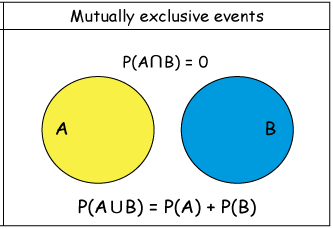
\( \mathrm{P}(\mathrm{A\ and\ B}) = 0 \)
So the rule simplifies to:
\( \mathrm{P}(\mathrm{A\ or\ B}) = \mathrm{P}(\mathrm{A}) + \mathrm{P}(\mathrm{B}) \)
2. Multiplication Rule (AND Probability)
Use this when the question asks for the probability that both events happen.
Independent events:
\( \mathrm{P}(\mathrm{A\ and\ B}) = \mathrm{P}(\mathrm{A}) \times \mathrm{P}(\mathrm{B}) \)
Dependent events:
\( \mathrm{P}(\mathrm{A\ and\ B}) = \mathrm{P}(\mathrm{A}) \times \mathrm{P}(\mathrm{B\ given\ A}) \)
3. Complement Rule
Used when the question asks for the probability something does not occur.
\( \mathrm{P}(\mathrm{not\ A}) = 1 – \mathrm{P}(\mathrm{A}) \)
DIGITAL SAT Strategy
If a probability question looks complicated, try calculating the opposite event and subtract from 1. The SAT very often designs problems where the complement is easier.
Example 1 (Addition Rule — OR):
A class has 12 boys and 8 girls. One student is selected at random. What is the probability the student is a girl or a boy taller than 6 feet, if 3 boys are taller than 6 feet?
▶️ Answer/Explanation
Total students:
\( 20 \)
Girls:
\( 8 \)
Tall boys:
\( 3 \)
These do not overlap, so add probabilities:
\( \dfrac{8}{20} + \dfrac{3}{20} = \dfrac{11}{20} \)
Conclusion: The probability is \( \dfrac{11}{20} \).
Example 2 (Multiplication Rule — AND):
A fair coin is flipped and a fair six-sided die is rolled. What is the probability of getting heads and a 4?
▶️ Answer/Explanation
Coin:
\( \dfrac{1}{2} \)
Die:
\( \dfrac{1}{6} \)
Multiply:
\( \dfrac{1}{2} \times \dfrac{1}{6} = \dfrac{1}{12} \)
Conclusion: The probability is \( \dfrac{1}{12} \).
Example 3 (Complement Strategy):
A basketball player makes a free throw with probability \( 0.8 \). If the player attempts one shot, what is the probability the player misses?
▶️ Answer/Explanation
\( \mathrm{P}(\mathrm{miss}) = 1 – 0.8 = 0.2 \)
Conclusion: The probability of missing is \( 0.2 \).