
Conditional Probability
Conditional probability is the probability that an event occurs given that another event has already happened.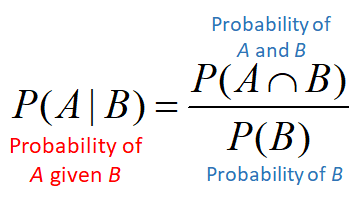
On the DIGITAL SAT, this is commonly tested using tables, surveys, or selecting objects.
Notation
\( \mathrm{P}(\mathrm{A|B}) \)
This reads as: “the probability of A given B”.
Formula
\( \mathrm{P}(\mathrm{A|B}) = \dfrac{\mathrm{P}(\mathrm{A\ and\ B})}{\mathrm{P}(\mathrm{B})} \)
Important idea: once event B has happened, the sample space changes. You are no longer considering all outcomes, only the outcomes where B is true.
Key SAT Interpretation
The word “given” means you restrict your attention to a smaller group.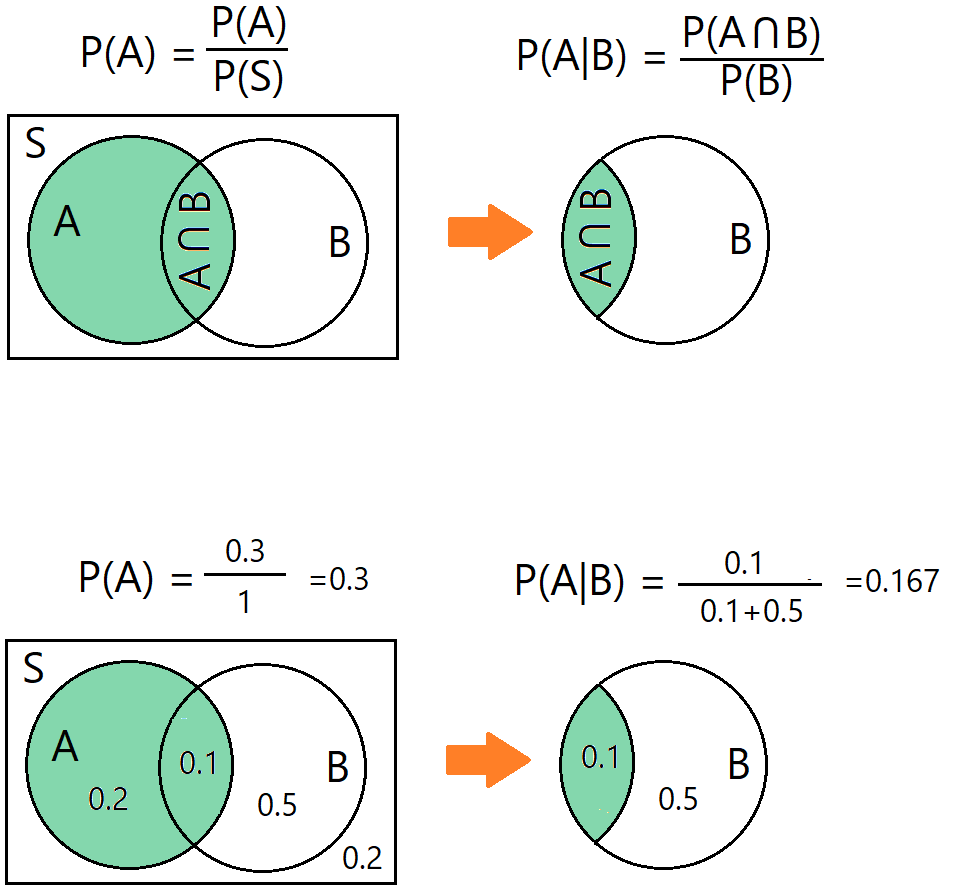
For example:
“probability a student is left-handed given that the student plays sports”
You only look at the students who play sports.
Connection to Independence
If
\( \mathrm{P}(\mathrm{A|B}) = \mathrm{P}(\mathrm{A}) \)
then the events are independent because B does not affect A.
Example 1 (From a Table):
In a survey, 40 students play sports and 25 do not. Among the students who play sports, 10 prefer math. What is the probability that a randomly selected student prefers math given that the student plays sports?
▶️ Answer/Explanation
We only consider students who play sports.
Total in restricted group:
\( 40 \)
Prefer math within that group:
\( 10 \)
\( \mathrm{P}(\mathrm{math|sports}) = \dfrac{10}{40} = \dfrac{1}{4} \)
Conclusion: The probability is \( \dfrac{1}{4} \).
Example 2 (Cards):
A card is drawn from a standard deck. What is the probability the card is a king given that the card drawn is a face card?
▶️ Answer/Explanation
Face cards: Jack, Queen, King
Each suit has 3 face cards:
Total face cards = \( 12 \)
Kings among face cards:
\( 4 \)
\( \mathrm{P}(\mathrm{king|face}) = \dfrac{4}{12} = \dfrac{1}{3} \)
Conclusion: The probability is \( \dfrac{1}{3} \).
Example 3 (Testing Independence):
The probability a student plays chess is \( 0.4 \). The probability a student plays chess given the student is in the math club is also \( 0.4 \). Are the events independent?
▶️ Answer/Explanation
\( \mathrm{P}(\mathrm{chess|math\ club}) = \mathrm{P}(\mathrm{chess}) \)
Since the probabilities are equal, membership in the math club does not change the probability of playing chess.
Conclusion: The events are independent.