
Area and Perimeter — 2D Shapes
For flat (two-dimensional) figures, the DIGITAL SAT mainly tests two measurements:
- Area → space inside the shape
- Perimeter → distance around the shape
Area is measured in square units (cm², m², ft²) while perimeter is measured in linear units (cm, m, ft).
Common Formulas
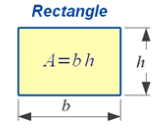
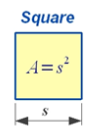
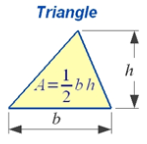
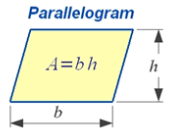
| Shape | Area | Perimeter / Circumference |
|---|---|---|
| \( A = lw \) | \( P = 2l + 2w \) |
| \( A = s^2 \) | \( P = 4s \) |
| \( A = \dfrac{1}{2}bh \) | Sum of side lengths |
| \( A = bh \) | \( 2(a+b) \) |
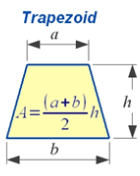
| \( A = \dfrac{1}{2}(b_1+b_2)h \) | Sum of all sides |
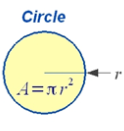
| \( A = \pi r^2 \) | \( C = 2\pi r \) or \( \pi d \) |
Important DIGITAL SAT Ideas
- Height must be perpendicular to the base
- Sometimes you must find a missing side first
- The SAT often gives diameter instead of radius
- Composite figures require adding or subtracting areas
Example 1 (Rectangle in Context):
A rectangular floor is 9 m by 6 m. Tiles cover 1 m² each. How many tiles are needed?
▶️ Answer/Explanation
Area \( = 9\times6 = 54\text{ m}^2 \)
Answer: 54 tiles
Example 2 (Circle):
A circular garden has diameter 10 m. Find its area. Use \( \pi \approx 3.14 \).
▶️ Answer/Explanation
Radius \( r=5 \)
\( A=3.14(5^2)=3.14(25)=78.5 \)
Area: \( 78.5\text{ m}^2 \)
Example 3 (Composite Figure):
A square of side 8 cm has a semicircle (radius 4 cm) attached to one side. Find the total area. Use \( \pi \approx 3.14 \).
▶️ Answer/Explanation
Square area:
\( 8^2=64 \)
Semicircle area:
\( \dfrac{1}{2}\pi r^2=\dfrac{1}{2}(3.14)(4^2)=25.12 \)
Total:
\( 64+25.12=89.12 \)
Total area: \( 89.12\text{ cm}^2 \)
3D Shapes
Three-dimensional figures have both surface area and volume.
- Surface Area → total area covering the outside of the solid
- Volume → space inside the solid
Surface area uses square units (cm², m²) and volume uses cubic units (cm³, m³).
Common Formulas
| 3D Shape | Surface Area | Volume |
|---|---|---|
Rectangular Prism | \( SA = 2(lw+lh+wh) \) | \( V = lwh \) |
Cube | \( SA = 6s^2 \) | \( V = s^3 \) |
Cylinder | \( SA = 2\pi r^2 + 2\pi rh \) | \( V = \pi r^2 h \) |
Cone | \( SA = \pi r^2 + \pi rl \) | \( V = \dfrac{1}{3}\pi r^2 h \) |
Sphere | \( SA = 4\pi r^2 \) | \( V = \dfrac{4}{3}\pi r^3 \) |


Important DIGITAL SAT Ideas
- The slant height \( l \) is used in cone surface area
- SAT may give diameter instead of radius
- Surface area questions often involve paint, wrapping paper, or material cost
- Volume questions often involve filling, storage, or capacity
Example 1 (Surface Area):
A cube has side length 4 cm. Find its surface area.
▶️ Answer/Explanation
\( SA = 6s^2 = 6(4^2)=6(16)=96 \)
Surface area: \( 96\text{ cm}^2 \)
Example 2 (Volume):
A cylinder has radius 3 m and height 5 m. Find its volume. Use \( \pi \approx 3.14 \).
▶️ Answer/Explanation
\( V=\pi r^2h=3.14(3^2)(5) \)
\( =3.14(9)(5)=141.3 \)
Volume: \( 141.3\text{ m}^3 \)
Example 3 (Real Context):
A spherical ball has radius 6 cm. Find its volume. Use \( \pi \approx 3.14 \).
▶️ Answer/Explanation
\( V=\dfrac{4}{3}\pi r^3=\dfrac{4}{3}(3.14)(6^3) \)
\( =\dfrac{4}{3}(3.14)(216)=904.32 \)
Volume: \( 904.32\text{ cm}^3 \)