
Angle Relationships
Angles on a Straight Line
When two angles form a straight line, their measures add to \( 180^\circ \).
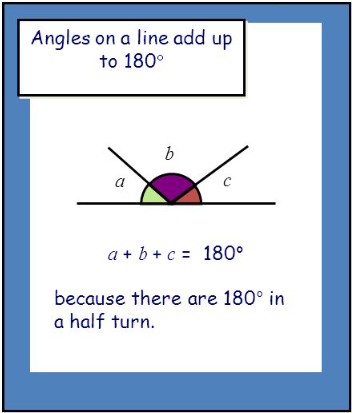
These angles are called supplementary angles.
If one angle is known, the other can be found by subtracting from \( 180^\circ \).
Angles Around a Point
All angles around a single point add up to \( 360^\circ \).
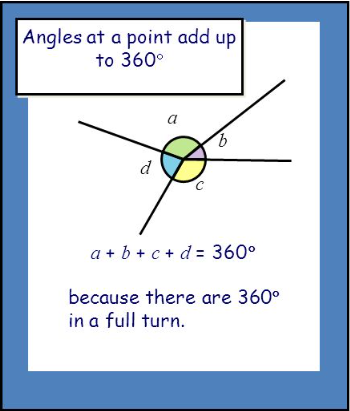
This is often used when several angles meet at one location.
Vertical Angles
When two lines intersect, they form opposite angles called vertical angles.
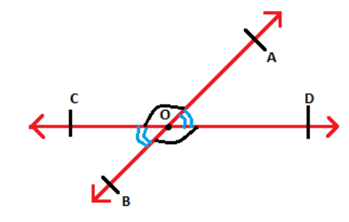
Vertical angles are always equal.
Linear Pair
A linear pair is a pair of adjacent angles forming a straight line.
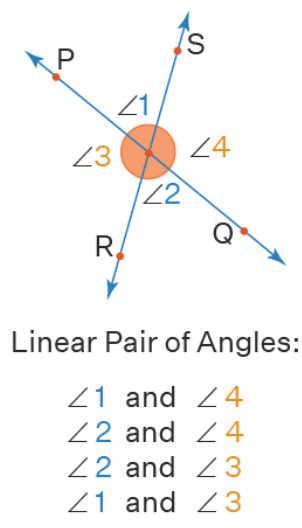
They add to \( 180^\circ \).
Complementary Angles
Two angles are complementary if their sum is \( 90^\circ \).
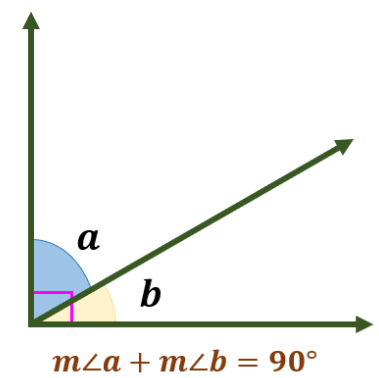
They often appear inside right triangles or corner diagrams.
Supplementary Angles
Two angles are supplementary if their sum is \( 180^\circ \).
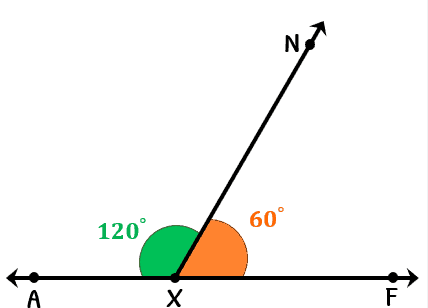
Supplementary relationships frequently appear in straight-line diagrams.
Example 1:
Two angles lie on a straight line. One angle measures \( 135^\circ \). Find the other angle.
▶️ Answer/Explanation
Straight line → sum \( 180^\circ \)
\( 180-135=45^\circ \)
Answer: \( 45^\circ \)
Example 2:
Two lines intersect. One angle is \( (2x+10)^\circ \) and the vertical angle is \( (5x-50)^\circ \). Find \( x \).
▶️ Answer/Explanation
Vertical angles are equal:
\( 2x+10=5x-50 \)
\( 60=3x \)
\( x=20 \)
Example 3:
Two angles are complementary. One angle measures \( (x+25)^\circ \) and the other \( (2x+5)^\circ \). Find the smaller angle.
▶️ Answer/Explanation
Complementary → sum \( 90^\circ \)
\( (x+25)+(2x+5)=90 \)
\( 3x+30=90 \)
\( 3x=60 \)
\( x=20 \)
Angles:
\( x+25=45^\circ \)
\( 2x+5=45^\circ \)
Smaller angle: \( 45^\circ \)
Parallel Lines & Transversals
What is a Transversal?
A transversal is a line that intersects two other lines. When the two lines are parallel, special angle relationships are formed.
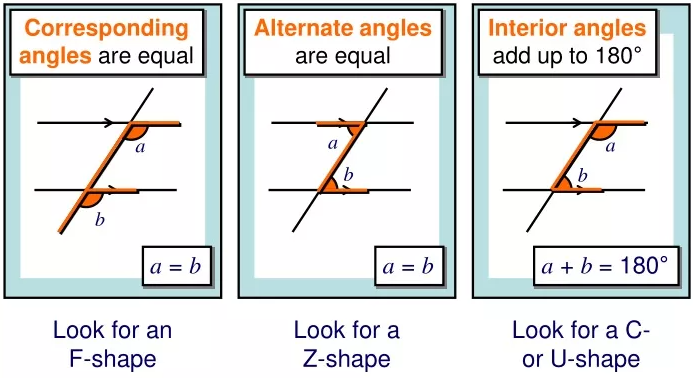
These angle relationships allow you to find unknown angles without measuring.
Corresponding Angles
Corresponding angles are in the same relative position at each intersection.
If the lines are parallel, corresponding angles are equal.
Alternate Interior Angles
Alternate interior angles lie between the two parallel lines but on opposite sides of the transversal.
If the lines are parallel, alternate interior angles are equal.
Alternate Exterior Angles
These angles lie outside the parallel lines on opposite sides of the transversal.
They are also equal when the lines are parallel.
Same-Side Interior Angles
These angles lie between the parallel lines on the same side of the transversal.
They are supplementary, meaning they add to \( 180^\circ \).
SAT Tip
Many SAT questions do not directly say the lines are parallel. Instead, they give equal angle measures and expect you to conclude the lines are parallel.
Example 1 (Corresponding Angles):
Two parallel lines are cut by a transversal. Corresponding angles are \( (2x+15)^\circ \) and \( (5x-30)^\circ \). Find \( x \).
▶️ Answer/Explanation
Corresponding angles are equal:
\( 2x+15 = 5x-30 \)
\( 45 = 3x \)
\( x=15 \)
Answer: \( 15 \)
Example 2 (Alternate Interior):
Alternate interior angles measure \( (4x-10)^\circ \) and \( (2x+30)^\circ \). Find the angle measure.
▶️ Answer/Explanation
Alternate interior angles are equal:
\( 4x-10 = 2x+30 \)
\( 2x=40 \)
\( x=20 \)
Angle:
\( 4(20)-10=70^\circ \)
Angle measure: \( 70^\circ \)
Example 3 (Same-Side Interior):
Same-side interior angles are \( (3x+20)^\circ \) and \( (2x+40)^\circ \). Find \( x \).
▶️ Answer/Explanation
They sum to \( 180^\circ \):
\( (3x+20)+(2x+40)=180 \)
\( 5x+60=180 \)
\( 5x=120 \)
\( x=24 \)
Answer: \( 24 \)