
Congruence & Similarity
Congruent Triangles
Two triangles are congruent if they are exactly the same size and shape.
All corresponding sides are equal and all corresponding angles are equal.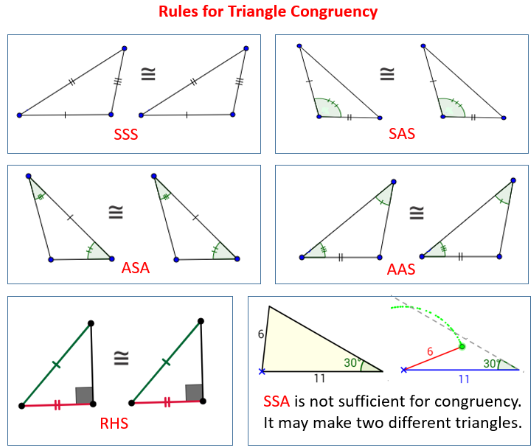
If triangles are congruent, they are essentially copies of each other.
Congruence Rules
SSS (Side–Side–Side)
If three sides of one triangle equal three sides of another, the triangles are congruent.
SAS (Side–Angle–Side)
If two sides and the included angle are equal, the triangles are congruent.
ASA (Angle–Side–Angle)
If two angles and the included side are equal, the triangles are congruent.
AAS (Angle–Angle–Side)
If two angles and a non-included side are equal, the triangles are congruent.
Important: SSA does not guarantee congruence.
Similar Triangles
Two triangles are similar if they have the same shape but different size. 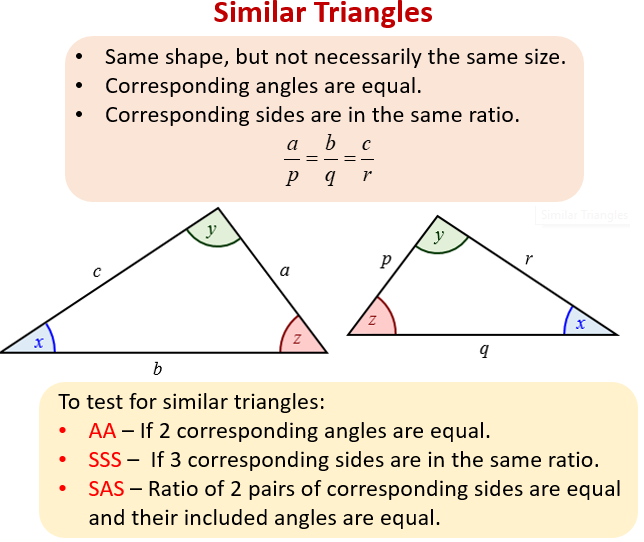
Corresponding angles are equal and corresponding sides are proportional.
Similarity Rules
AA (Angle–Angle)
If two angles match, triangles are similar.
SAS Similarity
Two side ratios equal and included angle equal.
SSS Similarity
All corresponding side ratios equal.
Scale Factor
The ratio between corresponding sides is called the scale factor.
If scale factor = 2, every side doubles.
Perimeter changes by the scale factor, but area changes by the square of the scale factor.
Example 1 (Congruence):
Triangle A has sides 5, 7, and 9. Triangle B also has sides 5, 7, and 9. Are they congruent?
▶️ Answer/Explanation
All three sides match → SSS rule.
Conclusion: The triangles are congruent.
Example 2 (Similarity Ratio):
Two similar triangles have corresponding sides 3 cm and 9 cm. Find the scale factor from the smaller to the larger triangle.
▶️ Answer/Explanation
\( \dfrac{9}{3}=3 \)
Scale factor: 3
Example 3 (Finding Missing Side):
Two similar triangles have side lengths in ratio 2:5. If the smaller triangle has a side 6 cm, find the corresponding side of the larger triangle.
▶️ Answer/Explanation
Scale factor \( = \dfrac{5}{2} \)
\( 6 \times \dfrac{5}{2}=15 \)
Answer: 15 cm
Pythagorean Theorem
Right Triangle
The Pythagorean Theorem applies only to a right triangle, which contains a \( 90^\circ \) angle.
The side opposite the right angle is called the hypotenuse. It is always the longest side of the triangle.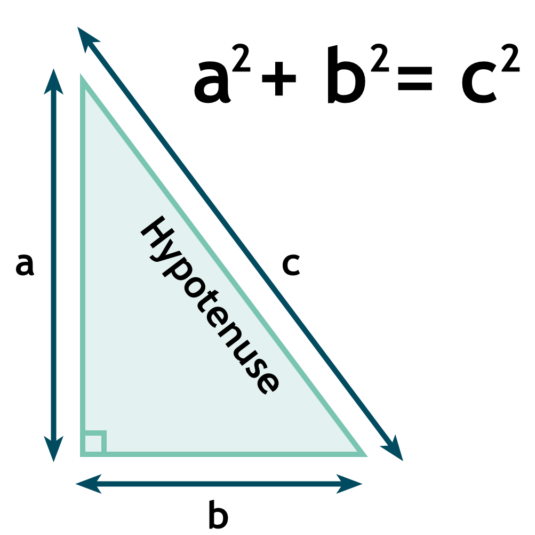
The Formula
If the legs of the triangle are \( a \) and \( b \), and the hypotenuse is \( c \), then
\( a^2 + b^2 = c^2 \)
You can use this formula to find any missing side.
Finding the Hypotenuse
When the two legs are known, add their squares and take the square root.
\( c=\sqrt{a^2+b^2} \)
Finding a Leg
If the hypotenuse and one leg are known, subtract the squares.
\( a=\sqrt{c^2-b^2} \)
Pythagorean Triples
Some right triangles have integer side lengths called Pythagorean triples.
- \( 3,4,5 \)
- \( 5,12,13 \)
- \( 8,15,17 \)
The SAT often uses multiples of these numbers.
Distance in the Coordinate Plane
The distance between two points uses the Pythagorean Theorem.
Between \( (x_1,y_1) \) and \( (x_2,y_2) \)
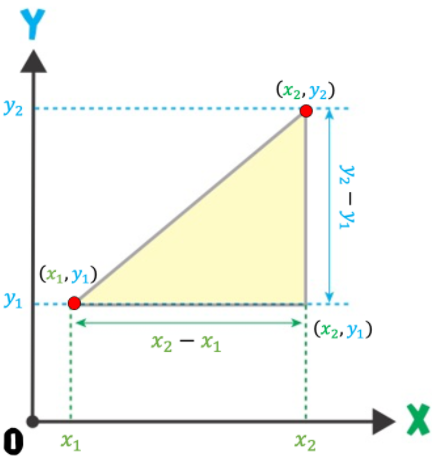
\( d=\sqrt{(x_2-x_1)^2+(y_2-y_1)^2} \)
Example 1 (Find Hypotenuse):
A right triangle has legs 6 cm and 8 cm. Find the hypotenuse.
▶️ Answer/Explanation
\( c=\sqrt{6^2+8^2}=\sqrt{36+64}=\sqrt{100}=10 \)
Answer: 10 cm
Example 2 (Find Missing Leg):
The hypotenuse is 13 cm and one leg is 5 cm. Find the other leg.
▶️ Answer/Explanation
\( a=\sqrt{13^2-5^2}=\sqrt{169-25}=\sqrt{144}=12 \)
Answer: 12 cm
Example 3 (Coordinate Distance):
Find the distance between \( (2,3) \) and \( (8,11) \).
▶️ Answer/Explanation
\( d=\sqrt{(8-2)^2+(11-3)^2} \)
\( =\sqrt{6^2+8^2}=\sqrt{36+64}=\sqrt{100}=10 \)
Answer: 10 units