
\( \sin \), \( \cos \), \( \tan \)
Trigonometry studies relationships between the angles and sides of a right triangle. On the DIGITAL SAT, trigonometry is mainly used to connect an angle with a ratio of side lengths.
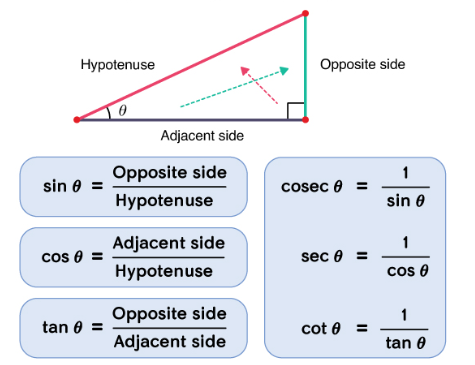
Right Triangle Terms
- Hypotenuse: longest side (opposite the right angle)
- Opposite: side across from the angle
- Adjacent: side next to the angle
The Three Trigonometric Ratios
For an angle \( \theta \):
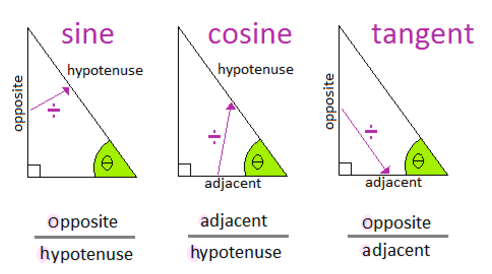
\( \sin \theta = \dfrac{\text{opposite}}{\text{hypotenuse}} \)
\( \cos \theta = \dfrac{\text{adjacent}}{\text{hypotenuse}} \)
\( \tan \theta = \dfrac{\text{opposite}}{\text{adjacent}} \)
Memory Tip (SOH-CAH-TOA)
- S → Opposite / Hypotenuse
- C → Adjacent / Hypotenuse
- T → Opposite / Adjacent
Important Relationship
\( \tan \theta = \dfrac{\sin \theta}{\cos \theta} \)
DIGITAL SAT Meaning
You usually are not asked heavy trig manipulation. Instead, the SAT uses trigonometry to:
- find missing side lengths
- interpret diagrams
- model real-world situations
Example 1 (Find a Side Using Sine):
In a right triangle, the hypotenuse is 10 and the angle is \( 30^\circ \). Find the opposite side.
▶️ Answer/Explanation
\( \sin \theta = \dfrac{\text{opposite}}{\text{hypotenuse}} \)
\( \sin 30^\circ = \dfrac{x}{10} \)
\( x = 10 \sin 30^\circ \)
\( x = 10(0.5) = 5 \)
Conclusion: Opposite side = 5.
Example 2 (Find Adjacent Using Cosine):
A right triangle has hypotenuse 13 and angle \( 60^\circ \). Find the adjacent side.
▶️ Answer/Explanation
\( \cos 60^\circ = \dfrac{x}{13} \)
\( x = 13 \cos 60^\circ \)
\( x = 13(0.5) = 6.5 \)
Conclusion: Adjacent side = 6.5.
Example 3 (Using Tangent):
In a right triangle, the adjacent side is 8 and the angle is \( 45^\circ \). Find the opposite side.
▶️ Answer/Explanation
\( \tan \theta = \dfrac{\text{opposite}}{\text{adjacent}} \)
\( \tan 45^\circ = \dfrac{x}{8} \)
\( x = 8 \tan 45^\circ \)
\( x = 8(1) = 8 \)
Conclusion: Opposite side = 8.
Applications
One of the most common uses of trigonometry on the DIGITAL SAT is solving real-life measurement problems. These are called angle of elevation and angle of depression questions.
Angle of Elevation
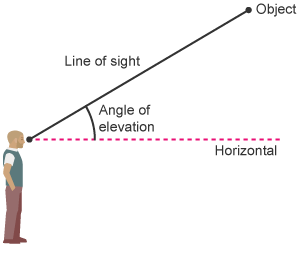
The angle measured upward from the horizontal line of sight.
Angle of Depression
The angle measured downward from the horizontal line of sight.
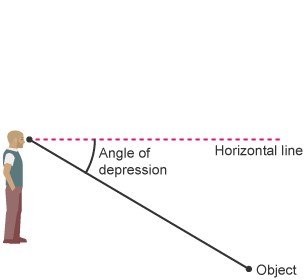
These situations always form a right triangle.
Which Ratio to Use
- Height and ground distance known → use \( \tan \theta \)
- Hypotenuse known → use \( \sin \theta \) or \( \cos \theta \)
Most SAT height problems use:
\( \tan \theta = \dfrac{\text{height}}{\text{horizontal distance}} \)
DIGITAL SAT Tip
Always label the triangle first. Students often use sine instead of tangent because they don’t identify opposite and adjacent correctly.
Example 1 (Height of a Building):
A person stands 20 m from a building. The angle of elevation to the top is \( 45^\circ \). Find the building’s height.
▶️ Answer/Explanation
\( \tan 45^\circ = \dfrac{h}{20} \)
\( 1 = \dfrac{h}{20} \)
\( h = 20 \)
Conclusion: The building is 20 m tall.
Example 2 (Finding Distance):
The angle of elevation to the top of a tower is \( 30^\circ \). The tower is 10 m tall. How far is the observer from the tower?
▶️ Answer/Explanation
\( \tan 30^\circ = \dfrac{10}{d} \)
\( \dfrac{1}{\sqrt{3}} = \dfrac{10}{d} \)
\( d = 10\sqrt{3} \)
Conclusion: Distance = \( 10\sqrt{3} \) m.
Example 3 (Angle of Depression):
A lighthouse 30 m high observes a boat at an angle of depression of \( 45^\circ \). How far is the boat from the base of the lighthouse?
▶️ Answer/Explanation
Angle of depression equals angle of elevation.
\( \tan 45^\circ = \dfrac{30}{d} \)
\( 1 = \dfrac{30}{d} \)
\( d = 30 \)
Conclusion: The boat is 30 m away.