
Effect of Temperature on Enzyme Function
📝 Introduction
- Enzymes are proteins that control and speed up chemical reactions inside living organisms.
- Every enzyme has a specially shaped region called the active site.
- The substrate fits into the active site, and the enzyme helps convert it into products.
- Temperature is one of the most important factors that affects how well an enzyme works.
- A small change in temperature can change the speed of the reaction, while a very high temperature can permanently damage the enzyme.
- Every enzyme has an optimum temperature, where it works at its fastest rate.
🧬 Active Site and Enzyme Function
- The active site is the part of an enzyme where the substrate binds.
- The shape of the active site is very specific.
- Only the correct substrate can fit into the active site.
- This is explained by the Lock and Key Model:
- Enzyme = Lock
- Substrate = Key
- If the active site changes shape, the substrate cannot fit properly.
- As a result, the enzyme cannot carry out the reaction.
🌡️ Why Does Temperature Affect Enzymes?
- Temperature changes affect enzyme activity because they change the movement of molecules.
When temperature changes:
- The kinetic energy of enzyme and substrate molecules changes.
- The speed at which molecules move changes.
- The number of collisions between enzymes and substrates changes.
- Very high temperatures can also change the shape of the enzyme’s active site.
❄️ Effect of Low Temperature (Below the Optimum Temperature)
- At low temperatures, enzymes still work, but much more slowly.
What happens?
- Molecules have low kinetic energy.
- Enzyme molecules move slowly.
- Substrate molecules also move slowly.
- Because they move slowly, they collide less often.
Effect on Enzyme Activity
- Fewer enzyme-substrate complexes are formed.
- Less product is produced in a given time.
- The reaction becomes slow.
Active Site
- The active site keeps its normal shape.
- The substrate can still fit into the active site.
- The enzyme is not damaged.
Important Points
- Low temperature does not denature the enzyme.
- The enzyme simply becomes less active.
- If the temperature is increased again, the enzyme starts working faster.
🌟 Effect at the Optimum Temperature
What is Optimum Temperature?
- The optimum temperature is the temperature at which an enzyme works most efficiently.
- At this temperature, the rate of reaction is at its highest.
In Human Enzymes
- Most human enzymes have an optimum temperature of about 37°C.
- This is the normal body temperature.
What happens at the Optimum Temperature?
- Enzyme molecules move quickly.
- Substrate molecules also move quickly.
- Collisions between enzymes and substrates happen very frequently.
- More enzyme-substrate complexes are formed.
- The active site keeps its correct shape.
- The substrate fits perfectly into the active site.
- The maximum amount of product is produced.
Result
- This is the fastest rate of enzyme activity.
🔥 Effect of High Temperature (Above the Optimum Temperature)
- As the temperature continues to rise above the optimum, enzyme activity begins to decrease.
What happens first?
- Molecules gain a lot of kinetic energy.
- They move and vibrate very rapidly.
What happens to the enzyme?
- The weak bonds that hold the enzyme’s shape begin to break.
- The enzyme loses its original three-dimensional shape.
What happens to the active site?
- The active site changes shape.
- It is no longer complementary to the substrate.
- The substrate cannot fit into the active site.
Result
- Enzyme-substrate complexes cannot form.
- The reaction slows down quickly.
- Eventually, the reaction stops completely.
🚫 Denaturation
- When an enzyme loses its normal shape because of high temperature, it is said to be denatured.
What is Denaturation?
- Denaturation is the permanent change in the shape of an enzyme’s active site.
- It usually happens when the enzyme is exposed to temperatures above its optimum.
What happens after denaturation?
- The substrate can no longer bind to the active site.
- No enzyme-substrate complex can form.
- No product is produced.
- The enzyme can no longer perform its function.
Important Points
- Denaturation is usually permanent.
- Cooling the enzyme afterwards does not restore its original shape.
- Once denatured, the enzyme cannot work again.
🔬 Effect of Temperature on the Active Site
At Low Temperature
- Active site keeps its normal shape.
- Substrate fits correctly.
- Reaction is slow because molecules move slowly.
At Optimum Temperature
- Active site has the perfect shape.
- Substrate fits easily.
- Maximum enzyme activity occurs.
At High Temperature
- Active site changes shape.
- Substrate cannot fit.
- Reaction stops because the enzyme is denatured.
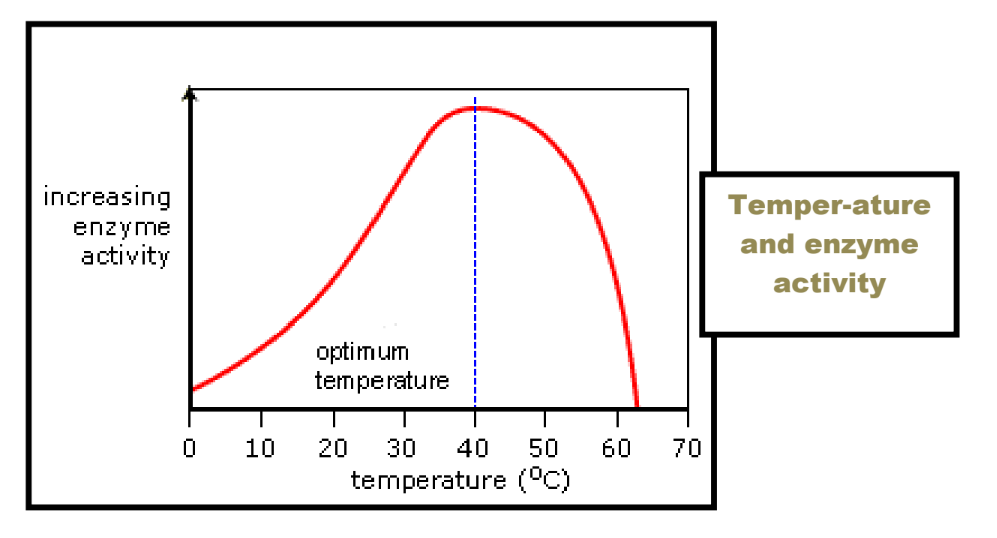
📈 Temperature and Enzyme Activity Graph
- The graph of enzyme activity against temperature has a characteristic pattern.
Low Temperature
- Enzyme activity starts at a low level.
- As temperature increases, activity increases gradually.
Near the Optimum Temperature
- Activity increases rapidly.
- The graph reaches its highest point.
- This is where the enzyme works best.
Above the Optimum Temperature
- Activity falls sharply.
- This happens because enzymes become denatured.
- The graph drops quickly to a very low level.
Remember
- The graph rises gradually.
- The graph falls suddenly.
- This gives the graph an asymmetrical shape.
🧪 Examples
Human Amylase
- Human amylase works best at about 37°C.
- This matches normal human body temperature.
- At temperatures much higher than this, amylase becomes denatured.
Enzymes in Thermophilic Bacteria
- Thermophilic bacteria live in hot environments such as hot springs.
- Their enzymes have a much higher optimum temperature, often around 70°C.
- These enzymes remain stable at temperatures that would denature human enzymes.
- They are useful in many industrial processes that require high temperatures.
💡 Important Points
- Temperature changes the kinetic energy of molecules.
- Low temperature slows down enzyme activity but does not damage the enzyme.
- At the optimum temperature, enzyme activity is at its maximum.
- High temperature changes the shape of the active site.
- A changed active site prevents the substrate from binding.
- Denatured enzymes stop working permanently.
- Different organisms have enzymes with different optimum temperatures depending on where they live.
📊 Summary Table – Effect of Temperature on Enzymes
| Temperature | What Happens? | Active Site | Effect on Reaction |
|---|---|---|---|
| Low Temperature | Molecules move slowly and collide less often. | Normal shape | Slow reaction |
| Optimum Temperature | Molecules move quickly and collide frequently. | Perfect shape | Fastest reaction |
| High Temperature | Weak bonds break and enzyme changes shape. | Denatured | Reaction stops |
⚡ Quick Recap
✔ Enzymes are proteins that act as biological catalysts.
✔ Every enzyme has a specific active site where the substrate binds.
✔ Low temperature slows the movement of molecules, so fewer collisions occur and the reaction is slow.
✔ The enzyme is not damaged at low temperatures and works normally again when warmed.
✔ Optimum temperature is the temperature at which the enzyme works at its fastest rate.
✔ Most human enzymes have an optimum temperature of 37°C.
✔ High temperature causes the enzyme to vibrate strongly, breaking the weak bonds that maintain its shape.
✔ This changes the shape of the active site, so the substrate can no longer fit.
✔ The enzyme becomes denatured, and the reaction stops permanently.
✔ The enzyme activity graph shows a gradual increase, reaches a peak at the optimum temperature, and then falls sharply due to denaturation.