
Effect of pH on Enzyme Function
📝 Introduction
- Enzymes only work properly under certain pH conditions.
- The pH scale measures how acidic or alkaline a solution is.
- Changes in pH can affect the structure of an enzyme.
- If the pH becomes too high or too low, the enzyme may stop working properly.
- This happens because pH can change the shape of the enzyme’s active site.
- Every enzyme is adapted to work best at a particular pH, called its optimum pH.
🧬 What is pH?
- pH tells us whether a solution is acidic, neutral, or alkaline.
- The pH scale ranges from 0 to 14.
- pH 7 is neutral.
- Below pH 7 is acidic.
- Above pH 7 is alkaline.
| pH Value | Nature |
|---|---|
| 0–6 | Acidic |
| 7 | Neutral |
| 8–14 | Alkaline |
🔑 Why Does pH Affect Enzymes?
- Enzymes are made of proteins that have a fixed three-dimensional shape.
- Their active site must keep the correct shape for the substrate to fit.
- Changes in pH can affect the bonds that help maintain this shape.
- When these bonds are disturbed, the active site changes shape.
- If the active site changes, the substrate cannot bind properly.
- As a result, the enzyme cannot carry out the reaction efficiently.
🌟 Optimum pH
What is Optimum pH?
- The optimum pH is the pH at which an enzyme works most efficiently.
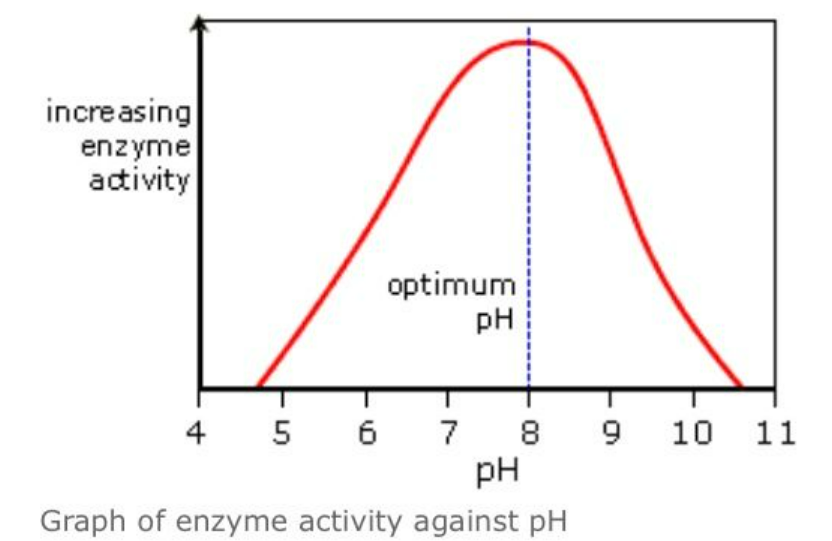
- At this pH, the enzyme has the correct shape and the active site fits the substrate perfectly.
- The rate of reaction is at its highest.
Important Points
- Different enzymes have different optimum pH values.
- An enzyme’s optimum pH depends on where it normally works inside the organism.
- Many enzymes inside the human body work best around pH 7, but not all enzymes have the same optimum pH.
⬇️ Effect of Low pH (Highly Acidic Conditions)
What happens?
- The solution contains a large number of hydrogen ions.
- These ions interfere with the bonds that maintain the enzyme’s shape.
- The active site begins to change.
Effect on Enzyme Activity
- The substrate cannot fit into the active site as easily.
- Fewer enzyme-substrate complexes are formed.
- The reaction becomes slower.
If the pH becomes extremely low
- The enzyme may become denatured.
- The active site changes permanently.
- The reaction stops completely.
⬆️ Effect of High pH (Highly Alkaline Conditions)
What happens?
- The alkaline conditions also disturb the bonds inside the enzyme.
- The enzyme gradually loses its normal shape.
Effect on Enzyme Activity
- The active site no longer matches the substrate.
- Enzyme activity decreases.
- Fewer products are formed.
If the pH becomes too high
- The enzyme becomes denatured.
- The active site changes permanently.
- The substrate can no longer bind.
🚫 Denaturation by pH
- Very acidic or very alkaline conditions can cause denaturation.
During denaturation:
- The enzyme loses its original shape.
- The active site changes.
- The substrate cannot fit into the active site.
- The enzyme stops working.
Important Points
- Mild changes in pH may only slow the reaction.
- Extreme changes in pH can permanently damage the enzyme.
- Once an enzyme is permanently denatured, it usually cannot return to its original shape.
🔬 Examples of Enzymes with Different Optimum pH
🍽️ Pepsin
- Pepsin is a digestive enzyme found in the stomach.
- The stomach contains hydrochloric acid.
- Pepsin works best in strongly acidic conditions.
- Its optimum pH is about 2.
- This allows it to digest proteins efficiently inside the stomach.
🍞 Amylase
- Amylase is found in saliva.
- It begins the digestion of starch in the mouth.
- The mouth has a nearly neutral pH.
- Amylase works best at about pH 7.
🥩 Trypsin
- Trypsin is a digestive enzyme found in the small intestine.
- The small intestine is slightly alkaline.
- Trypsin works best at about pH 8.
- This alkaline environment allows it to digest proteins effectively.
📈 pH and Enzyme Activity Graph
- The graph showing enzyme activity against pH forms a bell-shaped curve.
At Low pH
- Enzyme activity is low.
- The active site begins to lose its correct shape.
At the Optimum pH
- Enzyme activity reaches its highest point.
- The active site has the correct shape.
- The substrate fits perfectly.
At High pH
- Enzyme activity decreases again.
- The active site becomes altered.
- The reaction slows or stops.
Remember
- The graph rises towards the optimum pH.
- It falls on both sides of the optimum.
- This gives the graph a bell-shaped appearance.
💡 Important Points
- Every enzyme has its own optimum pH.
- Different enzymes do not all work best at the same pH.
- pH affects the shape of the active site.
- The correct pH helps the substrate bind easily.
- Very acidic or very alkaline conditions reduce enzyme activity.
- Extreme pH values can denature enzymes permanently.
- Enzymes are adapted to the pH of the place where they normally work.
📊 Summary Table – Effect of pH on Enzymes
| pH Condition | Effect on Active Site | Effect on Enzyme Activity |
|---|---|---|
| Low (Acidic) | Active site begins to change | Reaction slows and may stop if pH is too low |
| Optimum pH | Active site has the correct shape | Maximum rate of reaction |
| High (Alkaline) | Active site changes shape | Reaction slows and may stop if pH is too high |
📋 Optimum pH of Common Enzymes
| Enzyme | Optimum pH | Where it Works |
|---|---|---|
| Pepsin | About 2 | Stomach |
| Amylase | About 7 | Mouth (Saliva) |
| Trypsin | About 8 | Small Intestine |
⚡ Quick Recap
✔ pH measures how acidic or alkaline a solution is.
✔ Every enzyme has a specific optimum pH where it works best.
✔ At the optimum pH, the active site has the correct shape and the reaction is fastest.
✔ Low or high pH can change the shape of the active site.
✔ If the substrate cannot fit into the active site, the enzyme cannot work properly.
✔ Very acidic or very alkaline conditions can denature the enzyme permanently.
✔ Pepsin works best at pH 2, Amylase at pH 7, and Trypsin at pH 8.
✔ Enzyme activity against pH forms a bell-shaped curve, with the highest point at the optimum pH.