
Human Alimentary Canal – Structure & Function
📝 Introduction
- The alimentary canal is a long, continuous tube that runs from the mouth to the anus.
- It is also called the digestive tract.
- Its main job is to break down food into small, soluble molecules so that they can be absorbed and used by the body.
- Digestion takes place in different organs, and each organ has a specific role.
- Some organs carry out mechanical digestion (breaking food into smaller pieces), while others carry out chemical digestion using enzymes.
- After digestion, useful nutrients are absorbed into the blood, while undigested material leaves the body as faeces.
📍 Pathway of Food
Mouth → Oesophagus → Stomach → Duodenum → Ileum → Colon → Rectum → Anus
👄 1. Mouth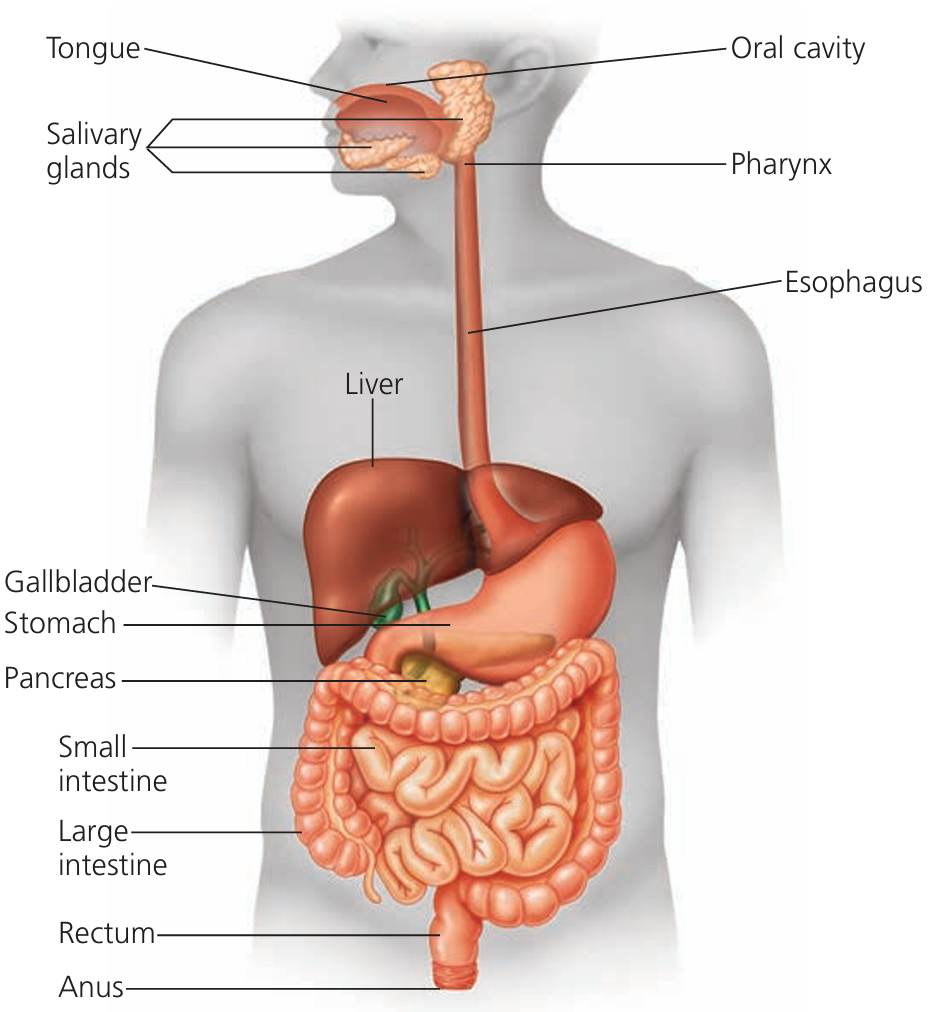
Structure
- First part of the alimentary canal.
- Contains teeth, tongue and salivary glands.
Functions
- Teeth break food into smaller pieces by chewing.
- This is called mechanical digestion.
- Smaller pieces have a larger surface area, making enzymes work faster.
- Salivary glands produce saliva.
- Saliva moistens food and makes it easier to swallow.
- Saliva contains the enzyme amylase.
- Amylase begins chemical digestion.
- It breaks starch into maltose.
- Tongue mixes food with saliva.
- It rolls the food into a soft ball called a bolus.
- The bolus is then pushed into the oesophagus during swallowing.
Important
- Digestion starts in the mouth.
- Both mechanical and chemical digestion occur here.
🛤️ 2. Oesophagus
Structure
- Long muscular tube connecting the mouth to the stomach.
- Does not produce digestive enzymes.
Functions
- Moves food from the mouth to the stomach.
- Uses peristalsis to push food downward.
Peristalsis
- Alternate contraction and relaxation of circular and longitudinal muscles.
- Pushes food along the digestive tract even if a person is upside down.
Important
- No digestion takes place here.
- Only transport of food occurs.
🍲 3. Stomach
Structure
- Thick muscular sac.
- Inner lining contains glands that release gastric juice.
Functions
Mechanical Digestion
- Strong muscles churn and mix food with gastric juice.
- Food becomes a semi-liquid mixture called chyme.
Chemical Digestion
- Gastric juice contains hydrochloric acid (HCl) and pepsin.
Hydrochloric Acid (HCl)
- Creates a strongly acidic environment.
- Kills many harmful bacteria present in food.
- Provides the correct pH for pepsin to work.
Pepsin
- A protease enzyme.
- Digests proteins into shorter peptide chains.
Important
- Starch digestion stops here because the acidic pH inactivates salivary amylase.
- Protein digestion begins in the stomach.
🧪 4. Small Intestine
- Longest part of the alimentary canal.
- Divided into two main parts:
- Duodenum
- Ileum
A. Duodenum
Structure
- First section of the small intestine.
- Receives digestive juices from the pancreas and bile from the liver.
Functions
- Completes most chemical digestion.
Pancreatic Enzymes
Amylase
- Breaks starch into maltose.
Protease
- Breaks proteins into amino acids.
Lipase
- Breaks lipids into fatty acids and glycerol.
Role of Bile
- Produced by the liver.
- Stored in the gall bladder.
- Released into the duodenum.
Bile does not contain enzymes.
Instead, it:
- Neutralises acidic chyme from the stomach.
- Creates an alkaline pH for intestinal enzymes.
- Emulsifies fats into tiny droplets.
- Smaller droplets provide a larger surface area for lipase.
Important
- Digestion of carbohydrates, proteins and fats is completed mainly in the duodenum.
B. Ileum
Structure
- Second and longest part of the small intestine.
- Inner surface contains millions of villi.
- Each villus has even smaller projections called microvilli.
Function
- Main site of nutrient absorption.
Adaptations for Absorption
Long length
- Gives more time for absorption.
Villi and microvilli
- Greatly increase surface area.
Thin epithelium
- Only one cell thick.
- Provides a short diffusion distance.
Rich blood supply
- Quickly carries absorbed nutrients away.
- Maintains a steep concentration gradient.
Lacteals inside villi
- Absorb fatty acids and glycerol into the lymphatic system.
Nutrients Absorbed
- Glucose
- Amino acids
- Fatty acids
- Glycerol
- Vitamins
- Mineral ions
- Water (some)
Important
- Most digestion is completed in the duodenum.
- Most absorption takes place in the ileum.
🚰 5. Large Intestine
The large intestine consists mainly of the:
- Colon
- Rectum
A. Colon
Structure
- Wider and shorter than the small intestine.
Functions
- Absorbs most of the remaining water.
- Absorbs some mineral ions.
- Helps convert undigested food into solid faeces.
Important
- Prevents excessive water loss from the body.
B. Rectum
Structure
- Final section of the large intestine.
Functions
- Stores faeces before removal.
- Stretch receptors signal when the rectum is full.
- Faeces leave the body through the anus during egestion.
Important
- Egestion is the removal of undigested food.
- It is not the same as excretion.
🧫 6. Pancreas
Structure
- Large gland located below the stomach.
- Connected to the duodenum by the pancreatic duct.
- Not part of the alimentary canal, but an important accessory digestive organ.
Functions
- Produces pancreatic juice containing digestive enzymes.
Pancreatic Amylase
- Digests starch into maltose.
Pancreatic Protease
- Digests proteins into amino acids.
Pancreatic Lipase
- Digests fats into fatty acids and glycerol.
Additional Function
- Produces alkaline secretions that help neutralise acidic chyme entering the duodenum.
🔄 Summary of Digestion Along the Alimentary Canal
| Organ | Main Function |
|---|---|
| Mouth | Chewing food and starting starch digestion with amylase |
| Oesophagus | Moves food to the stomach by peristalsis |
| Stomach | Churns food, begins protein digestion, kills bacteria |
| Duodenum | Receives bile and pancreatic enzymes, completes digestion |
| Ileum | Absorbs digested nutrients into blood and lymph |
| Colon | Absorbs water and mineral ions, forms faeces |
| Rectum | Stores faeces before egestion |
| Pancreas | Produces digestive enzymes released into the duodenum |
📌 Important Points
- The alimentary canal is a continuous tube from mouth to anus.
- Mechanical digestion occurs mainly in the mouth and stomach.
- Chemical digestion is carried out by enzymes.
- Peristalsis moves food through the digestive system.
- The stomach starts protein digestion using pepsin.
- The duodenum receives bile and pancreatic enzymes.
- Bile is not an enzyme. It neutralises acid and emulsifies fats.
- The ileum is the main site of nutrient absorption because of its villi and microvilli.
- The colon absorbs water.
- The rectum stores faeces before egestion.
- The pancreas produces digestive enzymes but food never passes through it.
⚡ Quick Recap
Mouth → Chewing + amylase starts starch digestion.
Oesophagus → Peristalsis moves food.
Stomach → Churning + pepsin digests proteins.
Duodenum → Bile + pancreatic enzymes complete digestion.
Ileum → Villi absorb nutrients.
Colon → Absorbs water and forms faeces.
Rectum → Stores faeces before egestion.
Pancreas → Produces amylase, protease and lipase.