
Small Intestine – Adaptations for Absorption
📝 Introduction
- After digestion, food is broken into small soluble molecules like glucose, amino acids, fatty acids, and glycerol.
- These nutrients are absorbed mainly in the small intestine, especially the ileum.
- The small intestine is specially adapted to absorb nutrients quickly and efficiently.
- Its structure increases surface area and reduces the distance for diffusion.
- It is one of the most important regions for getting nutrients into the blood and lymph.
⚙️ Adaptations of the Small Intestine
Very Long Structure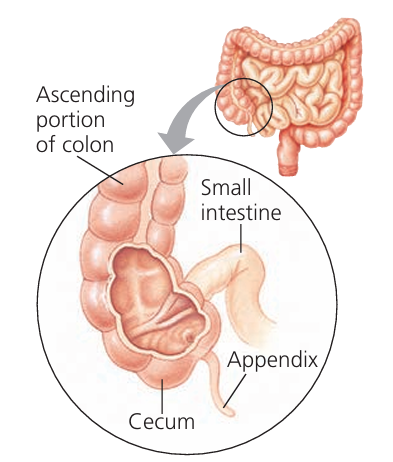
- The small intestine is around 6 metres long.
- This long length provides a very large internal surface area.
- More surface area means more space for absorption to take place.
- It also allows food to stay longer, giving more time for absorption.
Villi – Finger-like Projections
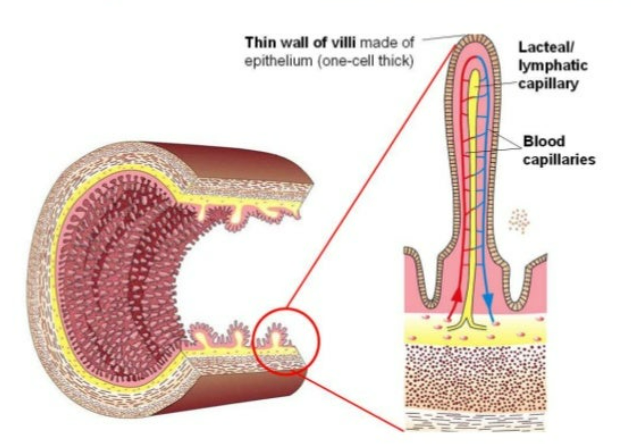
- The inner lining of the small intestine has many villi (singular: villus).
- Villi are tiny finger-shaped structures projecting into the intestinal space.
- They massively increase the surface area for absorption.
- Each villus is adapted to absorb nutrients quickly into the body.
Microvilli – Even More Surface Area
- The surface of epithelial cells in villi has tiny folds called microvilli.
- These form a “brush border” appearance.
- Microvilli further increase the surface area for absorption.
- This ensures maximum uptake of nutrients from digested food.
Thin Wall Structure
- The wall of each villus is only one cell thick.
- This reduces the distance nutrients must travel during absorption.
- Short diffusion distance means faster movement of substances.
- It improves the rate at which nutrients enter the blood.
Rich Blood Supply
- Each villus contains a dense network of blood capillaries.
- These capillaries quickly carry away absorbed nutrients.
- This maintains a steep concentration gradient.
- The gradient ensures continuous diffusion of glucose and amino acids into the blood.
Presence of Lacteal
- Each villus contains a central lymph vessel called a lacteal.
- Lacteals absorb fatty acids and glycerol.
- These fats are transported through the lymph system before entering the bloodstream.
- This prevents fats from blocking blood capillaries and ensures smooth transport.
Movement of Villi
- Villi show slight rhythmic movement inside the intestine.
- This movement mixes the digested food with intestinal juices.
- It brings fresh nutrients into contact with the villi surface.
- This improves the efficiency of absorption.
📌 Key Parts and Their Functions
| Part | Adaptation | Function |
|---|---|---|
| Epithelial cells | One cell thick | Short diffusion distance for nutrients |
| Microvilli | Tiny projections on cell surface | Greatly increase surface area |
| Blood capillaries | Dense network inside villus | Absorb glucose and amino acids |
| Lacteal | Central lymph vessel | Absorb fatty acids and glycerol |
| Thin moist lining | Permeable surface | Helps fast diffusion of nutrients |
📊 How Absorption Happens
Glucose and Amino Acids
- Glucose and amino acids pass through villus walls into blood capillaries.
- They are then carried to the liver and body cells via the bloodstream.
- These nutrients are mainly used for energy, growth, and repair.
Fatty Acids and Glycerol
- Fatty acids and glycerol enter the lacteal instead of blood capillaries.
- They are transported through the lymph system first.
- Later, they enter the bloodstream for use or storage.
⚡ Why the Small Intestine is Highly Efficient
- Huge surface area due to length, villi, and microvilli.
- Very thin walls reduce diffusion distance.
- Rich blood supply maintains concentration gradient.
- Lacteals help in fat transport.
- Continuous movement ensures better contact with nutrients.
📦 Quick Recap
Small intestine is adapted for fast and efficient absorption.
Villi + microvilli = maximum surface area.
One-cell-thick walls = short diffusion path.
Capillaries = absorb glucose & amino acids.
Lacteal = absorbs fats (fatty acids + glycerol).
Continuous movement helps mixing and absorption.
Small intestine is adapted for fast and efficient absorption.
Villi + microvilli = maximum surface area.
One-cell-thick walls = short diffusion path.
Capillaries = absorb glucose & amino acids.
Lacteal = absorbs fats (fatty acids + glycerol).
Continuous movement helps mixing and absorption.