
2.5B Cell Differentiation – Specialised Cells
📝 Introduction
- Cell differentiation is the process by which unspecialised cells become specialised to perform a particular function.
- During differentiation, cells develop different structures and characteristics that make them suitable for specific jobs.
- Although most cells contain the same DNA, different genes are switched on in different cells.
- This causes cells to become specialised and perform different roles within the organism.
- Cell differentiation is essential for the growth, development and survival of multicellular organisms.
- Without differentiation, all cells would remain identical and organisms would not be able to form tissues, organs or organ systems.
🔹 Why is Cell Differentiation Important?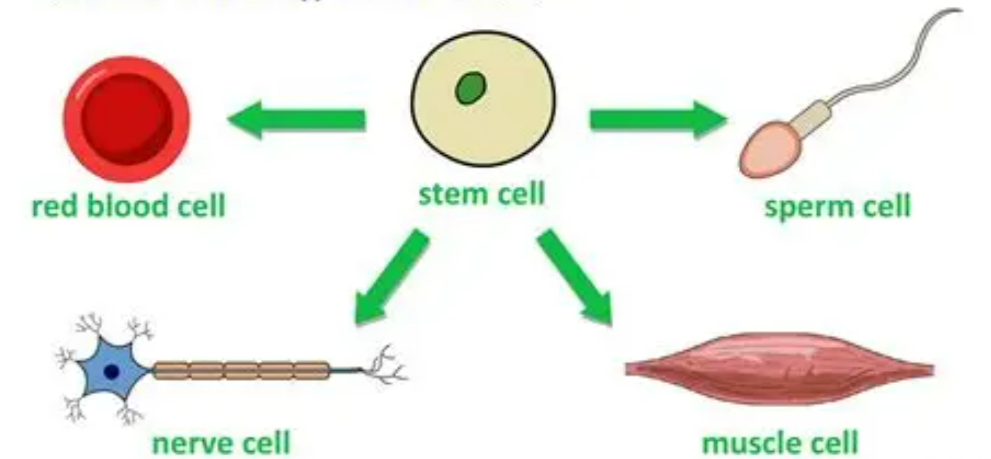
🎯 Allows Cells to Perform Specific Functions
- Different jobs require different cell structures.
- Differentiation enables cells to develop adaptations suited to their function.
- As a result, specialised cells can carry out their roles much more efficiently.
Examples:
- Red blood cells lose their nucleus and develop a biconcave shape, allowing them to transport oxygen efficiently.
- Root hair cells develop long extensions that increase surface area for water and mineral absorption.
- Sperm cells develop tails that allow them to swim towards the egg cell.
⚙️ Creates Division of Labour
- In multicellular organisms, different cells perform different tasks.
- This is known as division of labour.
- Instead of every cell carrying out all functions, each cell specialises in one particular job.
- This increases efficiency and allows complex organisms to function effectively.
- For example, nerve cells transmit impulses, muscle cells contract and red blood cells transport oxygen.
🏗️ Enables the Formation of Tissues, Organs and Organ Systems
- Groups of specialised cells combine to form tissues.
- Different tissues work together to form organs.
- Organs then work together to form organ systems.
Example:
Muscle Cell → Muscle Tissue → Heart → Circulatory System
Without cell differentiation, these levels of organisation could not develop.
👶 Essential for Growth and Development
- Every multicellular organism begins life as a single fertilised egg cell.
- This cell divides repeatedly to produce many new cells.
- These cells then differentiate into specialised cell types.
- Differentiation allows the formation of all body tissues and organs during development.
- Without differentiation, an embryo would remain a mass of identical cells and could not develop properly.
🔹 Examples of Specialised Cells
| Specialised Cell | Adaptations | Function |
|---|---|---|
| Red Blood Cell | Biconcave shape, no nucleus, contains haemoglobin | Transport oxygen around the body |
| Sperm Cell | Tail for swimming, many mitochondria, enzyme-containing head | Fertilisation |
| Nerve Cell | Long axon, branched endings, insulating sheath | Transmit electrical impulses |
| Root Hair Cell | Long projection, thin cell wall, many mitochondria | Absorb water and mineral ions |
| Muscle Cell | Contractile protein fibres, many mitochondria | Contraction and movement |
🌟 Key Idea
- Cell differentiation allows cells to become specialised.
- Specialised cells perform specific jobs more efficiently.
- Differentiation makes tissues, organs and organ systems possible.
- It is one of the main reasons multicellular organisms can be complex and highly organised.
⚡ Quick Recap
- Cell differentiation = unspecialised cell → specialised cell.
- Different genes are switched on in different cells.
- Allows cells to perform specific functions efficiently.
- Creates division of labour in multicellular organisms.
- Enables formation of tissues, organs and organ systems.
- Essential for growth, development and repair.
- Examples: red blood cells, sperm cells, nerve cells, root hair cells and muscle cells.