
Practical: Investigate Food Samples for Glucose, Starch, Protein and Fat
📝 Introduction
- Different foods contain different nutrients.
- Scientists use food tests to find out which nutrient is present in a food sample.
- Each nutrient has its own chemical test.
- A positive result shows that the nutrient is present.
- A negative result shows that the nutrient is absent.
- These tests are qualitative tests, which means they tell us whether a nutrient is present or not, but not the exact amount.
🎯 Aim
To test food samples for the presence of:
- Glucose (reducing sugar)
- Starch
- Protein
- Fat (lipid)
🧪 Food Samples
Some common food samples used in this practical are:
- Glucose solution
- Bread
- Potato
- Milk
- Egg white
- Cheese
- Vegetable oil
🧰 Apparatus and Chemicals
Apparatus
- Test tubes
- Test tube rack
- Test tube holder
- Pipettes or droppers
- Measuring cylinder
- Beaker
- Water bath
- Spotting tile or white tile
- Safety goggles
Chemicals
- Benedict’s solution
- Iodine solution
- Biuret reagent
- Sudan III stain (or Ethanol for the emulsion test)
- Distilled water
⚖️ Controls
- Using controls helps us know whether the test has worked correctly.
Positive Control
- A sample that is already known to contain the nutrient.
Examples:
| Nutrient | Positive Control |
|---|---|
| Glucose | Glucose solution |
| Starch | Starch solution |
| Protein | Egg white |
| Fat | Vegetable oil |
Negative Control
- Distilled water
- It should give a negative result in every food test.
🍬 Test for Glucose (Reducing Sugar)
Reagent Used
- Benedict’s Solution
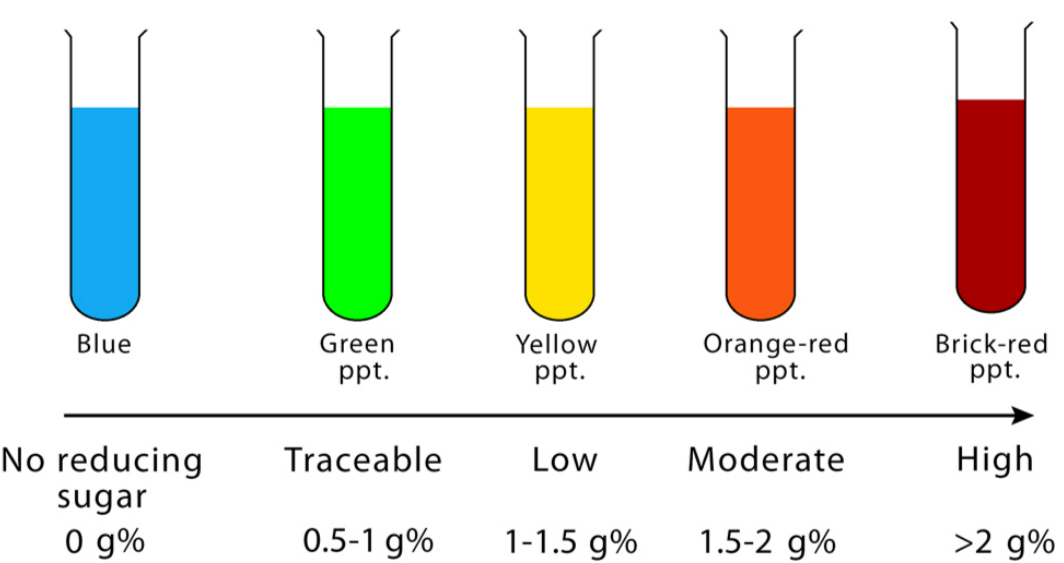
Procedure
- Place about 2 cm³ of the food sample into a test tube.
- Add 2 cm³ of Benedict’s solution.
- Mix the contents gently.
- Place the test tube in a hot water bath for about 2–5 minutes.
- Observe the final colour.
Positive Result
If glucose is present, the solution changes from:
Blue → Green → Yellow → Orange → Brick Red
The colour depends on the amount of glucose present.
- Green = Small amount
- Yellow = Moderate amount
- Orange = High amount
- Brick red = Very high amount
Negative Result
- Solution remains blue.
Important Points
- Benedict’s test only works after heating.
- A water bath is safer than heating directly over a flame.
- Always use clean test tubes to avoid contamination.
🌾 Test for Starch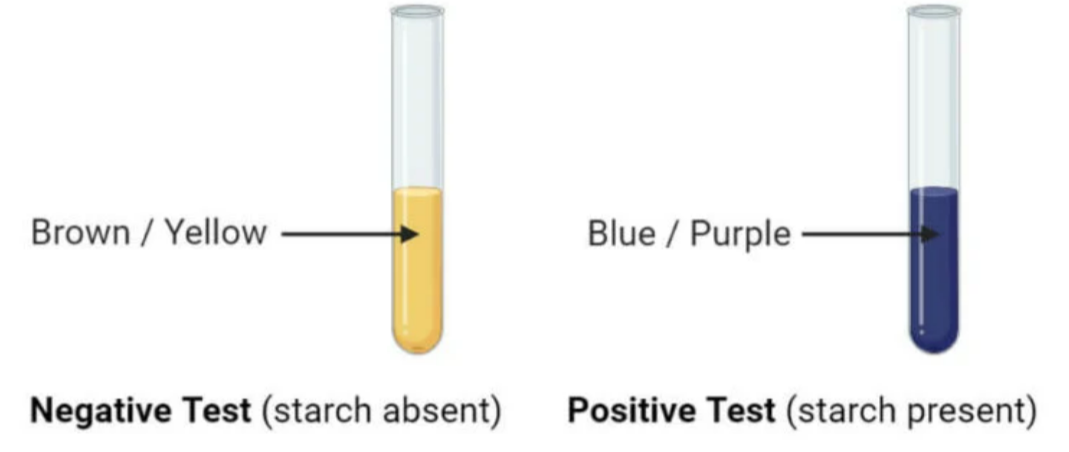
Reagent Used
- Iodine Solution
Procedure
- Place a small amount of food sample on a spotting tile or in a test tube.
- Add 2–3 drops of iodine solution.
- Mix gently if necessary.
- Observe the colour.
Positive Result
Colour changes:
Yellow-brown → Blue-black
This shows starch is present.
Negative Result
Colour stays:
Yellow-brown
Important Points
- Heating is not required.
- Iodine reacts only with starch.
- Even a small amount of starch gives a clear colour change.
🥚 Test for Protein
Reagent Used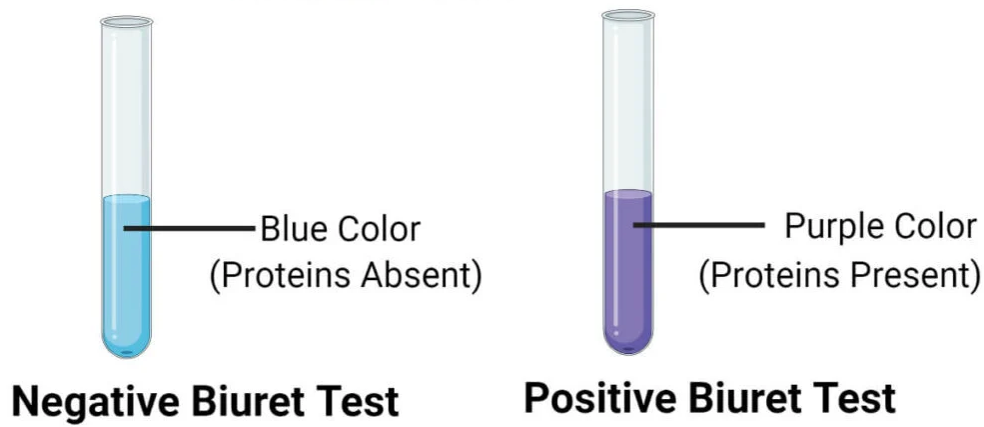
- Biuret Reagent
Procedure
- Place 2 cm³ of food sample into a test tube.
- Add 2 cm³ of Biuret reagent.
- Shake gently.
- Observe the colour.
Positive Result
Colour changes:
Blue → Lilac or Purple
This shows protein is present.
Negative Result
Solution remains:
Blue
Important Points
- Heating is not needed.
- The purple colour appears because the reagent reacts with peptide bonds in proteins.
🥜 Test for Fat (Lipids)
There are two commonly used methods.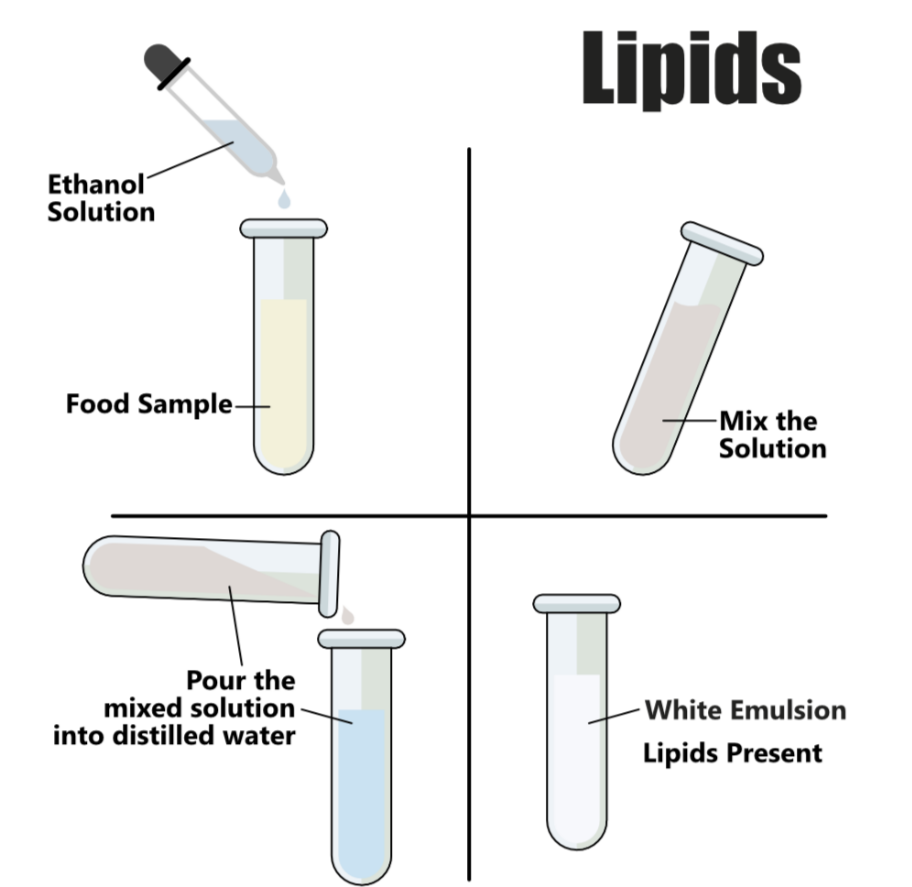
Method 1 – Sudan III Test
Reagent Used
- Sudan III Solution
Procedure
- Place 2 cm³ of food sample into a test tube.
- Add a few drops of Sudan III solution.
- Shake gently.
- Allow the mixture to stand.
Positive Result
- A red-stained oil layer forms on the surface.
Negative Result
- No red oil layer appears.
Method 2 – Ethanol Emulsion Test
Reagents Used
- Ethanol
- Water
Procedure
- Add the food sample to a test tube.
- Add ethanol and shake well.
- Pour the mixture into water.
- Observe the solution.
Positive Result
- A white cloudy emulsion appears.
Negative Result
- Solution remains clear.
📊 Expected Results
| Food Sample | Benedict’s Test | Iodine Test | Biuret Test | Sudan III / Ethanol Test |
|---|---|---|---|---|
| Glucose Solution | Brick red | No change | No change | Negative |
| Bread | Slight colour change | Blue-black | Weak positive | Negative |
| Potato | Green/Orange | Blue-black | Negative | Negative |
| Milk | Green/Orange | Negative | Purple | Small fat layer / White emulsion |
| Egg White | Blue | Negative | Purple | Negative |
| Vegetable Oil | Blue | Negative | Blue | Positive |
| Distilled Water | Blue | Yellow-brown | Blue | Negative |
⚠️ Safety Precautions
- Wear safety goggles throughout the practical.
- Tie back long hair.
- Handle hot test tubes carefully using a holder.
- Never point heated test tubes towards yourself or others.
- Benedict’s and Biuret solutions should not touch the skin or eyes.
- Iodine can stain clothes and skin.
- Ethanol is highly flammable, so keep it away from naked flames.
- Wash hands after completing the experiment.
❗ Common Errors and How to Avoid Them
| Possible Error | How to Avoid It |
|---|---|
| Benedict’s solution not heated | Heat for at least 2–5 minutes in a water bath |
| Dirty test tubes | Wash equipment before each test |
| Using the wrong reagent | Label all reagents clearly |
| Cross-contamination | Use a clean pipette for every solution |
| Very dilute food sample | Use enough sample for testing |
💡 Important Points
- Benedict’s test must be heated.
- Iodine test does not require heating.
- Biuret test does not require heating.
- Sudan III and Ethanol tests are both used to detect fats.
- A colour change indicates that the nutrient is present.
- No colour change means the nutrient is absent.
- These tests only show the presence or absence of nutrients, not the exact quantity.
📋 Summary Table
| Nutrient Tested | Reagent Used | Heating Required? | Positive Result | Negative Result |
|---|---|---|---|---|
| Glucose (Reducing Sugar) | Benedict’s Solution | Yes | Green → Yellow → Orange → Brick Red | Blue |
| Starch | Iodine Solution | No | Blue-black | Yellow-brown |
| Protein | Biuret Reagent | No | Lilac / Purple | Blue |
| Fat (Lipid) | Sudan III | No | Red oil layer | No red layer |
| Fat (Lipid) | Ethanol + Water | No | White cloudy emulsion | Clear solution |
⚡ Quick Recap
✔ Glucose → Benedict’s solution + heat → Brick red (positive).
✔ Starch → Iodine solution → Blue-black (positive).
✔ Protein → Biuret reagent → Lilac/Purple (positive).
✔ Fat → Sudan III → Red oil layer (positive).
✔ Fat → Ethanol test → White cloudy emulsion (positive).
✔ Benedict’s test is the only test that requires heating.
✔ Always use clean apparatus, correct reagents, and follow safety precautions for accurate results.