
Diffusion in Simple Unicellular Organisms
📝 Introduction
All organisms need to exchange substances (like oxygen, carbon dioxide, nutrients, and wastes) with their surroundings.
The method depends on their size and structure.
🌱 Why Unicellular Organisms Can Rely on Diffusion
Small Size → Large Surface Area to Volume Ratio (SA:V)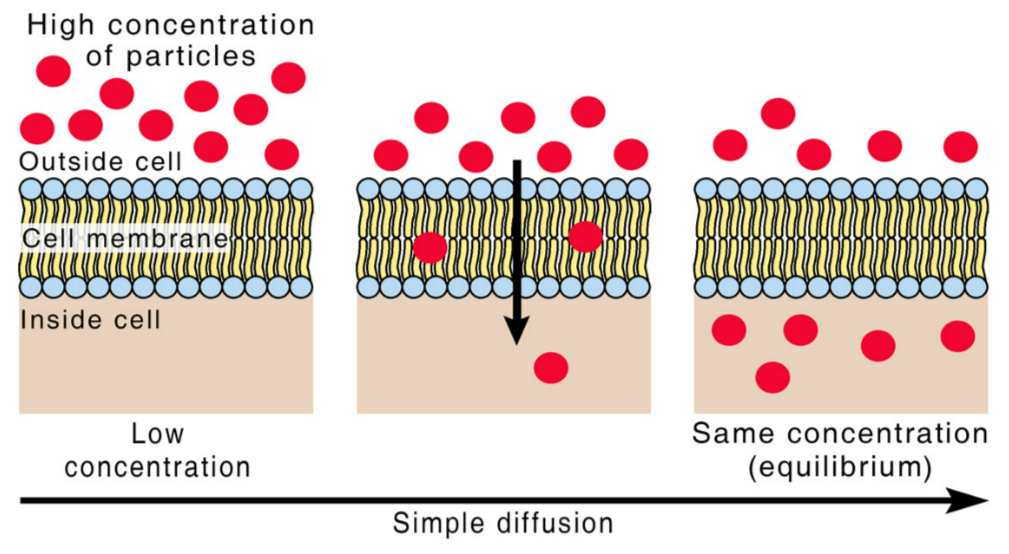
- Unicellular organisms (e.g., Amoeba, bacteria) are very small.
- They have a large surface area compared to volume.
- Diffusion across the cell membrane is fast enough to meet their needs.
Short Diffusion Distance
- The whole cell is only a few micrometres across.
- Substances travel only a tiny distance → diffusion is quick.
Low Metabolic Demand
- Simple unicellular organisms don’t need as much oxygen/nutrients as bigger multicellular ones.
- Diffusion alone is sufficient to supply them.
Direct Exchange with Environment
- They usually live in watery environments.
- Gases (O₂, CO₂) and nutrients diffuse directly through the cell membrane.
- No need for blood or complex transport systems.
📊 Summary Table
| Feature | Effect | Why Diffusion Works |
|---|---|---|
| Large SA:V ratio | More surface area for exchange | Faster diffusion |
| Very small size | Short distances | Substances reach inside quickly |
| Simple needs | Lower energy/oxygen demand | Diffusion can keep up |
| Thin membrane | Easy movement of substances | Efficient gas & nutrient exchange |
⚡ Quick Recap
Unicellular = large SA:V ratio + short distance → diffusion is enough.
Multicellular = small SA:V ratio + high demand → need transport systems.