
Role of Platelets in Blood Clotting
📝 Introduction
- Platelets are tiny cell fragments present in the blood.
- Their main function is to stop bleeding when a blood vessel is damaged.
- They also help prevent harmful micro-organisms from entering the body through wounds.
- The process by which blood changes from a liquid to a solid clot is called blood clotting (coagulation).
- Blood clotting is an important defence mechanism that protects the body after an injury.
🟡 What are Platelets?
Definition
- Platelets (also called thrombocytes) are small fragments of cells circulating in the blood.
- Unlike red and white blood cells, platelets are not complete cells because they do not have a nucleus.
- They are always present in the bloodstream, ready to act whenever a blood vessel is damaged.
🩸 How Platelets are Involved in Blood Clotting
When a blood vessel is cut or damaged, platelets respond immediately to stop blood loss.
Step 1: Platelets Detect the Injury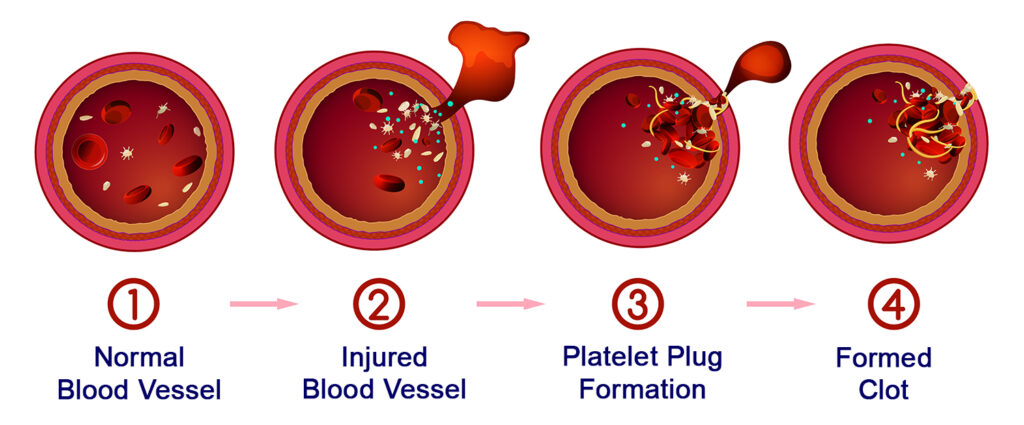
- Damage to a blood vessel exposes the underlying tissue.
- Platelets quickly move to the damaged area.
- They stick to the broken surface of the blood vessel.
Result: The damaged area is covered by the first layer of platelets.
Step 2: Platelets Form a Temporary Platelet Plug
- The attached platelets release chemicals that attract more platelets.
- More platelets gather at the injury and stick together.
- This forms a temporary platelet plug over the wound.
Result: Bleeding is reduced while the clot continues to develop.
Step 3: Formation of a Fibrin Mesh
- Chemicals released by platelets trigger a series of clotting reactions.
- These reactions convert fibrinogen (a soluble protein in plasma) into fibrin (insoluble fibres).
- Fibrin fibres form a strong mesh across the wound.
Result: The platelet plug becomes stronger and more stable.
Step 4: Formation of the Blood Clot
- The fibrin mesh traps:
- Red blood cells
- More platelets
- This forms a firm blood clot that seals the damaged blood vessel.
Result: Bleeding stops and the wound is closed.
🛡️ How Blood Clotting Prevents Blood Loss
The blood clot:
- Seals the damaged blood vessel.
- Prevents excessive bleeding.
- Reduces the loss of blood from the body.
- Allows damaged tissues to begin healing.
🦠 How Blood Clotting Prevents the Entry of Micro-organisms
An open wound provides an easy entry point for pathogens such as bacteria and viruses.
The blood clot helps by:
- Covering the wound completely.
- Forming a protective barrier over the damaged area.
- Preventing micro-organisms from entering the body.
- Reducing the risk of infection while the tissue heals.
🌟 Importance of Platelets
- Platelets are essential because they:
- Start the blood clotting process.
- Help stop bleeding quickly.
- Seal damaged blood vessels.
- Protect the body from infection.
- Allow wounds to heal safely.
📊 Stages of Blood Clotting
| Step | What Happens | Result |
|---|---|---|
| 1 | Platelets stick to the damaged blood vessel | Injury is detected |
| 2 | Platelets clump together | Temporary platelet plug forms |
| 3 | Fibrin fibres are produced | Strong fibrin mesh develops |
| 4 | Blood cells become trapped in the fibrin mesh | Stable blood clot seals the wound |
📊 Functions of Blood Clotting
| Function | Importance |
|---|---|
| Prevents blood loss | Stops excessive bleeding after injury |
| Seals damaged blood vessels | Allows tissues to repair |
| Prevents entry of micro-organisms | Reduces the risk of infection |
⚡ Quick Recap
Platelets → clot formation → prevents blood loss & infection.
Steps: stick → clump → fibrin mesh → stable clot.
Vitamin K & calcium → essential for clotting.