
Coronary Heart Disease (CHD) – Risk Factors
📝 Introduction
- Coronary Heart Disease (CHD) is a disease in which the coronary arteries become narrowed or blocked.
- Coronary arteries supply the heart muscle with oxygen and glucose, which are needed for respiration.
- Fatty deposits build up inside the artery walls, reducing blood flow to the heart.
- If the heart muscle does not receive enough oxygen, it cannot work properly.
- Severe blockage can lead to angina (chest pain) or a heart attack.
❤️ What Causes Coronary Heart Disease?
The main cause of CHD is atherosclerosis.
Atherosclerosis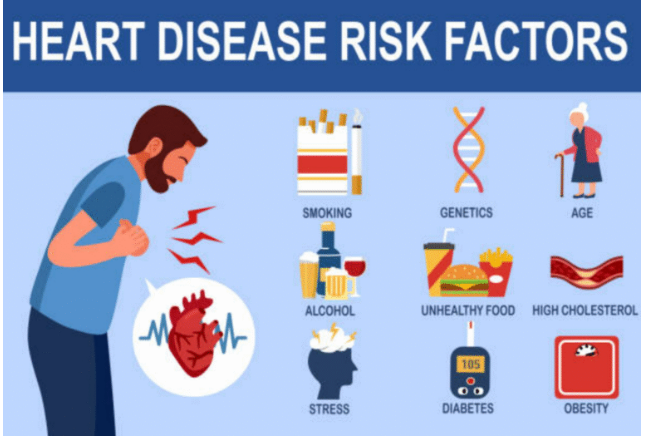
- Atherosclerosis is the build-up of fatty deposits (plaques) inside the walls of arteries.
- These deposits are mainly made of cholesterol and other fatty substances.
- As the plaques become larger, the artery becomes narrower.
- Less blood can flow through the artery.
- This means the heart muscle receives less oxygen and glucose.
Effects of Reduced Blood Flow
- Less oxygen reaches the heart muscle.
- Less glucose is available for respiration.
- Less ATP is produced.
- The heart has to work harder.
- This increases the risk of chest pain and heart attacks.
⚠️ Risk Factors for Coronary Heart Disease
A risk factor is anything that increases the chance of developing a disease.
1. Diet High in Saturated Fat and Cholesterol
- A diet containing too much saturated fat and cholesterol increases the risk of CHD.
How it increases the risk
- More cholesterol enters the bloodstream.
- Fatty deposits build up inside the coronary arteries.
- The arteries become narrower.
- Blood flow to the heart decreases.
- The risk of artery blockage becomes higher.
Examples of foods high in saturated fat
- Butter
- Fatty meat
- Sausages
- Cakes and pastries
- Fast food
- Full-fat dairy products
2. Smoking
Smoking is one of the major causes of coronary heart disease.
Harmful substances in cigarette smoke
Nicotine
- Increases heart rate.
- Raises blood pressure.
- Makes the heart work harder.
Carbon Monoxide
- Reduces the amount of oxygen carried by haemoglobin.
- The heart receives less oxygen than normal.
Other harmful chemicals
- Damage the inner lining of arteries.
- Damaged arteries are more likely to develop fatty deposits.
Overall effect
Smoking increases the chance of arteries becoming blocked and raises the risk of heart attacks.
3. Lack of Physical Exercise
Regular exercise helps keep the heart and blood vessels healthy.
A lack of exercise can lead to:
- Weight gain.
- Obesity.
- Higher blood pressure.
- Increased cholesterol levels.
These changes increase the risk of coronary heart disease.
Benefits of regular exercise
- Keeps the heart muscle strong.
- Helps maintain a healthy body weight.
- Improves blood circulation.
- Helps reduce blood pressure.
- Can increase “good” HDL cholesterol.
4. Obesity
Obesity means having too much body fat.
People who are obese are more likely to develop CHD because:
- The heart has to pump blood around a larger body.
- Blood pressure often increases.
- Cholesterol levels are more likely to be high.
- The risk of developing type 2 diabetes also increases, which further raises the risk of CHD.
5. High Blood Pressure (Hypertension)
Blood pressure is the force of blood pushing against the artery walls.
How high blood pressure affects arteries
- Constant high pressure damages artery walls.
- Damaged areas attract fatty deposits.
- Plaques build up more easily.
- Arteries become narrower over time.
Effect on the heart
- The heart has to work harder to pump blood.
- This increases the risk of heart disease.
6. Family History (Genetics)
Some people inherit a higher risk of developing coronary heart disease.
How genetics affects risk
- Close relatives may have had CHD at an early age.
- Some inherited conditions cause naturally high cholesterol levels.
- Genes can also influence blood pressure and other risk factors.
Although genes cannot be changed, healthy lifestyle choices can reduce the overall risk.
7. Age
The risk of coronary heart disease increases as people get older.
Reasons
- Arteries gradually lose their elasticity.
- Fatty deposits have more time to build up.
- Blood vessels become less efficient.
Older people are therefore more likely to develop narrowed arteries.
8. Gender
Gender also affects the risk of CHD.
Men
- Men generally develop CHD at a younger age.
- They have a higher risk before middle age.
Women
- Before menopause, women have some protection from the hormone oestrogen.
- Oestrogen helps maintain healthy blood vessels.
- After menopause, oestrogen levels fall.
- The risk of CHD increases and becomes similar to that of men.
⚠️ Why Having More Than One Risk Factor is Dangerous
Risk factors often work together.
For example:
A person who smokes, does not exercise, and eats a diet high in saturated fat has a much greater risk than someone with only one risk factor. The more risk factors a person has, the greater the chance of developing coronary heart disease.
🌱 How the Risk of CHD Can Be Reduced
Although some risk factors cannot be changed, many can be controlled through a healthy lifestyle.
Ways to reduce the risk include:
- Eating a balanced diet low in saturated fat.
- Exercising regularly.
- Avoiding smoking.
- Maintaining a healthy body weight.
- Controlling blood pressure.
- Managing cholesterol levels.
- Having regular health check-ups, especially if there is a family history of CHD.
📊 Summary Table
| Risk Factor | How It Increases the Risk of CHD |
|---|---|
| High saturated fat and cholesterol diet | Causes fatty deposits to build up inside arteries |
| Smoking | Damages artery walls, raises blood pressure and reduces oxygen in the blood |
| Lack of exercise | Increases obesity, cholesterol and blood pressure |
| Obesity | Makes the heart work harder and increases blood pressure |
| High blood pressure | Damages artery walls, making plaque build-up more likely |
| Family history | Inherited genes may increase the chance of developing CHD |
| Age | Arteries become less elastic and fatty deposits increase over time |
| Gender | Men are at higher risk before menopause; risk rises in women after menopause |
⚡ Quick Recap
CHD = narrowed/blocked coronary arteries due to fatty deposits.
Main risks: diet, smoking, lack of exercise, high BP, genetics, age, gender.
All cause less oxygen & glucose to heart → higher heart attack risk.